Cinética Química: Velocidad de Reacción,
Understanding Chemical Kinetics
Introduction to Reaction Rates
- The video introduces the concept of chemical kinetics, focusing on the speed at which chemical reactions occur and the factors influencing these rates.
- It highlights historical interest in why some reactions are rapid while others can take centuries to complete.
Activation Energy
- A reaction requires an initial energy input known as activation energy, which stimulates reactants to collide effectively.
- Activation energy is defined as the minimum energy needed for a chemical reaction to proceed, facilitating collisions that break bonds and form new substances.
Factors Influencing Reaction Speed
Orientation and Concentration
- Proper orientation during collisions is crucial; incorrect alignment may prevent desired products from forming.
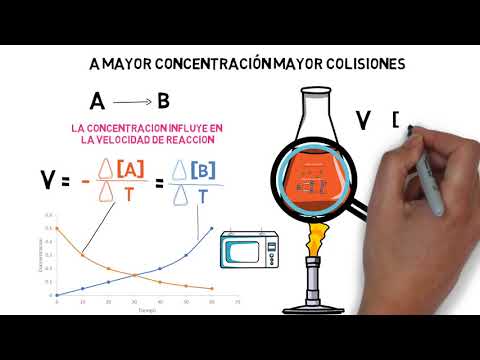
- Higher concentrations of reactants lead to more frequent collisions, thus increasing reaction speed.
Temperature Effects
- Increased temperature results in faster particle movement due to added energy, leading to more effective collisions.
Measuring Reaction Rates
Rate Expression
- The rate of reaction can be expressed as the change in concentration over time, with negative values indicating decreasing reactant concentration.
- Specialized laboratory equipment measures concentration changes throughout a reaction.
Rate Constant (k)
- The relationship between reaction rate and reactant concentration is captured by a constant called the rate constant (k), integral in rate equations.
Order of Reactions
Understanding Reaction Orders
- The order of a reaction indicates how the rate depends on reactant concentrations; it is determined by summing the exponents in the rate equation.
Examples of Reaction Orders
- For example, if one reactant's concentration is squared while another is raised to the first power, this indicates second-order overall behavior.
Types of Reactions Based on Order
First and Second Order Reactions
- First-order reactions depend linearly on one reactant's concentration; second-order can depend either on one or two different reactants' concentrations.
Zero Order Reactions
- Zero-order reactions do not rely on concentration for their speed; they remain constant regardless of changes in reactant amounts.
Additional Factors Affecting Reaction Speed
Other Influential Elements
- Various factors such as substance type, size, variety of reactants influence collision frequency necessary for product formation.
Role of Catalysts