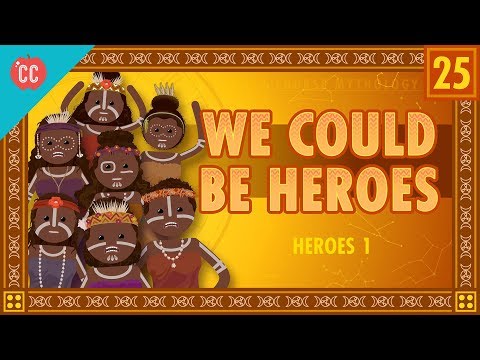
The Hero's Journey and the Monomyth: Crash Course World Mythology #25
Introduction to Heroes in Mythology
In this section, Mike Rugnetta introduces the concept of heroes in mythology and discusses their significance. He mentions that heroes appear in the stories of various cultures and ages, and explores what defines a hero.
What Makes a Hero?
- Heroes are central characters in mythological stories.
- The definition of a hero can vary, but they often fight villains, serve as role models, or act as protagonists.
- Joseph Campbell's theory of the monomyth or hero's journey is examined to understand the concept of heroes more deeply.
Campbell's Theory of the Hero's Journey
In this section, Mike Rugnetta explains Joseph Campbell's theory of the hero's journey. He acknowledges that Campbell had a male-centric view but assures that later he will discuss stories about heroines. The theory suggests that heroes embark on a journey away from safety towards adventure before returning home.
Influence and Controversy Surrounding Campbell's Theory
- Joseph Campbell identified recurring events in multiple stories from different cultures.
- His theory became influential but also controversial due to his narrow view of gender roles.
- Contemporary mythology scholars describe his view as "we are all heroes struggling to accomplish our adventure."
- Campbell drew inspiration from psychological theories by Sigmund Freud, Otto Rank, and Carl Jung.
Psychological Aspects of Hero Myths
This section delves into the psychological aspects present in hero myths according to Joseph Campbell. It highlights how individual heroes symbolize the psychological journey experienced by all humans.
Importance of Mother Figure and Father-Son Relationship
- Campbell emphasizes the significance of both mother figures (vital to Carl Jung) and father-son relationships in hero myths.
- He suggests that heroes' journeys represent universal cosmic forces shaping the human subconsciousness.
- Campbell's framework allows for the interpretation of individual heroes as symbolic representations of psychological development.
The Structure of the Hero's Journey
In this section, Mike Rugnetta explains the structure of the hero's journey according to Joseph Campbell. He mentions that not all stories have all 17 sub-parts but most heroic stories contain some of them.
Part 1: Departure
- Heroes separate themselves from the world or retreat to the realm of the unconscious.
- Possible elements include receiving a call to adventure and crossing a threshold guardian.
Part 2: Trials and Victories of Initiation
- Heroes undergo trials and demonstrate their worthiness.
- Tasks can vary from a laundry list to one extended challenge.
- Psychological danger is represented by these trials, which may involve encounters with powerful ladies or father figures.
Conclusion
This section concludes Mike Rugnetta's discussion on heroes in mythology and Joseph Campbell's theory. It highlights how hero myths follow similar patterns and structures across different cultures.
Significance of Hero Myths
- Hero myths provide insights into our struggles as individuals and our search for wisdom and understanding.
- These myths are believed to be manifestations of universal cosmic forces that shape human subconsciousness.
Timestamps are provided for each section based on available information in the transcript.
New Section
This section discusses the return and reintegration to society in the hero's journey, which is different from contemporary story tone. It explores how mythological heroes face challenges in finding acceptance after their great enlightenment.
The Return and Reintegration to Society
- Mythological heroes often face challenges in returning home and finding acceptance after their great enlightenment.
- Defeating the monster, recovering the Grail, or getting the girl are usually seen as the end of contemporary stories, but for mythological heroes, returning home is just as challenging.
- The hero may be less than eager to return to normal life or may be forced to flee with the help of magical creatures or other means.
- Symbolic crossings between the everyday world and the land of adventure are common in hero stories.
- Ultimately, the hero ends up back where they started, living happily ever after.
New Section
This section introduces Campbell's heroic scenes and highlights how his theory can be a useful tool for recognizing and comparing stories. It also mentions some well-known hero stories like Odysseus, Beowulf, Luke Skywalker, and Men in Black.
Campbell's Heroic Scenes
- Campbell's theory is not a road map for every hero story but serves as a useful tool for recognizing and comparing stories.
- Examples of well-known hero stories include Odysseus, Beowulf, Luke Skywalker, and Men in Black.
- Recognizing patterns in these stories helps illustrate Campbell's framework.
New Section
This section presents an alternative story from Australia that demonstrates some alternatives to Campbell's monomyth formula. It features seven teenage Aboriginal girls who go through intense trials to shed their childhood.
Alternative Story: Seven Aboriginal Girls
- The story features seven teenage Aboriginal girls who must shed their childhood by gaining control over hunger, pain, and fear.
- The girls spend three years isolated from their siblings, receiving only two small meals a day.
- They then embark on a week-long journey into the wilderness without food, enduring the heat and hunger.
- At the end of the journey, they are tested by cutting off portions of a roasted kangaroo without giving in to temptation.
- The girls also endure painful trials such as having their front teeth broken and their breasts cut with a flint knife.
- Finally, they face their fears through scary stories and sleeping on an anthill without showing signs of fear.
- After passing all these tests, they become symbols to their people and are taken into the heavens.
New Section
This section reflects on the story of the seven Aboriginal girls and how it aligns with Campbell's framework. It also prompts questions about human psychology and personal growth.
Reflections on the Story
- The story of the seven Aboriginal girls aligns with Campbell's framework in terms of leaving home, going through trials, gaining enlightenment, returning home with further drama, and becoming celestial bodies.
- Questions arise about what these trials symbolize and how personal growth can be seen in one's own life after undergoing massive personal changes.
New Section
This section concludes by encouraging viewers to identify Campbell's framework in mythological heroes and even in contemporary media or their own lives.
Identifying Campbell's Framework
- Viewers are encouraged to identify Campbell's framework in well-known mythological heroes as well as contemporary media or even their own lives.
- With practice, viewers can recognize patterns that align with Campbell's monomyth structure.