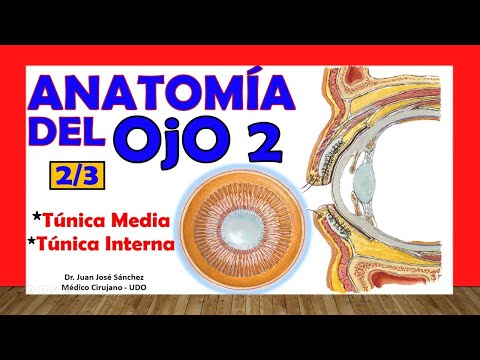
🥇 Anatomía del OJO 2/3 - Túnica Media y Túnica Interna
Anatomy of the Eye: Part 2 - The Middle and Internal Tunics
Overview of the Eye's Structure
- Introduction to the second part of the anatomy series on the eyeball, focusing on the middle (tunica media) and internal tunic.
- Recap from previous video discussing the outermost tunic, including sclera and cornea as components of the fibrous tunic.
The Tunica Media
- Description of the tunica media, also known as tunica vascular, consisting of three parts: choroid, ciliary body, and iris.
Choroid
- Explanation that choroid is located at the posterior pole of the eye and contributes to forming fibers for cribriform plate where optic nerve passes.
- Importance of choroid as a vascular layer containing most blood vessels supplying nutrients to the eyeball; it is loosely attached to retina via connective tissue.
Layers of Choroid
- Choroid extends from posterior pole to ora serrata where retina narrows; consists of four layers:
- Suprachoroidal Lamina: Outermost layer in contact with sclera containing pigment cells.
- Vascular Lamina: Contains large blood vessels divided into arterial (superficial plane with long/short posterior ciliary arteries) and venous (deep plane ending in vorticose veins).
- Choriocapillaris Layer: A layer rich in capillaries adjacent to retinal surface; sometimes referred to as choroidocapillary layer.
- Basement Membrane: Innermost layer directly contacting retina.
Ciliary Body
- Transition from ora serrata to ciliary body which connects with iris; described as triangular in shape with base facing pupil and vertex towards choroid.
Components of Ciliary Body
- Ciliary body comprises two main structures:
- Ciliary Muscle: Triangular muscle aiding lens accommodation; has anterior muscles oriented towards pupil.
- Ciliary Processes: Extensions contributing to overall structure.
Anatomy of the Eye: Ciliary Muscles and Iris
Ciliary Muscles and Their Function
- The eye contains groups of muscles with radiated fibers, known as meridional fibers, alongside circular fibers called ciliary muscles. These are crucial for lens function.
- The ciliary processes, approximately 70 in number, have a pyramidal shape and are positioned around the pupil, connecting to the ciliary muscle.
- Between these ciliary processes are zonular spaces that prevent tangling; this structure is essential for lens support. A posterior view shows how these connect to the lens and other eye components like the iris and retina.
- Ciliary muscles receive parasympathetic innervation which plays a key role in adjusting the lens shape for focusing on objects at varying distances through accommodation reflexes. When relaxed, they elongate the cornea for distant vision; when contracted, they allow close focus by changing the lens shape to biconvex.
Structure and Function of the Iris
- The iris is pigmented tissue that gives color to the eye; it has an anterior face facing the anterior chamber and a posterior face towards the posterior chamber. It features folds known as radiating folds on its surface.
- The iris consists of two colored rings: an internal ring (1-2 mm thick) and a larger external ring (3-4 mm thick). Its peripheral circumference connects to the ciliary body while forming an angle with the cornea where aqueous humor is reabsorbed via Schlemm's duct.
- The free edge of the iris forms the pupillary orifice (the pupil), allowing light entry into the eye. Two sphincter muscles control pupil size:
- Sphincter muscle (medial): causes miosis (pupil constriction) via parasympathetic impulses.
Understanding the Retina and Its Functions
Overview of Ocular Structures
- The channel features various ocular videos, including those on the orbit, tear duct, and ocular muscles. The retina is divided into three portions.
- The retina is referred to as the "nervous tunic" due to its role in housing nervous structures that capture light impulses and transform them into perceivable images.
Anatomy of the Retina
- The retina is an extension of the optic nerve, extending from its emergence at the optic nerve to a structure called ora serrata.
- The external face of the retina contacts the choroid but does not adhere to it; its internal face is in contact with the vitreous body.
Key Features of Retinal Structure
- At the center of the retina lies the optic papilla where the optic nerve emerges; this area is not centrally located within the eye.
- Medial to this point is a structure known as macula lutea, which measures 3mm by 1.5mm and plays a crucial role in vision.
Vascularization and Functionality
- The optic papilla has a central excavation from which retinal blood vessels emerge; these vessels are critical for supplying nutrients.
- Notably, macula lutea lacks blood vessels (avascular), featuring a central fovea with an even deeper depression called foveola.
Retinal Blood Supply
- Retinal blood supply branches from central retinal artery into nasal and temporal branches based on their orientation relative to facial anatomy.
- This vascular system includes ascending branches leading to superior nasal/temporal areas and descending branches leading to inferior regions.
Transitioning Portions of Retina
Turn any video into a summary like this
YouTube links, meetings, lectures. With transcripts, search, and chat.