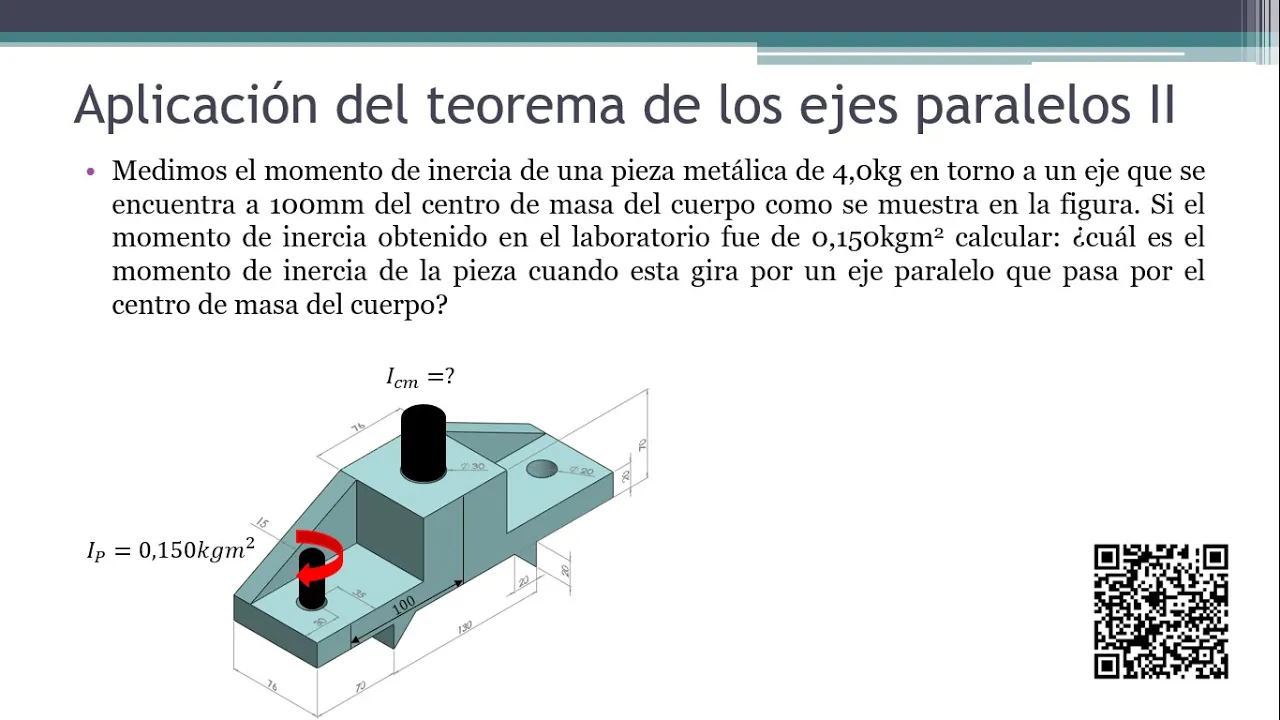
TEOREMA DE STEINER o de los ejes paralelos EJERCICIO RESUELTO N°2 Momento de inercia, aplicación.
New Section
In this section, the concept of moment of inertia and its application in a specific problem scenario are discussed.
Moment of Inertia Calculation
- When rotating a metallic piece around an axis passing through its center of mass, the moment of inertia is measured as 0.150 kg/m^2.
- The task is to calculate the moment of inertia when rotating the same piece around an axis parallel to the center of mass axis, with a distance between them being 100 mm.
- Given data: mass of the body is 4 kg, distance between parallel axes is 100 mm, and known moment of inertia is 0.150 kg/m^2.
- Applying Steiner's theorem which states that the moment of inertia about a point P equals the sum of the moment of inertia about its center plus mass times square distance between centers.
- By substituting values into Steiner's theorem equation, we can calculate the moment of inertia around an axis passing through the center of mass.
Moment of Inertia Calculation Continued
Continuing from previous calculations to determine the final moment of inertia value.
Final Moment of Inertia Calculation
- Substituting values into Steiner's theorem formula for parallel axes with given distances and masses.
- After calculation, it is found that the moment of inertia around an axis passing through the center of mass is 0.11 kg/m^2.
- The decrease in moment of inertia by approximately 30% when rotating around an axis passing through its geometric center indicates less energy required due to symmetry.