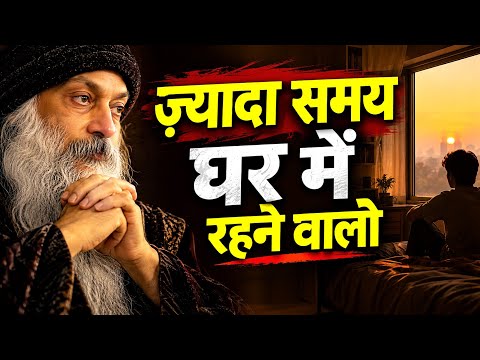
घर में रहकर जाग जाओ | Hindi speech Discours 🕊️
The Relationship Between Home and Self
Understanding Presence at Home
- The question posed is whether individuals live in their homes or if their homes live within them, highlighting a deeper philosophical inquiry about presence.
- Two types of people exist: those who feel trapped in their homes (prisoners) and those who flourish there (seekers), differentiated by perspective rather than physical space.
- Sorrow arises when one's body is present but the mind wanders elsewhere; true bliss comes from being fully present where one is.
The Journey to Happiness
- A story illustrates that happiness can often be found in familiar places, emphasizing the importance of perception over physical journeys.
- A home can serve as a temple—a state of being—if one maintains consciousness; otherwise, it becomes just another market filled with distractions.
Solitude vs. Loneliness
- Solitude is presented as a blessing for those who spend time at home, contrasting it with loneliness which stems from missing others.
- Loneliness seeks validation while solitude fosters self-discovery; the former feels like begging while the latter embodies empowerment.
Perspective on Home Life
Transforming Perception
- Viewing home as a punishment leads to feelings of confinement; conversely, seeing it as an opportunity transforms walls into embraces.
- Fear may keep individuals at home; acknowledging this fear without suppression allows for personal growth and understanding.
Embracing Stillness
- Society equates movement with life, yet stillness can lead to profound insights—like a lake reflecting the sky versus a flowing river.
Cultivating Awareness
Daily Practices for Mindfulness
- Begin each day by appreciating your surroundings anew, fostering gratitude towards everyday objects that are often overlooked.
- Embrace moments of emptiness instead of filling them with tasks or noise; these moments allow for self-reflection and meditation.
Meditation Defined
- Meditation is described not as an action but as a state of being fully alive while doing nothing—akin to observing thoughts like clouds passing through the sky.
The Dangers of Comparison
Avoiding Toxic Comparisons
- Comparing oneself to others leads to dissatisfaction since inner states are invisible compared to outward appearances; true fulfillment comes from individual blooming rather than competition.
Discipline in Domestic Life
- Staying at home presents unique challenges that test one's peace amidst daily life’s chaos, making it harder than seeking solitude in nature.
Relationships as Mirrors
Learning Through Interactions
- Family members serve as teachers by triggering hidden wounds within us; recognizing this helps cultivate spiritual growth without needing external validation or extreme measures.
True Love Defined
- Genuine love involves offering presence rather than demanding anything from others; being fully attentive is considered one of the greatest gifts we can give loved ones.
Living Your Truth
Experimentation Over Acceptance
- Listeners are encouraged not just to accept teachings but to experiment with them in their own lives, discovering personal truths through experience rather than borrowed beliefs.
Remembering Your Essence
- Recognizing one's completeness negates the need for external validation or achievement; ignorance stems from forgetfulness about our inherent worth.
Finding Peace Within
Embracing Inner Silence
- Reflecting on stars symbolizes timeless existence without rush or comparison—encouraging individuals to find tranquility within themselves amidst life's pressures.
Conclusion
- Those who stay home possess everything they seek externally—it only requires opening one's eyes and embracing what already exists within.
Turn any video into a summary like this
YouTube links, meetings, lectures. With transcripts, search, and chat.