Understanding Time Zones
Understanding Time Zones and Their Origins
Historical Context of Timekeeping
- In the past, towns maintained their own local times, with clocks set to noon when the sun was at its highest point.
- The advent of rail travel in the late 19th century created confusion due to varying local times at different stops, necessitating a standardized time system.
Establishment of Standard Time
- In 1884, representatives from 26 countries convened in Washington D.C. to establish a Prime Meridian for global timekeeping.
- Greenwich, England was chosen as the international standard for zero degrees longitude, leading to the creation of 24 distinct time zones.
Understanding Time Zone Calculations
- Each time zone is based on the Earth's rotation of 15 degrees longitude per hour; thus there are 24 standard time zones.
- To calculate local time relative to Greenwich Mean Time (GMT), determine if a location is east or west of the Prime Meridian and count how many time zones away it is.
Practical Examples of Time Calculation
- For locations east of GMT (e.g., Oslo), add hours; for those west (e.g., Greenland), subtract hours from GMT.
- Example: Buenos Aires is four time zones west of GMT; if it's 4:34 PM GMT, it would be 12:34 PM in Buenos Aires.
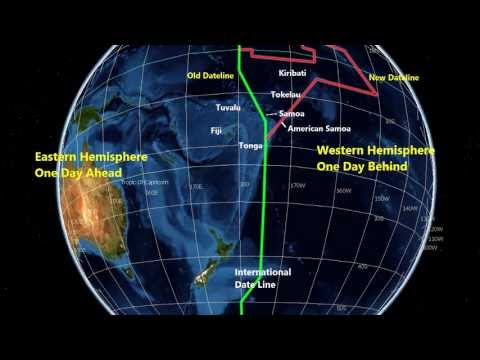
The International Dateline
- The International Dateline lies at 180 degrees longitude and separates calendar days; it deviates in places to avoid land crossings.