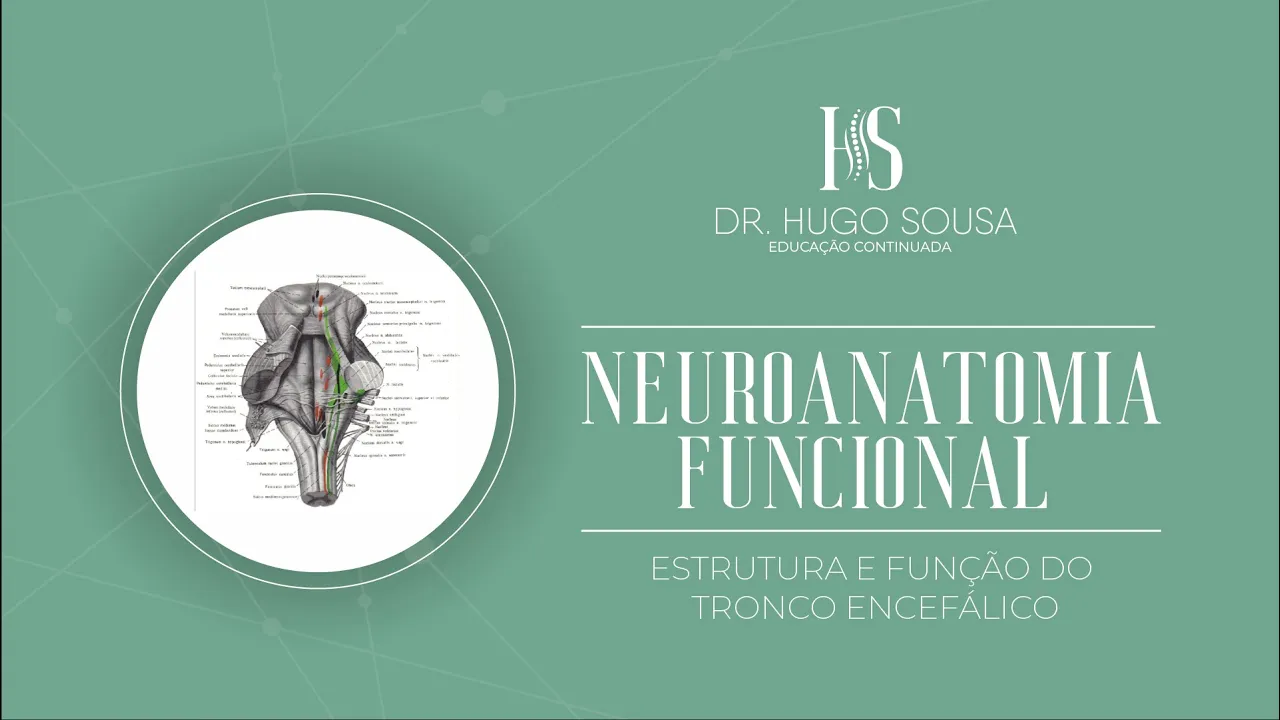
ESTRUTURA E FUNÇÃO DO TRONCO ENCEFÁLICO - PARTE 1
Estrutura e Função do Tronco Encefálico
Introdução ao Tronco Encefálico
- O tronco encefálico é composto por três partes principais: mesencéfalo, ponte e bulbo.
- A estrutura interna do tronco encefálico é formada por quatro pilares principais que devem ser sempre lembrados.
Estruturas Ventriculares
- O tronco encefálico contém uma parte ventricular preenchida com líquido cerebrospinal, incluindo o aqueduto mesencefálico e o quarto ventrículo.
- O canal central bulbar conecta-se ao canal central da medula espinhal, formando um sistema ventricular contínuo.
Teto do Mesencéfalo
- O teto do mesencéfalo inclui a lâmina quadrigeminal, que é composta pelos colículos superiores (via visual) e inferiores (via auditiva).
- Os colículos estabelecem conexões com os corpos geniculados laterais e mediais, integrando as vias visual e auditiva.
Tegumento do Mesencéfalo
- O tegumento está localizado à frente do sistema ventricular e abriga os núcleos dos nervos cranianos.
- Dez dos doze pares de nervos cranianos têm origem no tronco encefálico, com seus núcleos localizados nesta região.
Formação Reticular
- A formação reticular desempenha um papel vital na integração das informações que chegam ao tronco encefálico.
Understanding the Brainstem and Cranial Nerves
Overview of the Brainstem Structure
- The brainstem is positioned anteriorly, containing descending fibers that are crucial for motor functions. These include both motor tracts and sensory pathways.
- The base of the brainstem houses descending fibers related to motor activity, specifically from the corticospinal tract and cortico-nuclear tract, which connect to cranial nerves for their respective functions.
- Various nuclei, such as pontine nuclei, receive these descending fibers from the cerebral cortex and facilitate connections with other brain regions.
- The brainstem can be viewed as having four main pillars or components that support its overall function, including numerous structures and nuclei involved in cranial nerve activities.
- Key anatomical features include the ventricular system (fourth ventricle), aqueduct of Sylvius, central canal, and tectum formed by superior and inferior colliculi.
Cranial Nerves: An Introduction
- There are 12 pairs of cranial nerves; notably, 10 originate from the brainstem. This includes nerves III through XII.
- The first cranial nerve is the olfactory nerve (I), responsible for olfaction. It projects directly to the brain from nasal epithelium.
- The second cranial nerve is the optic nerve (II), which captures light stimuli and also connects to parts of the midbrain for visual reflexes.
Motor Functions of Cranial Nerves
- Cranial nerves III (oculomotor), IV (trochlear), and VI (abducens) are primarily involved in eye movement control.
- The trigeminal nerve (V), known for its sensory functions in facial sensation, also has a significant role in motor control related to mastication.
Additional Cranial Nerve Functions
- The vestibulocochlear nerve (VIII) consists of two branches: vestibular for balance and cochlear for hearing.
- The vagus nerve (X), also called pneumogastric due to its extensive innervation territory affecting various organs throughout the body.
Key Nuclei Related to Eye Movement
- Accessory nerve (XI): Originates partly from cervical roots; it integrates with cranio-cervical structures before projecting into the brainstem.
- Discussion on key gray matter nuclei associated with eye motricity begins here; focusing on oculomotor-related nuclei located medially within mesencephalon structures.
Eye Muscle Innervation and Cranial Nerves
Overview of Eye Muscles and Their Innervation
- Four out of six eye muscles are innervated by the oculomotor nerve, which is the third cranial nerve. This nerve plays a crucial role in eye motricity.
- The trochlear nerve, also located in the mesencephalon, innervates the superior oblique muscle, responsible for medial rotation and depression of the eye.
- The abducens nerve's nucleus is found in the pons; it innervates the lateral rectus muscle, facilitating lateral movement (abduction) of the eyeball.
Functions of Oculomotor and Abducens Nerves
- The abducens nerve allows for lateral gaze by controlling the lateral rectus muscle, while the oculomotor nerve is responsible for adduction (looking towards the nose).
- Conjugate gaze requires coordinated action between these nerves; when looking sideways, both eyes must move together to maintain focus.
Additional Eye Movement Control
- The oculomotor nerve also controls vertical movements—looking up or down—alongside contributions from other nerves like trochlear.
Hypoglossal Nerve and Other Motor Nuclei
Hypoglossal Nerve Functionality
- The hypoglossal nuclei are located in the bulb's tegmentum and are associated with tongue movement.
- These nuclei are situated near anatomical landmarks such as the trigone of hypoglossus within the fourth ventricle.
Trigeminal and Facial Nerves
- The motor nucleus of the trigeminal nerve is located in the pons; it innervates muscles involved in mastication.
- The facial motor nucleus is also found in the pons but more caudally; it controls muscles responsible for facial expressions.
Ambiguous Nucleus Role
- The ambiguous nucleus combines projections from cranial nerves IX (glossopharyngeal) and X (vagus), playing a key role in swallowing and vocalization.
- It coordinates actions related to pharyngeal and laryngeal muscles essential for speech production and swallowing functions.
Nervous System Functions and Structures
Overview of Nerve Functionality
- Discussion on the role of the accessory nerve nucleus, which is involved in motor fiber projection from the spinal region to specific muscles.
- The accessory nerve's primary function is to innervate the sternocleidomastoid and trapezius muscles, highlighting its importance in neck movement.
Parasympathetic Nervous System
- Introduction to parasympathetic nervous system nuclei located in the brainstem and sacral regions, emphasizing their role in visceral motor functions.
- Explanation of how cranial nerves project from the brainstem to various structures, indicating a complex network for autonomic control.
Key Nuclei Associated with Cranial Nerves
- Focus on the Edinger-Westphal nucleus associated with the oculomotor nerve, responsible for controlling smooth muscle in the eye (pupil constriction).
- The Edinger-Westphal nucleus specifically innervates both the sphincter pupillae and ciliary muscles, crucial for pupil size regulation and lens accommodation.
Salivary Gland Innervation
- Introduction of the superior salivatory nucleus located near the pons; it connects with facial nerve fibers to facilitate saliva production.
- Description of how these fibers contribute to lacrimal gland innervation as well as major salivary glands: sublingual, submandibular, and parotid glands.
Inferior Salivatory Nucleus Functionality
- Overview of inferior salivatory nucleus linked with glossopharyngeal nerve fibers that innervate parotid glands, emphasizing its anatomical location.
Understanding the Dorsal Vagal Nucleus
Overview of the Dorsal Vagal Nucleus
- The dorsal vagal nucleus is located in the region of the vagus trigone, specifically in the rhomboid fossa of the fourth ventricle.
- This nucleus plays a crucial role in parasympathetic innervation, impacting various bodily functions.
Functions and Innervations
- It provides extensive parasympathetic innervation to multiple structures including:
- Esophagus
- Lungs
- Heart
- Gastrointestinal tract (stomach, duodenum, parts of both small and large intestines)
- Spleen, pancreas, liver, gallbladder, and kidneys.