Transcripción en procariotas y eucariotas V22
Transcription Process: Eukaryotes vs. Prokaryotes
The discussion delves into the transcription process, highlighting the differences between eukaryotes and prokaryotes in how DNA is transcribed into RNA.
Transcription Initiation
- In eukaryotes, transcription occurs in the nucleus, while in prokaryotes, it happens in the cytoplasm.
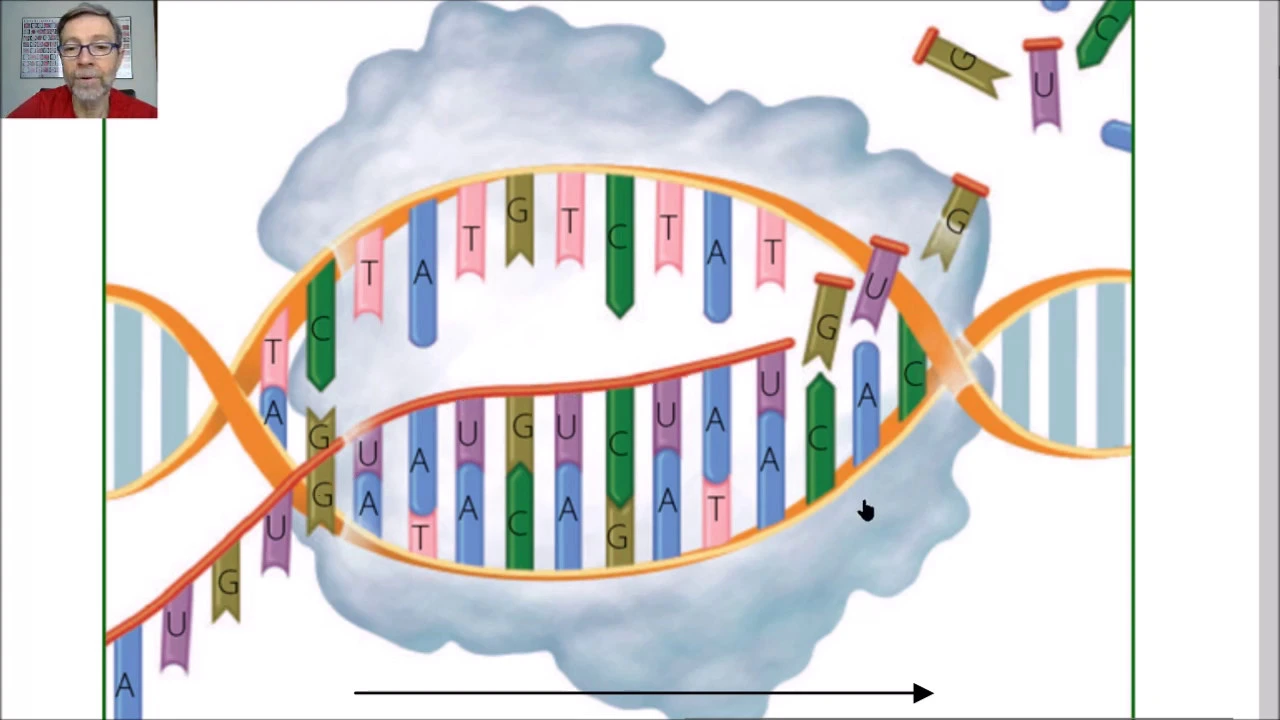
- Only one DNA strand containing genetic information is copied during transcription.
- Eukaryotes have three types of RNA polymerases compared to one in prokaryotes.
Transcription Process
- Transcription initiation begins with RNA polymerase locating a promoter region on DNA.
- Promoter regions contain specific base sequences recognized by RNA polymerase.
- In eukaryotes, additional transcription factors are needed for promoter recognition.
RNA Synthesis and Elongation
- RNA polymerase opens a transcription bubble to start copying DNA into RNA.
- Transcription proceeds from 5' to 3' direction without requiring primers.
- Ribonucleotides are added complementary to the template DNA strand.
Transcription Termination and Post-Transcriptional Modifications
This segment covers the termination of transcription and post-transcriptional modifications that occur differently in eukaryotic and prokaryotic cells.
Termination Process
- Termination signals on DNA prompt RNA polymerase to release the transcript.
- Different termination signals exist for prokaryotes (palindromic sequences) and eukaryotes (polyadenylation signal).
Post-Transcriptional Modifications
- Eukaryotic transcripts receive a protective cap of nucleotides after synthesis completion.
- Polyadenylation adds a tail of adenine nucleotides to eukaryotic transcripts for stability.
RNA Processing: Eukaryotic vs. Prokaryotic Cells
Contrasting how mature mRNA is produced in eukaryotic versus prokaryotic cells through different processing mechanisms.
mRNA Maturation in Eukaryotes
- Mature mRNA undergoes splicing where introns are removed, leaving only exons for protein synthesis.
- Spliced mRNA contains only coding regions essential for protein production.
Detailed Explanation of RNA Processing
In this section, the speaker delves into the process of RNA processing, specifically focusing on the removal of introns and joining of exons to form mature mRNA.
Process of RNA Splicing
- The process involves cutting and splicing where introns are removed, and exons are joined. This results in a shortened but mature mRNA molecule.
Enzyme Involvement in Splicing
- An enzyme called ribonucleoprotein catalyzes the splicing reaction by removing introns and joining exons.
Alternative Splicing
- Through alternative splicing, exons can be rearranged or cut in different ways, leading to diverse mRNA transcripts. This variability allows for the production of different proteins from the same DNA material.
Impact of Alternative Splicing on Protein Diversity
The discussion shifts towards how alternative splicing contributes to protein diversity and its significance in scenarios like combating new diseases.
Protein Variability through Alternative Splicing
- Alternative splicing enables reorganization and alteration of exons' order, resulting in varied protein synthesis unrelated to the original sequence.
Analogy with Puzzle Pieces
- Using a puzzle analogy, alternative splicing is likened to rearranging puzzle pieces to create different images despite starting with the same material. This illustrates how diverse proteins can be synthesized from identical DNA.
Comparative Analysis: Prokaryotic vs. Eukaryotic Transcription
A comparison between prokaryotic and eukaryotic transcription processes highlights differences in RNA structure and processing mechanisms.
Distinctive Features in Transcription Processes
- Eukaryotic transcription involves additional modifications post-transcriptionally compared to prokaryotes. These include cap formation, intron removal, and mRNA transfer from nucleus to cytoplasm.