3tentos | Resultados 2T24
Welcome to the Q2 2024 Results Conference
Introduction and Participants
- The conference begins with a welcome message, introducing key participants including Luí Osório (CEO), João Marcelo (VP of Operations), Cristiano Costa (CFO), Misiara de Alcântara (HR Director), and Eduardo Moter (Manager).
- The session is recorded and will be available on the company's investor relations website. Simultaneous translation tools are provided for English listeners.
- Attendees can submit questions via audio or text during the Q&A session after the presentation.
Forward-Looking Statements
- A disclaimer is given regarding forward-looking statements about business prospects, operational goals, and growth potential, emphasizing that these are based on current beliefs and expectations.
- Investors are cautioned about risks and uncertainties that may affect future performance, highlighting economic conditions in agribusiness as a significant factor.
Q2 Performance Overview
Financial Highlights
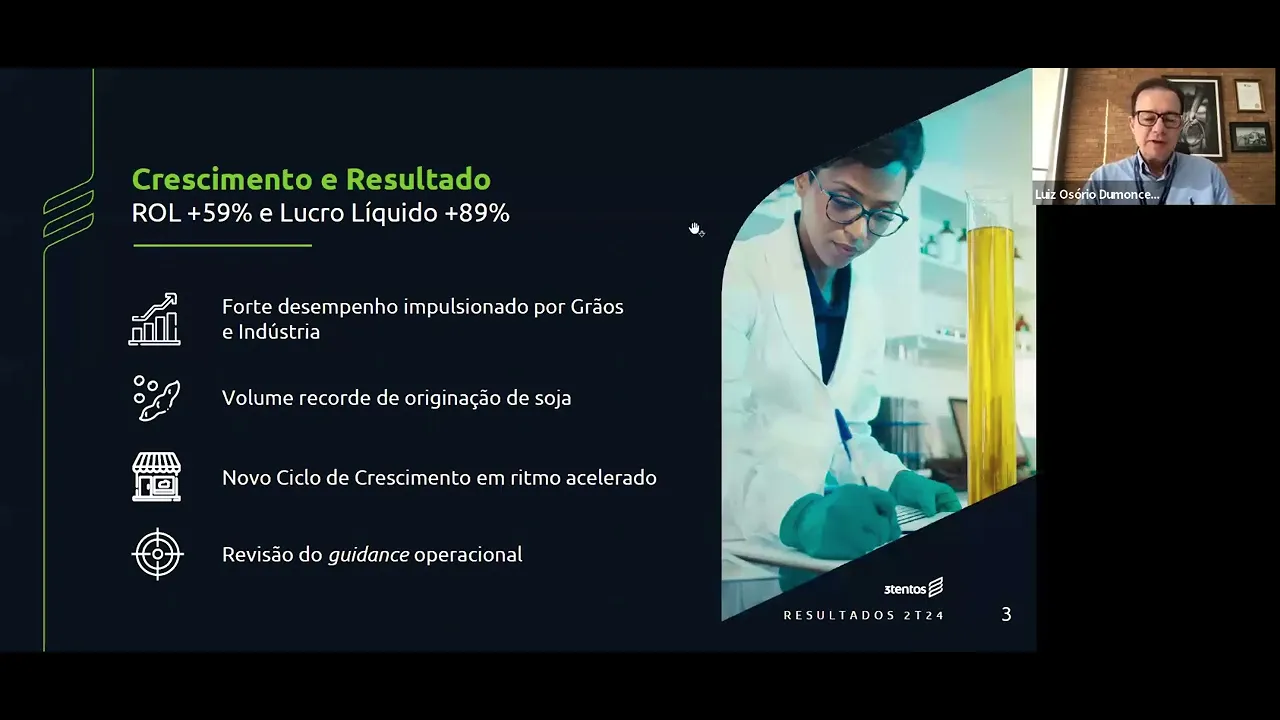
- Luí Osório expresses gratitude for attendance and reports strong financial results for Q2 2024: net revenue of R$2.8 billion, a 59% increase year-over-year.
- The company achieved a net profit of R$145 million, reflecting an 89% increase, showcasing dedicated efforts from the team across various Brazilian states.
Operational Achievements
- Record volumes were reached in soybean origination in Rio Grande do Sul and Mato Grosso, indicating robust operational capabilities.
- The company is entering a new growth cycle with plans to expand into Vale do Araguaia; this will be elaborated further during the call.
Strategic Focus Areas
Governance and Risk Management
- Emphasis on corporate governance evolution as Trentos continues to grow while penetrating challenging agricultural markets.
- Commitment to excellence in management practices focused on risk management and transparency is highlighted as essential for sustainable growth.
Market Dynamics
- Confidence in financial stability is reinforced by strong performance within Brazil's agribusiness sector despite ongoing challenges.
Detailed Financial Analysis
Revenue Growth Breakdown
- An overview of Q2 shows net revenue growth of 59%, reaching R$2.8 billion; year-to-date figures also reflect substantial increases.
- Adjusted gross profit exceeded R$800 million with adjusted EBITDA at R$221 million; detailed discussions on these numbers will follow later in the presentation.
Segment Reporting
Business Segmentation Insights
Agribusiness Ecosystem Overview
Synergy in Agribusiness Segments
- The agribusiness ecosystem consists of various segments, each contributing to overall stability and performance.
- Different segments may perform variably; however, their combination provides a stabilizing effect on results over time.
- Consistency in results is closely tied to the effective modeling of these segments within the business.
Analysis of Input Segment Performance
- The input segment experienced a decline in revenue and adjusted gross profit by approximately 30-35% compared to the previous year.
- This decrease is attributed to delayed purchases by producers due to climatic factors, particularly heavy rainfall affecting planting schedules.
- The postponement of input usage means that inputs intended for May were pushed into June, impacting agricultural operations.
Crop Dynamics and Revenue Growth
- Expectations are set for a return to normal demand for inputs as crop development progresses.
- There has been a general reduction in input prices aligned with decreasing grain prices, influencing profitability dynamics.
Grain Segment Insights
- Strong growth was observed in both revenue and results from grain sales during this period, particularly influenced by soybean commercialization.
- The recovery of soybean production in Rio Grande do Sul contributed significantly to origination opportunities and overall market performance.
Industrial Segment Highlights
- The industrial segment emerged as a standout performer with nearly 100% revenue growth (96% for the quarter).
- Adjusted gross profit saw an impressive increase close to 200% over the first six months due to operational improvements and favorable pricing conditions.
Conclusion on Ecosystem Strength
Growth in SDNA and Logistics Challenges
Overview of SDNA Growth
- The company has observed significant growth in SDNA, particularly linked to logistics challenges.
- The distance from ports increases logistical costs for transporting products, impacting pricing strategies.
- Despite higher logistics costs, the company is experiencing an increase in gross margin that compensates for these expenses.
Operational Capacity and Comparisons
- In 2024, operations in Mato Grosso are fully functional compared to limited operations in 2023.
- Future comparisons will be made between the two years as operations ramp up, especially focusing on the last quarter.
Efficiency Gains and Expense Management
- The company is achieving efficiency gains through scale, positively affecting personnel and other expenses.
- Record volumes of grains and meal reflect operational improvements despite rising logistics costs.
Financial Performance Insights
Revenue Growth Metrics
- There has been a notable increase in revenue: 58% growth for the quarter and 53% for the semester compared to previous periods.
- Adjusted EBIT reflects strong financial performance with a focus on risk management related to NDF contracts.
Detailed Financial Analysis
- Adjusted EBIT increased by 36% for the quarter (from $55 million to $75 million), indicating robust operational health.
- Year-over-year analysis shows adjusted EBIT growing from $159 million to $243 million over six months, aligning closely with revenue growth.
Understanding Adjusted Net Income
Key Metrics of Profitability
- The first semester concluded with an adjusted net income of $302 million; adjustments account for stock variations and financial instruments.
- Reconciliation includes fair value adjustments on stocks and financial instruments like NDF that protect against currency fluctuations.
Final Thoughts on Financial Health
Financial Performance Overview and Strategic Growth Plans
Financial Results for the Semester
- The company reported a net profit of 182,939, reflecting a 20.4% increase compared to the same period last year, maintaining an adjusted net margin of 3.3%.
- After accounting for income tax on financial instrument market adjustments, the adjusted net profit for the quarter reached 56 million.
- The company's net debt at 511.1 million includes both positive and negative effects from open financial instruments, indicating careful management of liabilities.
Debt Management and Financial Stability
- Compared to the previous year, there was a reduction in net debt relative to EBITDA since 2020, showcasing improved debt management metrics favored by market analysts.
- A successful issuance of debentures in May increased long-term debt but was strategically planned to support future growth initiatives.
- The variation in net debt throughout the year is primarily attributed to working capital needs due to seasonal grain purchases and extended sales cycles.
Investment Strategies and Growth Initiatives
- The total net debt stands at 511 million; however, after excluding non-cash financial instrument valuations (207 million), effective indebtedness is approximately 304 million.
- Significant investments totaling 374 million were made towards expanding production facilities in Porto Alegre do Norte and enhancing other operational sites.
Expansion Plans and Operational Updates
- CEO João Marcelo emphasized ongoing updates regarding company growth strategies including new store openings and construction projects like the ethanol plant in Vale do Araguai.
- Construction progress on the ethanol plant is on schedule with current activities focused on earthworks and foundations; operations are expected to commence by late next year (2025).
Retail Expansion Efforts
- New store openings include locations in Fresa and São Félix Araguaia as well as Nova Mutum along BR 1663, aligning with strategic growth objectives.
Company Growth and People Strategy
Importance of People in Business Growth
- The growth of the company is heavily reliant on its people, emphasizing that success is not just about building stores but also about the individuals who drive business operations.
- The speaker highlights that the company's achievements are attributed to a differentiated team and a unique culture, reinforcing the idea that human resources are critical for success.
Focus on Human Resources
- Introduction of Misiara, the HR director, to discuss the significance of people as a critical factor for organizational success.
- Misiara aligns HR strategy with business objectives, focusing on purpose and values to support organizational growth.
Organizational Structure and Development
- Emphasis on strong leadership and an evolving organizational architecture designed to sustain growth and development within the company.
- Recruitment processes aim to attract professionals with competencies that complement existing skills within the organization.
Employee Development Initiatives
- The company prioritizes employee development through various programs aimed at enhancing internal knowledge sharing and professional growth.
- Safety is highlighted as a core value, ensuring a secure working environment while maintaining effective communication throughout the organization.
Future Outlook and Strategic Goals
- Key pillars for developing personnel are identified as essential for maintaining current organizational performance levels.
- Plans for 2024 include opening new stores in specific regions while addressing challenges related to supply chain issues affecting margins.
Market Dynamics and Agricultural Focus
Agricultural Sector Insights
- Discussion on agricultural trends including biodiesel's role as a renewable energy source in Brazil, contributing positively to market stability.
Cost Management Strategies
- A focus on managing input costs effectively while ensuring producers maintain profitability amidst fluctuating prices in agricultural commodities.
Leadership Confidence
- Assurance from leadership regarding their growing confidence in managing processes effectively as they expand operations across various units.
Q&A Session Overview
Engaging with Stakeholders
- Transition into an interactive Q&A session where participants can ask questions via audio or text format.
Expansion Plans and Market Coverage
Understanding Market Coverage and Expansion
- The discussion begins with a focus on the company's expansion plans, which exceed initial guidance for 2030, particularly in terms of market coverage.
- There is an emphasis on the robust portfolio of inputs, with expectations for volume acceleration aligned with seasonal trends while acknowledging competitive pressures.
- Questions arise regarding profitability across the company, especially concerning grain components and potential revenue impacts as the year progresses.
Insights from João Marcelo
- João Marcelo addresses inquiries about market coverage, noting that the addressable market has expanded significantly to 19 million hectares due to growth in areas previously used for degraded pastures.
- He highlights strategic store placements aimed at enhancing market penetration and mentions specific locations like Nova Mutum and Lucas do Rio Verde as key areas for growth.
Store Performance and Market Share
- The conversation shifts to store performance; new stores are expected to gain significant market share within their first three years of operation.
- A target of achieving 10% to 15% market share by the third to fifth year is discussed, emphasizing gradual growth through effective strategies.
Input Costs and Profitability
- The impact of input delays on quarterly results is acknowledged, affecting both usage effects and historical mix comparisons. However, there remains optimism about overall annual performance.
- Despite fluctuations in input costs impacting revenues, gains in market share from new stores are expected to offset these declines.
Future Expectations and Logistics Challenges
- Current stock levels are reported as well-regulated compared to previous years when price volatility was high. This stability is anticipated to positively influence margins moving forward.
- Discussion includes logistics challenges related to grain pricing; lower grain prices can inflate logistical expenses since they don't decrease proportionately with grain costs.
Market Insights and Future Expectations
Current Market Stability
- The speaker discusses the stability of prices in the market, indicating that nominally, prices are not falling significantly. This suggests a more stabilized situation regarding price percentages moving forward.
Questions on Order Book and Pricing
- Guilherme Palhares from Santander asks about the order book for the semester, specifically focusing on defensive products sold, particularly herbicides in the generic market which have lower pricing and margins.
Seed Market Dynamics
- Palhares also inquires about seed pricing, noting that farmers are holding back orders while observing that soybean seed prices appear significantly higher year-over-year. He requests insights into this segment's current scenario.
Order Book and Product Delivery
Herbicide Application Delays
- The response highlights delays in product delivery due to previous setbacks affecting crop protection applications, particularly with herbicides being a primary focus.
Fertilizer Deliveries Impacted
- There were also disruptions in fertilizer deliveries due to volume issues related to May's circumstances. However, expectations for improved product entry in Q3 are noted.
Technological Advancements Expected
- Anticipation is expressed for an influx of more technologically advanced products like fungicides and seeds during Q3, with significant deliveries expected towards the end of Q3 or early Q4.
Seed Market Confidence
Importance of Seeds
- The speaker emphasizes that seeds are essential for planting; even if other inputs are slightly below optimal levels, seeds remain critical for successful cultivation.
Regional Price Variations
- It is noted that there is a relative increase in seed prices in Mato Grosso compared to Rio Grande do Sul due to different operational models concerning seed sales between these regions.
Capital Allocation and Competitive Landscape
Low Leverage Strategy
- Matthus Enfield from BS raises questions about capital allocation given low leverage levels. He queries whether it makes sense to consider dividends as they remain below an ideal leverage range while still generating cash flow despite high growth investments.
Competitive Market Challenges
- Enfield seeks clarification on comments regarding a highly competitive market impacting margins slightly this quarter but potentially leading to volume pressures later in the year as new store ramp-ups may face challenges.
Guidance Adjustments Explained
Investment and Growth Strategy Overview
Focus on Expansion and Capital Allocation
- The company is committed to continuing investments aimed at expanding its operational scope, identifying numerous opportunities within the global ecosystem.
- Current capital allocation strategies are focused on a new growth cycle while remaining open to future opportunities as they arise.
Financial Stability and Debt Management
- The company maintains a strong commitment to financial security, ensuring that growth does not compromise stability; current debt levels remain manageable.
- Confidence in Brazil's agricultural sector is high, with expectations for continued growth despite competitive pressures.
Dividend Distribution and Market Competitiveness
- Over the past two years, the company has distributed dividends at around 10%, reflecting a solid financial position amidst market competition.
- The focus remains on being a leading choice for producers by offering innovative technologies and services tailored to their needs.
Production Capacity Adjustments
- A strategic decision was made to maintain production capacity at 3,000 tons per day until logistical improvements are confirmed before increasing to 4,000 tons.
- Transparency with stakeholders is emphasized regarding production adjustments and future expansion plans.
Future Growth Plans and Financial Strategy
- Plans include gradually increasing production capacity while ensuring logistical efficiency to support competitiveness in the market.
Financial Stability in Volatile Economic Scenarios
Importance of Financial Culture
- The discussion emphasizes the significance of a strong financial culture within companies, especially in light of changing interest rate trajectories and macroeconomic volatility.
Industry Performance Insights
- Pedro Fonseca from XP Inc. raises questions about industry performance, specifically regarding sequential margin improvements across different regions.
- There is an observation that the crushing performance in Rio Grande do Sul may have been better due to higher soybean availability, prompting inquiries into this trend.
Structural Margins and Upside Potential
- Questions arise about whether the structural margin improvements in Mato Grosso could provide additional upside for business margins.
- A request is made for quantification of the sequential 230 basis points margin improvement, particularly how it relates to factors like cheaper soybeans and biodiesel enhancements.
Expansion Strategies and Learnings
- Discussion shifts to the company's expansion into new areas, specifically Vale, with a focus on lessons learned from previous growth cycles in Mato Grosso.
Expense Clarifications
- Inquiry into a reported expense of 13 million for the quarter leads to requests for clarification on its nature.
Analyzing Industry Performance Factors
Response to Industry Queries
- The speaker reflects on how best to address questions regarding industry performance and begins by discussing soybean commercialization rhythms.
Regional Performance Comparison
- Current operational metrics show strong performance across various plants, with specific mention of consistent crushing rates indicating improved margins.
Soybean Availability Dynamics
- The speaker notes that Rio Grande do Sul benefits from traditional producer behaviors leading to more stable soybean availability throughout the year compared to Mato Grosso's quicker sales cycle due to lower yields caused by drought conditions.
Margin Improvement Analysis
Breakdown of Margin Enhancements
- The discussion identifies three primary factors contributing to margin improvements: enhanced biodiesel margins, overall crush margin increases, and cost dilution through scale efficiencies.
Biodiesel's Role in Profitability
- It is noted that over half of the recent gains are attributed directly to improved biodiesel margins while also acknowledging contributions from other operational efficiencies.
Market Impressions and Future Prospects
Initial Impressions from New Markets
Growth Potential in Agriculture
Market Overview and Expansion
- The agricultural market has significant growth potential, particularly in the conversion of pastureland to agriculture, which is already underway and expected to continue robustly.
- The expansion system is improving as it evolves through practice, indicating a learning curve in operational strategies.
Importance of People in Expansion
- Human resources are crucial for successful expansion; initial skepticism about the business model has shifted towards greater confidence due to past performance.
- Increased recognition and trust from stakeholders have been observed, enhancing engagement with the project in Vale do Araguaia.
Support for Producers
- The transition from livestock to crop production requires substantial support for producers, including not just financial assistance but also technological and management guidance.
- New units will focus on grain origination and input commercialization, alongside establishing a central corn processing facility to streamline logistics.
Producer Engagement Insights
- Recent visits highlighted the value producers place on support services provided by 300ent, emphasizing their need for comprehensive assistance during this transitional phase.
Financial Performance Discussion
Detailed Financial Analysis
- Reference was made to explanatory notes detailing expenses by function and nature, highlighting key differences compared to previous years' results.
Volume Operations Insight
- A discussion arose regarding the relationship between grain origination capacity (especially soybeans) and retail operations; increased origination expectations were noted despite lower retail volumes.
Optimism About Recovery
- There is optimism regarding recovery in input operations during the second half of the year despite challenges faced earlier due to planting delays.
Future Projects: Ethanol Production
Project Viability Concerns
- Questions were raised about ongoing confidence in executing the corn ethanol project within its originally disclosed capital expenditure budget.
Clarification on Operational Dynamics
Insights on Agricultural Input Sales and Market Trends
Expectations for Input Sales Normalization
- The speaker expresses optimism regarding the normalization of agricultural input sales following the 2024-2025 harvest season, noting potential delays that may occur around year-end.
Price Trends in Inputs
- There is a significant decrease in input prices compared to the previous year, with an estimated drop of at least 20%. However, fluctuations in currency exchange rates could impact this trend.
Synergy Between Inputs and Grain Production
- The relationship between input sales and grain production is highlighted as mutually beneficial; inputs are sold to produce grains, which in turn generates revenue for further input purchases.
Budget Confidence and Negotiations
- The organization maintains a confident outlook on its budget, with a substantial portion already negotiated. Daily monitoring ensures adherence to timelines and financial expectations.
Acknowledgment of Team Efforts
- The speaker concludes the Q&A session by thanking participants and recognizing the dedication of their team members who support producers consistently throughout each quarter.
Commitment to Growth and Innovation
- Emphasis is placed on growth opportunities through new technologies and renewable energy sources. The company’s governance maturity enhances confidence in future operations.
Market Predictions for Crop Yields
- Anticipated crop yields include 169 million tons of soybeans and 127 million tons of corn for Brazil's upcoming harvest seasons. Additionally, there are projections for wheat production between 8.5 to 9 million tons.
Strategic Focus on Input Sales
- The company aims to sell inputs across nearly one million hectares, indicating significant potential for continued growth while ensuring safe operational practices.
Final Remarks on Transparency and Dedication