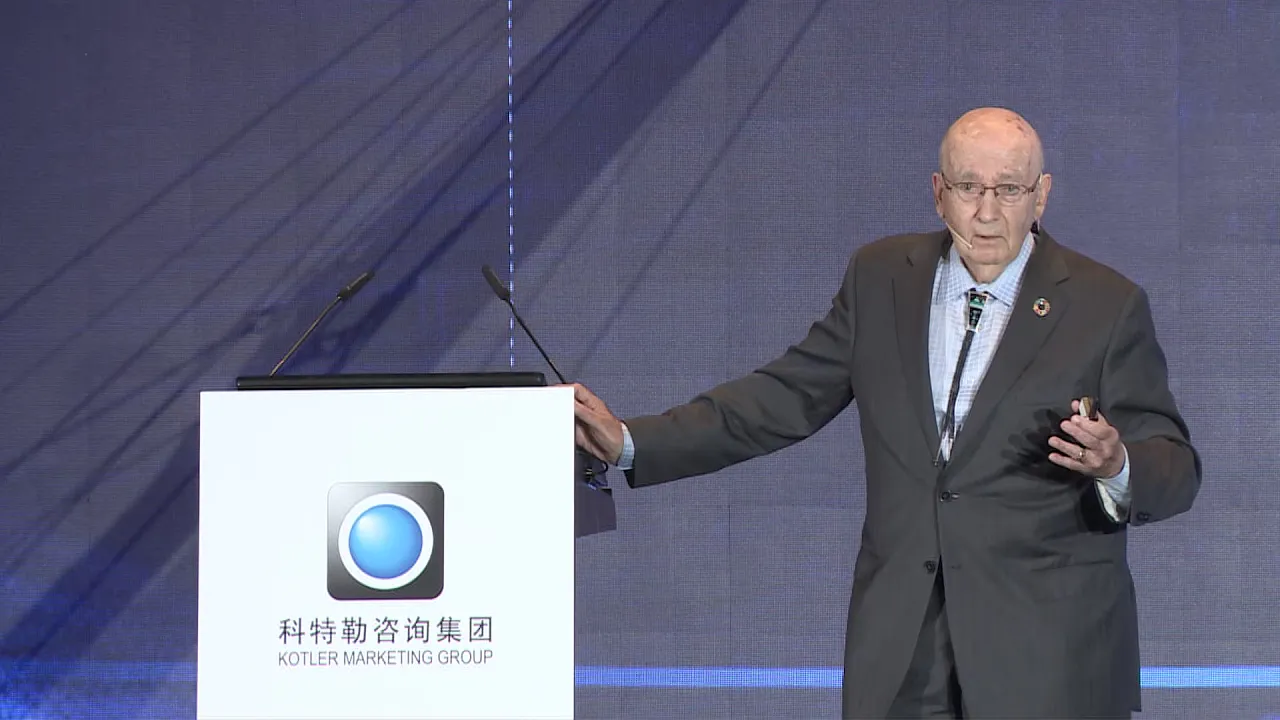
Philip Kotler -The Father of Modern Marketing-Keynote Speech-The Future of Marketing
Introduction and Context
Overview of the Lecture
- The speaker expresses gratitude for the opportunity to lecture, highlighting the prestige of the Kotler marketing group as a leading marketing consulting firm.
- Acknowledges a significant event: a trade deal signed between China and the United States, emphasizing its potential for win-win outcomes.
Economic Implications of Trade Deals
Stock Market Reaction
- The speaker notes that tariffs are ineffective and advocates for collaboration between nations to foster economic growth.
- Reports an increase in stock market performance by 319 points following news of the trade deal, indicating positive investor sentiment.
Advancing Common Good
New Book Release
- Introduces his recently published book titled "Advancing the Common Good," focusing on enhancing happiness and prosperity for all, not just billionaires.
Observations on China's Growth
Historical Visits to China
- Reflecting on previous visits to China (2006, 2009, 2014, 2015), he discusses China's evolving understanding of business amidst global economic challenges.
Future of Marketing
Evolution of Consumer Behavior
- Predicts that consumers may become so knowledgeable that traditional sales roles could diminish due to access to information via the internet and social media.
Word-of-Mouth Marketing
- Emphasizes that future marketing will focus on managing word-of-mouth as it becomes more influential than traditional advertising methods.
Influencer Marketing Strategy
Engaging Influencers
- Discusses strategies for introducing new products through influencers rather than conventional advertising; highlights trust in personal recommendations over ads.
History and Development of Marketing
Understanding Marketing's Roots
- Describes marketing as a relatively young discipline compared to ancient trading practices; emphasizes its evolution from simple selling to complex customer-focused strategies.
Shift from Product-Centric to Customer-Centric Approaches
- Highlights a paradigm shift in marketing focus from product features to understanding customer needs and desires.
Branding Importance
Understanding Value Propositions in Marketing
Differentiation and Target Market
- McDonald's exemplifies a strong value proposition, which includes offering good food at various price points. However, they tailor separate value propositions for different customer segments.
- For senior citizens, McDonald's positions itself as a safe and comfortable dining option with affordable meals, while teenagers may require a different appeal to choose McDonald's over competitors like Wendy's.
- The key to effective marketing lies in defining the target market and crafting specific value propositions that resonate with each segment through branding efforts.
The Shift to Digital Marketing
- A significant revolution in marketing has emerged from digital and social media; companies not embracing digital marketing risk falling behind.
- Modern consumers increasingly prefer online shopping options, as illustrated by personal anecdotes of frequent online purchases over traditional store visits.
The Evolution of Marketing Definitions
New Perspectives on Marketing
- Traditional definitions of marketing focused on sales forces and advertising; however, the contemporary view emphasizes creating, communicating, and delivering value (CCD) to target markets.
- Marketing is now seen as a growth function responsible for expanding market size by identifying new opportunities through direct customer engagement.
Understanding Market Dynamics
- Marketers are uniquely positioned to recognize emerging trends and threats due to their close interactions with customers. This insight allows them to convert observations into actionable strategies.
Key Components of Effective Marketing Plans
The Five C's Framework
- A comprehensive marketing plan should address five critical components: Customers, Company, Collaborators (partners), Competitors, and Context—collectively known as the Five C's.
The Four P's of Marketing
- Initial planning involves detailing the product features (Product), pricing strategy (Price), distribution channels (Place), and promotional tactics (Promotion). Additional elements like Packaging can also be included.
The Process of Developing a Marketing Plan
Steps in Creating an Effective Strategy
- Successful marketing begins with thorough market research (MR), which informs segmentation—identifying distinct groups within the market based on varying needs.
- After segmentation comes targeting specific needs that align with business capabilities. This process is referred to as STP: Segmentation, Targeting, Positioning.
Implementation and Control Mechanisms
- Once a marketing plan is developed, it must be implemented effectively. Continuous control measures are necessary to assess performance against sales goals.
Understanding the Role of CEOs in Marketing
The Importance of CEO Background in Marketing
- Discussion on how a CEO's background influences their understanding of marketing, with a preference for those from marketing over finance or law.
- Noted that many CEOs lack marketing expertise, which can hinder effective decision-making regarding market strategies.
Types of CEOs and Their Marketing Perspectives
- Introduction to four types of CEOs based on their approach to marketing; the first type focuses solely on price.
- A higher-level CEO integrates product, price, place, and promotion into a cohesive strategy.
- The top-tier CEO views marketing as essential for creating customer value across all company operations.
The Evolution of Marketing: Old vs. New
Transition from Mass Marketing to Targeted Approaches
- Explanation of old marketing methods like mass advertising through 30-second commercials and their inefficiencies.
- Emphasis on the need for blending traditional and new marketing techniques to reach consumers effectively.
Consumer Empowerment and Distribution Changes
- Highlighting how modern consumers are informed and can easily research competitors, changing the dynamics of purchasing decisions.
- Mentioning innovative distribution channels that have emerged, such as buying food at gas stations.
Growth Strategies: Organic vs. Acquisition
Preference for Organic Growth
- Argument favoring organic growth over acquisition growth due to better long-term performance metrics.
- Companies that grow organically tend to have stronger alignment between marketing efforts and overall business strategy.
Case Study: Fujifilm vs. Kodak
- Contrast between Fujifilm's survival strategies compared to Kodak's decline; Fujifilm adapted by leveraging hidden technologies.
- Discussion about disruption in industries and how companies must innovate continuously to stay relevant.
Key Features of New Marketing Strategies
Assessing Company Performance in Modern Marketing
- Introduction to ten key features that define successful modern marketing practices; companies should evaluate themselves against these criteria.
Understanding Customer Journeys
- Exploration of the customer journey concept, illustrating varying lengths depending on consumer readiness when purchasing products like cars.
Understanding Customer Journeys and Touch Points
The Importance of Customer Journeys
- Different types of customer journeys exist, including short and elaborate ones. Understanding these variations is crucial for marketers.
- Marketers must identify touch points where customers interact with the brand; absence during these moments means missing out on potential sales.
Effective Presence at Touch Points
- Simply being present at touch points isn't enough; effectiveness at each point is essential. Poorly trained sales staff can lead to lost sales despite good marketing efforts.
- Customers often move from awareness to having questions about a product. Brands need to be available to provide answers that can convince customers to make a purchase.
Building Customer Loyalty and Advocacy
- Successful marketing aims not just for one-time purchases but also for creating lifetime customers who advocate for the brand.
- Net Promoter Score (NPS) measures how many customers are willing to recommend the company, identifying advocates or brand ambassadors.
Employee Engagement as Marketing Strategy
- Employees should also be seen as brand ambassadors. If they are unhappy or poorly treated, it reflects negatively on the company’s image.
- Walmart's approach shifted towards making employees feel valued, which in turn improved customer interactions and overall satisfaction.
Experience Over Service
- Marriott emphasizes that employees come first; happy employees lead to satisfied customers. They focus on delivering experiences rather than just services.
- The concept of experiential marketing highlights the importance of creating memorable shopping experiences for customers.
Measuring Marketing Effectiveness
Key Metrics in Customer Awareness
- In "Marketing 4.0," metrics are used to assess customer awareness, engagement, and advocacy levels throughout their journey with the brand.
Insights into Consumer Behavior
- Understanding consumer behavior requires deep insights beyond mere facts; brands should strive for a comprehensive understanding of customer needs and preferences.
Competitor Analysis
Peripheral Vision and Market Niches
Expanding Perspectives on Customer Needs
- Emphasizes the importance of peripheral vision in business, urging companies to broaden their focus beyond just current customers to identify emerging trends and changes.
- Highlights the significance of recognizing niches and micro-segments, where specific groups have urgent needs for certain products, leading to potential market leaders.
Insights from Niche Leaders
- Discusses examples of niche markets, such as a company that specializes in large umbrellas for outdoor cafes in France, illustrating how niche leaders can dominate specific segments.
- Mentions military binocular manufacturers as another example of niche leadership, emphasizing the importance of quality and specialization.
Identifying Micro Markets
- Introduces Mark Penn's concept from "Microtrends," identifying unique consumer groups like working retirees who may require specialized services.
- Points out other overlooked niches such as left-handed individuals and Protestant Hispanics, encouraging businesses to watch for these micro-markets.
The Necessity of Innovation
The Role of Continuous Innovation
- References Fuji Film's motto "innovation never stops," stressing that without innovation, companies risk failure.
- Shares insights from a venture capital firm indicating that only 1 out of 10 startups succeed significantly enough to cover losses from failures.
Balancing Innovation with Marketing
- Warns against relying solely on innovation without effective marketing strategies; both elements are crucial for success.
- Advocates for collaboration between product developers and marketers to ensure new products meet market demands effectively.
Case Study: Philips' Marketing Transformation
Learning from Past Mistakes
- Describes Philips' struggle with product failures due to a lack of marketing input during development phases.
- Highlights the hiring of CK Prahalad as a pivotal moment for Philips, focusing on integrating marketing into their innovation process.
Consultant Engagement Strategies
- Advises against hiring consultants who demand cash payments; instead suggests offering stock options based on performance outcomes.
The Dual Importance of Innovation and Marketing
Peter Drucker's Perspective
- Cites Peter Drucker’s assertion that successful companies must excel in both innovation and marketing rather than one at the expense of the other.
Questions for Fostering Innovation
Product Development and Marketing Strategies
The Process of Product Development
- Conduct market research to identify competitors and ensure the idea is viable before presenting it to creators for further development.
- Utilize lean marketing principles by creating a simplified version of the product, gathering customer feedback, and iterating based on their suggestions.
- Involve different roles in the development process: creators for design, developers for production logistics, and executors for marketing execution.
Managing Innovation with the Three Boxes Model
- The "three boxes" model emphasizes balancing current business management with innovation efforts; Box 1 focuses on existing products, Box 2 on improvements, and Box 3 on groundbreaking ideas like electric cars.
- Many companies fail to reach Box 3; however, visionary leaders like Elon Musk exemplify this approach by pursuing ambitious innovations.
The Role of CMOs in Business Growth
- Chief Marketing Officers (CMOs) are crucial in fostering a community among marketers; they often share strategies despite not competing directly.
- There is an ongoing debate about whether marketing should be rebranded as growth; however, effective leadership remains essential regardless of title.
Shifts in Marketing Strategy
- A significant shift has occurred from merely creating marketing strategies to actively driving business growth while managing public perception amidst reduced control over messaging.
- Social media platforms have diminished companies' ability to control their brand narratives; thus, galvanizing networks becomes vital for message dissemination.
Japanese Management Concepts: Kaizen and Quality Focus
- The concept of Kaizen promotes continuous improvement within organizations; at Toyota, a high percentage of workers contribute innovative ideas annually.
- Lifetime employment in Japan allows employees to feel secure enough to suggest changes without fear of job loss—fostering a culture of improvement.
Evolving Business Philosophy: Stakeholder Welfare Over Profit Maximization
Stakeholder Value vs. Shareholder Profit
The Importance of Stakeholders
- Emphasizes the need to consider not just shareholders but also customers, employees, suppliers, and distributors in profit-sharing.
- Argues that focusing solely on shareholders can lead to disengagement from employees who may question their own benefits.
Business Purpose and Environmental Responsibility
- Questions the environmental impact of businesses, urging them to invest in sustainable energy sources rather than relying solely on fossil fuels.
- Highlights the economic implications of neglecting low-income consumers; if they lack purchasing power, companies risk losing sales.
Evolution of Corporate Responsibility
- Discusses the shift from traditional corporate social responsibility (CSR), which often involved philanthropy, to a more integrated approach that considers broader societal impacts.
- Introduces Michael Porter's concept of "Corporate Shared Value," advocating for businesses to create value for both society and themselves.
Brand Activism and Values
- Explains how brand activism goes beyond CSR by requiring brands to actively engage with social issues relevant to their business.
- Stresses that brands should communicate their values clearly, moving beyond mere product offerings to demonstrate care for societal issues.
Storytelling in Marketing
- Advocates for brands to tell compelling stories about their origins and missions as a way to connect with consumers emotionally.
- Shares examples of effective storytelling in marketing, such as HP's garage beginnings or Haier's innovative leadership approach.
Adapting Marketing Strategies
- Suggests that marketers must align company values with customer values for successful engagement and advocacy.
- Encourages scenario planning using big data analytics to prepare for various market conditions while blending traditional and modern marketing techniques.
Future-Proofing Businesses
- Warns that failure to adapt will result in obsolescence within five years due to rapid changes in the business landscape.