DSM-5 Overview
Overview of DSM-5
In this section, Professor Karen McGruder introduces the purpose of the video, emphasizing its relevance for students interested in mental health careers or seeking licensing exam preparation.
Background and Importance of DSM
- The DSM-5 (Diagnostic and Statistical Manual of Mental Disorders) is crucial for mental health practitioners in the US, primarily for medical insurance reimbursement.
- Understanding previous editions like DSM-4 helps in recognizing trends, controversies, and old terminology changes.
Key Differences Between DSM-4 and DSM-5
- The shift from Roman numerals to numbers (e.g., V to 5) signifies a move towards planned updates akin to software versions.
- Organizational changes: DSM-4 categorized by age of onset while DSM-5 focuses on symptom similarity.
Controversies and Considerations
This part delves into controversies surrounding the creation and updating processes of the DSM, highlighting issues such as diagnostic criteria debates and concerns about stigma.
Controversies in Diagnostic Criteria
- Debates exist around diagnostic criteria decisions, exemplified by grief exclusion for major depressive disorder.
Concerns and Stigma
Self-Fulfilling Prophecy and DSM Organization
In this section, the speaker discusses the self-fulfilling prophecy and provides an overview of how the DSM (Diagnostic and Statistical Manual of Mental Disorders) is organized.
Self-Fulfilling Prophecy
- The speaker introduces the concept of a self-fulfilling prophecy.
- Explains how expectations about a person can influence that person's behavior or performance.
DSM Organization
- Illustrates a graphic showing the organization of the DSM.
- Mentions different categories within each section, including specific disorders, substance or medication-induced issues, conditions due to other medical factors, unspecified conditions.
- Highlights the use of codes for reimbursement and ICD codes for international classification.
Neurodevelopmental Disorders in DSM
This part focuses on neurodevelopmental disorders outlined in the DSM.
Intellectual Disability
- Emphasizes using "intellectual disability" instead of outdated terms like "mental retardation."
- Defines intellectual disability as deficits in intellectual functioning affecting learning, thinking, judgment.
- Discusses criteria such as onset before age 18 and exclusion of other medical conditions.
Communication Disorders
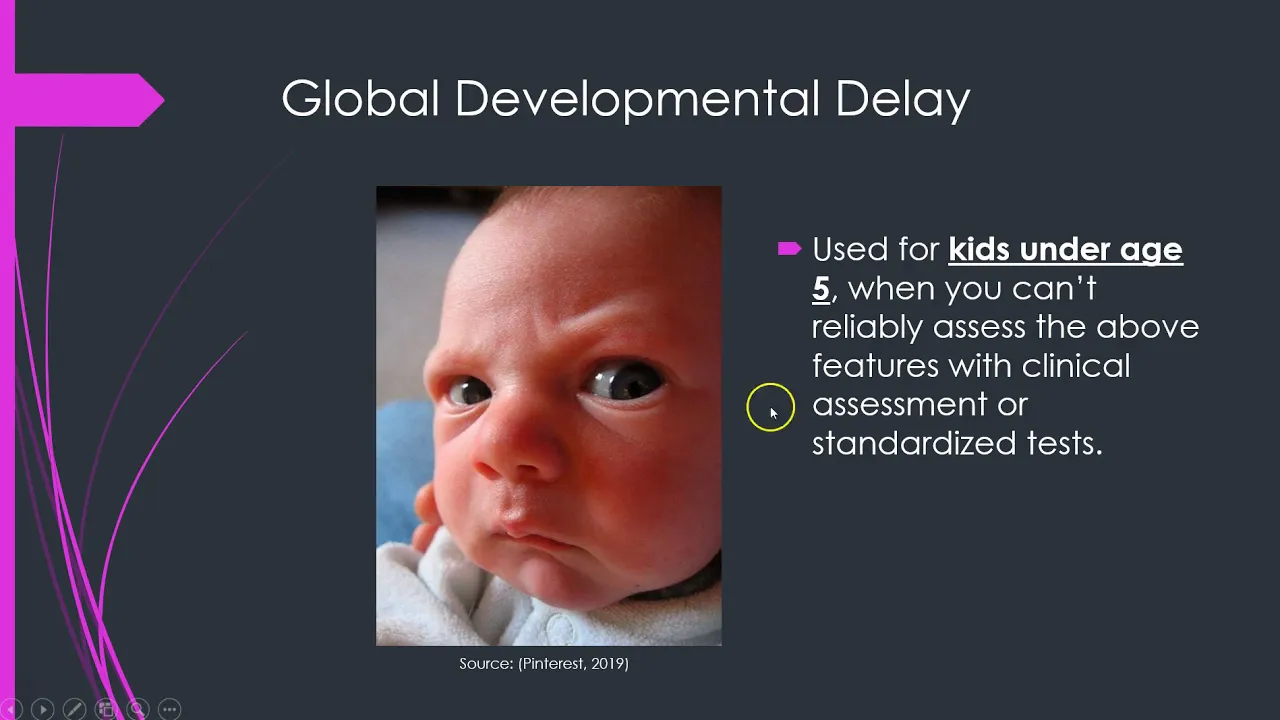
- Mentions global developmental delay for children under 5 when assessment is challenging.
- Provides examples like childhood-onset fluency disorder (stuttering).
Autism Spectrum Disorder
- Lists social deficits required for diagnosis: social-emotional reciprocity, nonverbal communication, friendships.
- Describes restrictive repetitive behaviors or interests criteria for diagnosis.
Schizophrenia and Psychotic Disorders
This segment delves into schizophrenia and other psychotic disorders as per the DSM classification.
Schizophrenia
- Details symptoms including delusions (fixed false beliefs), hallucinations (perceiving things not present), disorganized speech.
- Explains subtypes of delusions: erotomanic, grandiose, jealous persecutory, somatic.
Delusional Disorder
- Defines delusional disorder characterized by fixed false beliefs not influenced by facts or reason.
- Outlines categories of delusions: bizarre (implausible) vs. non-bizarre (possible but untrue).
Diagnostic Criteria
Schizophrenia and Bipolar Disorders Overview
In this section, the speaker discusses schizophrenia, its symptoms, and different types of disorders related to bipolar disorder.
Positive and Negative Symptoms of Schizophrenia
- Positive symptoms indicate the presence of something abnormal like hallucinations, delusions, and disorganized speech.
- Negative symptoms involve the absence of normal behaviors such as apathy, poor hygiene, flat effect (lack of emotion).
Types of Schizophrenia Disorders
- Brief psychotic disorder is diagnosed if symptoms last less than a month.
- Schizophreniform disorder is identified if symptoms persist between 1 to 6 months.
- Full-blown schizophrenia diagnosis requires symptoms for at least six months.
Bipolar Disorder Categories and Symptoms
This part covers the diagnostic criteria for bipolar affective disorder along with different types of bipolar disorders.
Bipolar Affective Disorder Criteria
- Combines diagnostic criteria for depression or bipolar disorder along with some criteria for schizophrenia.
Types of Bipolar Disorders
- Bipolar I requires experiencing both depression and mania for at least one week.
- Bipolar II involves hypomanic episodes lasting four days along with depressive episodes lasting two weeks.
Depressive Disorders Classification
The speaker delves into various depressive disorders including disruptive mood dysregulation disorder and major depressive disorder.
Depressive Disorder Types
- Disruptive mood dysregulation disorder characterized by temper outbursts in children aged over ten years.
Major Depressive Disorder Criteria
- Diagnosis includes a depressed mood or loss of interest plus five other symptoms lasting at least two weeks.
Understanding Anxiety and Related Disorders
In this section, the speaker discusses various anxiety-related disorders such as separation anxiety disorder, selective mutism, specific phobias, panic disorder, agoraphobia, and generalized anxiety disorder.
Separation Anxiety Disorder and Selective Mutism
- Separation anxiety disorder is diagnosed when a child struggles with daycare or preschool for at least four weeks.
- Selective mutism involves not speaking in specific social situations.
Specific Phobias and Panic Disorder
- Specific phobias include animal, natural environment, blood/injection/injury, and situational fears like planes or elevators.
- Panic attacks consist of symptoms like sweating, trembling, chest pain, fear of dying.
Agoraphobia and Generalized Anxiety Disorder
- Agoraphobia involves fear of public transit, open spaces, closed spaces.
- Generalized Anxiety Disorder (GAD) lasts at least six months with symptoms like restlessness and difficulty concentrating.
Multiple Personality Disorders and Related Conditions
This section discusses multiple personality disorders, dissociative amnesia, depersonalization, derealization disorders, somatic symptom and related disorders.
Multiple Personality Disorders
- Multiple personality disorder is rare and involves the development of different identities in response to trauma.
Dissociative Amnesia
- Dissociative amnesia involves the inability to recall autobiographical information due to stress or trauma.
Depersonalization and Derealization Disorders
- Depersonalization relates to feelings of unreality about oneself, while derealization pertains to surroundings or objects.
Somatic Symptom and Related Disorders
- Somatic symptom disorder involves distressing symptoms with disproportionate thoughts, feelings, or behaviors.
Eating Disorders and Sleep-Wake Disorders
This section covers feeding and eating disorders like pica, anorexia nervosa, bulimia nervosa as well as sleep-wake disorders.
Feeding and Eating Disorders
- Pica involves eating non-food items; avoidant restrictive food intake disorder criteria include weight loss, nutritional deficiency, interference with functioning not explained by lack of food.
Anorexia Nervosa
- Anorexia nervosa includes distorted self-perception, fear of weight gain leading to significantly low weight.
Bulimia Nervosa
- Bulimia nervosa is associated with binge eating followed by purging through vomiting or excessive exercise.
Sleep-Wake Disorders
- Sleep-wake disorders encompass conditions like insomnia, hypersomnia, narcolepsy, breathing-related issues such as sleep apnea.
Sexual Dysfunctions and Gender Dysphoria
This part delves into sexual dysfunctions listed in the DSM including erectile disorder (ED), premature ejaculation. It also touches on gender dysphoria controversy regarding its inclusion in the DSM.
Sexual Dysfunctions
- Sexual dysfunctions like ED are included in the DSM; some controversial issues surround their classification.
Gender Dysphoria
Diagnosis and Disorders
This section discusses the criteria for diagnosis, substance-related disorders, neurocognitive disorders, personality disorders, paraphilic disorders, and other mental disorders.
Diagnosis Criteria
- The diagnosis requires being at least 18 years old and exhibiting symptoms since at least 15 years old.
- Symptoms include unlawful behavior, lack of remorse, impulsivity, aggression, deceitfulness, and recklessness.
Substance-Related Disorders
- DSM lists various substances such as alcohol, caffeine, cannabis, hallucinogens, opioids, sedatives, stimulants, and tobacco.
- Categories include substance use disorder like alcohol use disorder and specific conditions like intoxication and withdrawal.
Neurocognitive Disorders
- Delirium is temporary and reversible due to factors like medication changes or dehydration.
- Other neurocognitive disorders are progressive and irreversible; examples include Alzheimer's disease with plaques and tangles in the brain.
Personality Disorders
Personality disorders are categorized into three clusters based on behavior patterns: odd or eccentric (Cluster A), dramatic or erratic (Cluster B), anxious or fearful (Cluster C).
Cluster A - Odd or Eccentric Behavior
- Includes paranoid personality disorder characterized by distrust.
- Schizoid personality disorder denotes loner tendencies.
- Schizotypal personality disorder involves odd behaviors.
Cluster B - Dramatic or Erratic Behavior
- Antisocial personality disorder exhibits a lack of regard for others' rights.
- Borderline personality disorder shows instability in relationships.
- Histrionic personality disorder seeks attention dramatically.
- Narcissistic personality disorder displays an inflated self-image.
Paraphilic Disorders
Paraphilic disorders encompass sexual conduct deviations beyond typical sexual dysfunctions.
Types of Paraphilic Disorders
- Voyeuristic behavior involves obtaining pleasure from watching others without consent.
- Exhibitionism includes exposing oneself without consent for gratification.
- Sexual masochism entails deriving pleasure from receiving pain.
Other Mental Disorders
Other mental disorders cover specified conditions not fitting into standard categories like paraphilic or substance-related disorders.
Categories of Other Mental Disorders
- Specified mental disorders have defined symptoms but do not align with existing classifications.
Medication Induced Movement Disorders
- Tardive dyskinesia results from long-term antipsychotic use causing involuntary movements like lip smacking.
- Acute dystonia leads to abnormal muscle postures due to certain medications.
Future Disorders in DSM
The discussion revolves around potential new disorders that may be included in future versions of the DSM, such as internet gaming disorder, pseudo suicidal behavior, and non-suicidal self-injury.
Potential New Disorders
- Mention of internet gaming disorder as a candidate for inclusion in the DSM.
- Discussion on the consideration of pseudo suicidal behavior for future DSM versions.
- Highlight on non-suicidal self-injury as another potential disorder to be included.