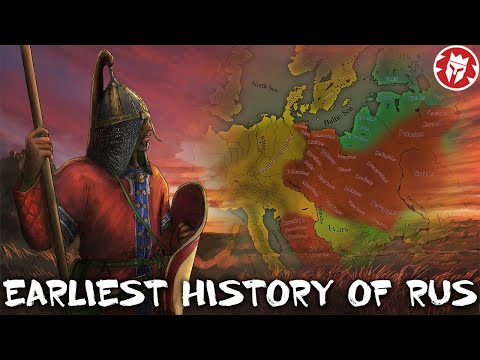
Slavs and Vikings: Medieval Russia and the Origins of the Kievan Rus
The Ancient Origins of Russia
Introduction to Russian History
- Russia is the largest country on Earth and has a significant historical influence, yet its early origins are often overlooked.
- The video series aims to explore the ancient history of Russia, presented by Devin from Kings and Generals.
Early Inhabitants of the Steppe
- The Ponto-Caspian Steppe, inhabited for millennia by nomadic tribes along major rivers like the Don, Dnieper, and Volga.
- Notable tribes included the Scythians and Sarmatians; Greek historians recorded their stories, including mythical origins linked to Hercules and Amazon warriors.
- These Iranian pastoralists were known for their equestrian lifestyle and consumption of horse milk, meat, psychoactive herbs, and wines.
Emergence of the Slavs
- The earliest written accounts of Slavic people come from Roman historian Tacitus in the 1st century AD describing a tribe called "Venedi."
- Venedi distinguished themselves from nomadic neighbors by building homes and fighting unmounted; they are considered ancestors of modern Slavic nations.
Migration Patterns
- Between the 4th and 6th centuries AD, migrations due to pressures from Huns and Germanic peoples allowed early Slavs to expand beyond their original territories.
- The Venedi evolved into distinct tribes that migrated into Eastern Roman territory (Balkans), Avar domains (Western Slavs), or eastward into Ukraine.
Expansion into Eastern Europe
- Proto-Slavic tribes settled in regions previously dominated by weakened Scythians and Sarmatians after conflicts with Goths, Romans, and Huns.
- This migration led to intermixing with indigenous Finno-Ugrics and Baltic peoples across modern Ukraine, Belarus, and central-western Russia.
Social Structure & Religion
- By 750 AD, Eastern Slavs occupied vast territories but remained politically fragmented into various tribes with complex kinship ties.
- Settlements were typically near water sources; strongholds featured earth-and-timber ramparts surrounded by villages providing resources.
Beliefs & Practices
- Early Slavic religion involved a pantheon resembling Indo-European deities; Perun was a prominent god associated with thunder while Veles ruled over magic.
- Pagan practices tied closely to nature; shrines were built in sacred groves. Information about these beliefs primarily comes from later Christian writers who viewed them negatively.
Cultural Values
War and Trade in Early Eastern Europe
The Nature of Warfare Among the Slavs
- War was prevalent among the Balts, Finns, and Slavs, characterized by ambush tactics rather than open battles.
- Combat involved short iron spears, heavy wooden shields, and poison-tipped arrows, reflecting a decentralized yet orderly society through shared customs.
The Arrival of the Norsemen
- In the 9th century, population pressures in Scandinavia led Norsemen to seek new lands; Danes went west as Vikings while Swedes ventured east.
- By navigating Eastern Europe's rivers, Norsemen engaged in established trade networks with Bulgars and Khazars for furs and silver.
Encounters with Constantinople
- The Norsemen reached Constantinople (Miklagard), where they laid siege in 860 but retreated due to a storm.
- Their interactions with Romans transitioned from conflict to commerce, enriching them with silks and wine.
Initial Hostility Between Norsemen and Slavs
- As "Varangians" or "Rus," the Norsemen initially raided Slavic villages for tribute and slaves.
- This period saw Scandinavian dominance over Slavic tribes leading to cultural intersections that birthed the Rurikid dynasty.
The Role of The Primary Chronicle
- Much of early Russian history is derived from Nestor's The Primary Chronicle, written in 1113 AD; its legitimacy is debated by historians.
- According to Nestor, after expelling their Scandinavian rulers around 860 AD, Slavic tribes fell into chaos without order or law.
Seeking Leadership: The Rise of Rurik
- In response to internal strife, Slavs sought a prince from the Varangian Russes; Rurik accepted their invitation in 862.
- He established Novgorod as his capital and worked on stabilizing his realm until his death in 879.
Oleg's Conquest of Kiev
- Rurik’s successor Oleg aimed to expand territory by targeting the Khazar-controlled Kiev.
- With a united army of various tribes under his command, he seized key towns before confronting local rulers Askold and Dir at Kiev.
Establishing Control Over Kiev
The Rise of Kievan Rus
Establishment of Kievan Rus
- The strategic position along the Dnieper River allowed Kiev to become a central hub for trade and commerce. Oleg, declaring himself Prince of Kiev, aimed to rule from this pivotal location.
- By 885, Oleg had successfully united most Eastern Slavic tribes under his control, marking the birth of Kievan Rus—a nation that would thrive for three centuries and emerge as one of Medieval Europe's wealthiest states.
- Initially, 'Rus' referred specifically to the ruling Scandinavian elite; however, over time it came to encompass all tribes within the Kievan realm—both Slavic and Nordic—collectively known as the people of the Rus.
Legacy of the Rurikid Dynasty
- Kiev served as the grand capital where descendants of Rurik and Oleg ruled as Princes of the Rurikid dynasty, establishing a lineage that significantly influenced Eastern European history.