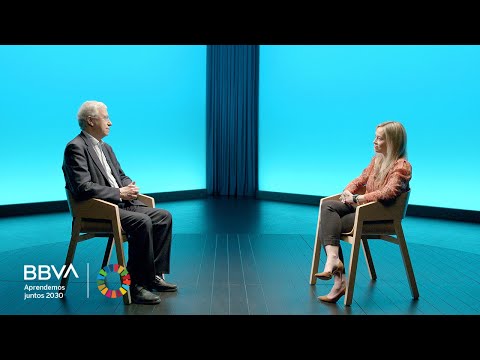
Un paseo por la historia de la ciencia | José Manuel Sánchez Ron
Importance of the Relationship Between Science and History
Introduction to José Manuel Sánchez Ron
- José Manuel Sánchez Ron introduces himself as a physicist and historian, emphasizing his background in theoretical physics and history of science.
- Carolina López, the interviewer, highlights Sánchez Ron's extensive publication record, noting he has authored over 40 books.
The Interconnection of Science and History
- Sánchez Ron argues that understanding science is crucial for grasping its historical context; without scientific disciplines, there can be no history.
- He stresses the importance of teaching history to students in a way that contextualizes significant scientific figures like Isaac Newton within their time.
The Humanistic Spirit in Science
The Role of Humanities in Scientific Understanding
- Sánchez Ron discusses the need for a humanistic approach to education that integrates technology, philosophy, sciences, and arts.
- He believes this integration helps individuals understand their relationship with nature and their obligations towards it.
Challenges in Education
Balancing Diverse Knowledge Areas
- He acknowledges the difficulty of harmonizing various fields such as ancient culture, mathematics, and sciences without overwhelming students.
- Emphasizes that foundational knowledge should be fostered before university education to cultivate curiosity.
Insights from Correspondence Among Scientists
Significance of Letters in Scientific History
- His book "Querido Isaac Querido Albert" focuses on correspondence between notable scientists like Ramón y Cajal and Marie Curie.
- Letters provide insights into scientists' thoughts beyond formal publications—showing doubts, personal circumstances, and emotional aspects often absent from academic works.
Darwin's Prolific Correspondence
Learning from Darwin's Letters
- Darwin wrote over 14,000 letters; these documents reveal his journey from medical studies to naturalism influenced by his father’s expectations.
- His transformative voyage on the Beagle significantly shaped his views on species variability through observations made during travels.
Einstein's Philosophical Influences
Philosophy's Impact on Scientific Theory
- Discusses how Einstein’s early letters reflect philosophical influences from thinkers like Hume which shaped his theory of relativity.
- Highlights how Einstein challenged Newtonian concepts by introducing relative notions of space and time based on observational perspectives.
Historical Contextualization of Scientific Development
Influence of Socio-political Events on Science
- Sánchez Ron identifies key historical moments impacting scientific progress including WWII’s atomic bomb development stemming from uranium fission discoveries (1938).
Notable Figures Shaping Science Through Politics
Contributions by Political Leaders
- Napoleon is noted for promoting science during his reign despite not being a scientist himself; he valued scientific contributions highly.
Hitler’s regime led to significant setbacks for German science due to exclusionary policies against Jewish scientists which weakened Germany's scientific community.
The Influence of Military-Industrial Complex on Science
Eisenhower's Warning
- Eisenhower highlighted the dangers of the military-industrial complex in his farewell address, warning that military interests could unduly influence scientific development.
- He noted that the military is often the primary client for industries, which can skew research directions away from public interest and beneficial scientific advancements.
Scientific Leadership and Challenges
- Despite maintaining its leadership in science during Eisenhower's presidency, concerns about competition from China were raised.
- The intersection of art and science was discussed, particularly how movements like Cubism relate to concepts in physics such as special relativity.
Notable Scientists and Their Contributions
Marie Curie
- Marie Curie is celebrated for her groundbreaking work on radioactivity, discovering polonium and radium while overcoming significant personal challenges.
- Her perseverance inspired many women, demonstrating that determination can lead to success in male-dominated fields.
Louis Pasteur
- Pasteur revolutionized medicine with his germ theory and developed vaccination techniques, notably saving a boy bitten by a rabid dog despite lacking formal medical training.
Galileo Galilei
- Galileo introduced quantitative measurement to physics, challenging Aristotelian views on motion and laying groundwork for modern scientific methods.
Future of Science: Technology and Ethics
Impact of Artificial Intelligence
- The discussion emphasized that future technological advancements will heavily rely on AI integrated with robotics, raising questions about job displacement similar to past industrial revolutions.
Ethical Considerations
- Concerns were raised regarding how technology might diminish human agency by influencing decisions through algorithms rather than personal reflection or ethical considerations.
Education's Role
- The importance of education was underscored as a means to prepare future generations for navigating an increasingly tech-driven world while fostering critical thinking about values influenced by technology.
Turn any video into a summary like this
YouTube links, meetings, lectures. With transcripts, search, and chat.