Weak acid–strong base reactions | Acids and bases | AP Chemistry | Khan Academy
Acetic Acid and Sodium Hydroxide Reaction
Overview of the Reaction
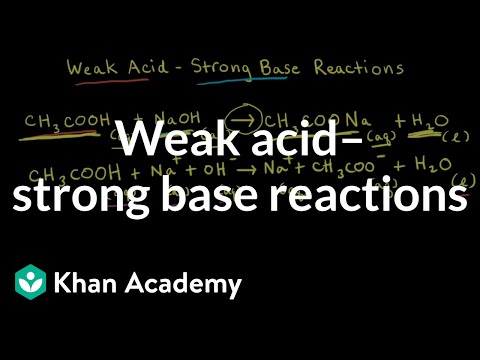
- Acetic acid is identified as a weak acid, while sodium hydroxide is classified as a strong base. Their reaction produces sodium acetate and water, indicating an acid-base neutralization that proceeds to completion.
Writing the Ionic Equations
- The overall ionic equation, also known as the complete ionic equation, begins with acetic acid (CH3COOH), which only partially ionizes in solution. Thus, it remains mostly protonated.
- In contrast, sodium hydroxide fully dissociates into sodium cations (Na+) and hydroxide anions (OH-) in solution. The products include soluble sodium acetate (Na+ and CH3COO-) and water (H2O).
Net Ionic Equation Formation
- To derive the net ionic equation from the complete ionic equation, spectator ions are identified. Sodium cations are present on both sides of the equation and can be eliminated.
- The resulting net ionic equation shows acetic acid reacting with hydroxide ions to form acetate anions and water.
Analyzing Different Scenarios
Equal Moles of Weak Acid and Strong Base
- When equal moles of acetic acid and sodium hydroxide react, they completely neutralize each other to form acetate anions.
- The pH of this resulting solution will be greater than seven due to the formation of hydroxide ions from acetate hydrolysis in water.
Excess Weak Acid Scenario
- If there is an excess of acetic acid over sodium hydroxide, all strong base will be consumed, leaving no hydroxide ions in solution.
- The pH will be less than seven because the remaining acetic acid reacts with water to produce hydronium ions (H3O+) alongside acetate anions.
Common-Ion Effect Consideration
- In this scenario where both acetic acid and acetate are present, it becomes a common-ion effect problem. This presence reduces the ionization of acetic acid but still results in increased hydronium ion concentration leading to a lower pH.
This structured summary captures key concepts regarding the reaction between acetic acid and sodium hydroxide while providing timestamps for easy reference back to specific parts of the transcript.
Buffer Solutions and pH Calculations
Formation of Buffer Solutions
- The neutralization reaction results in a weak acid being present in excess, leading to the formation of a buffer solution when both the weak acid and its conjugate base are available.
- The Henderson-Hasselbalch equation can be utilized to calculate the pH of this resulting buffer solution.
Impact of Strong Base in Excess
- In scenarios where a strong base is in excess, it will completely neutralize all available weak acid due to their one-to-one mole ratio.
- Consequently, upon completion of the reaction, no weak acid remains in the solution.
Determining pH with Excess Hydroxide Ions
- To find the pH of the resulting solution with excess hydroxide ions from the strong base, one must consider that at 25 degrees Celsius, this will result in a basic solution (pH > 7).
Calculating Actual pH
- The calculation for actual pH becomes focused on strong base properties; thus it transforms into a strong base pH calculation problem.
- While acetate anions produced during neutralization may react with water to generate additional hydroxide ions, their contribution is negligible compared to those from the strong base.