Le raffinage du cuivre par électrolyse
Electrolytic Refining of Copper
Introduction to Electrolysis
- The process of copper refining through electrolysis is introduced, highlighting its significance in metal purification.
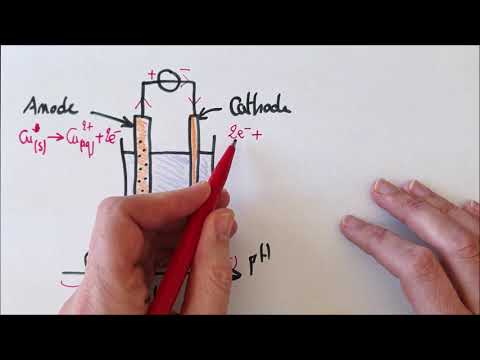
- An electrolytic setup typically involves a container and two electrodes connected by a voltage generator.
Components of the Electrolytic Cell
- The anode is made from blister copper (98.5% pure), while the cathode consists of already refined copper (over 99% pure).
- A solution containing Cu²⁺ ions at a concentration of 45 grams per liter is used for the electrolysis process.
pH Influence on Copper Ions
- A predominance diagram indicates that at a pH below 5.4, Cu²⁺ ions dominate; above this pH, Cu(OH)₂ precipitates as a solid.
- Maintaining the pH below 5.4 is crucial to keep Cu²⁺ ions available for electrolysis; thus, sulfuric acid (H₂SO₄) is added to ensure an acidic environment.
Reactions at the Electrodes
- At the anode, oxidation occurs where copper loses electrons and transforms into Cu²⁺ ions in solution.
- Electrons flow through an external circuit from the anode to the cathode due to the action of the voltage generator.
Reduction Process at Cathode
- At the cathode, reduction takes place where Cu²⁺ ions gain electrons and revert back to solid copper.
- Over time, as copper dissolves from the anode and deposits onto the cathode, impurities settle at the bottom of the container.
Observations During Electrolysis
- The anode diminishes in size as it releases copper into solution while impurities fall out as sludge.
- The cathode grows larger with nearly pure copper accumulating over time due to continuous deposition from solution.
Current Intensity Calculations
- To determine current intensity during electrolysis, calculations are based on 350 kg of blister copper containing approximately 345 kg of actual copper.
Electrolysis of Copper: Key Concepts and Calculations
Understanding the Electrolysis Process
- A quantity of 5.43 x 10^3 moles of copper is discussed, emphasizing that for complete oxidation to Cu²⁺, two electrons must be exchanged per mole.
- The amount of electrons circulating in the electrolytic system is double that of the copper being oxidized, leading to a total of approximately 18.9 x 10^3 moles of copper involved in the process.
- Each mole of electrons carries a charge of approximately 96.5 x 10^3 coulombs (Faraday's constant), allowing for the calculation that around 1.05 x 10^9 coulombs are transported during this electrolysis.
Current Intensity Calculation
- The total charge is transported over a duration of 20 days, which converts to about 6.07 x 10^6 seconds, resulting in an extremely high current intensity calculated as Q/Δt.