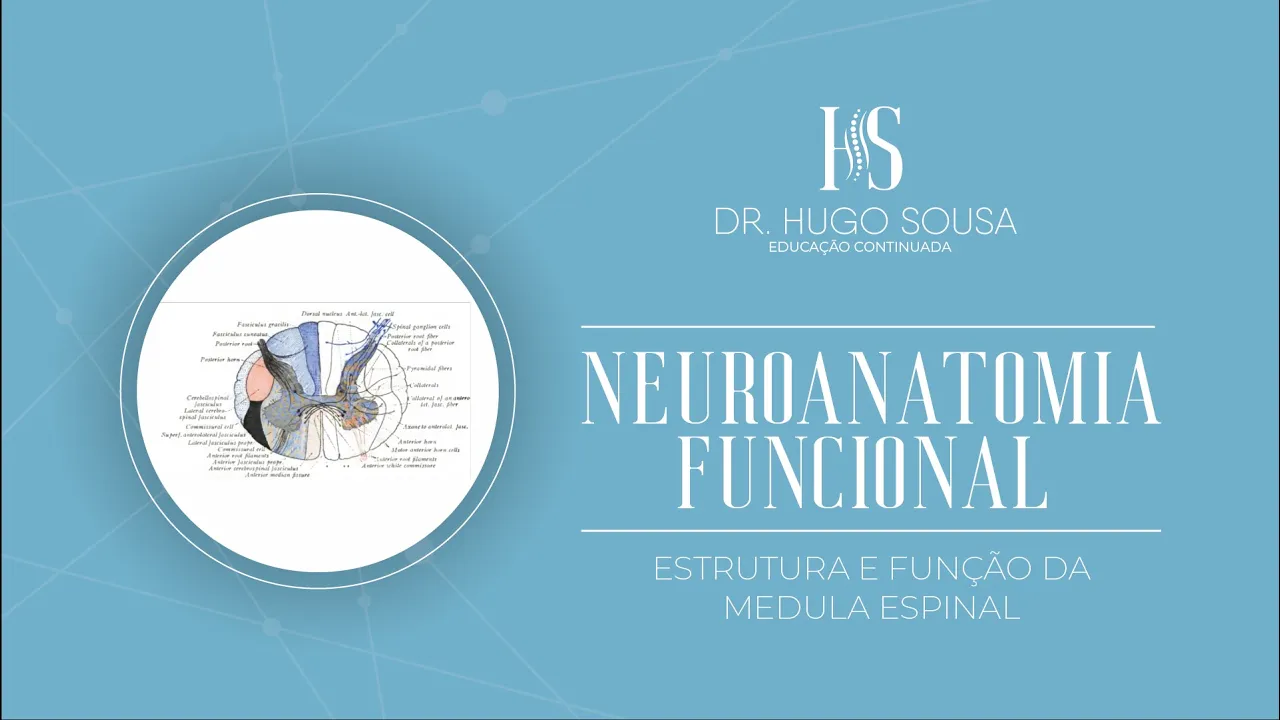
ESTRUTURA E FUNÇÃO DA MEDULA ESPINAL - PARTE 3
Overview of Spinal Cord Structure and Ascending Pathways
Introduction to Ascending Pathways
- The lecture focuses on the structure of the spinal cord, particularly the ascending pathways responsible for transmitting sensory information from the periphery.
- Sensory information, whether somatic or visceral, reaches the spinal cord through spinal nerves connecting to the dorsal root ganglion.
Dorsal Root and Sensory Information
- The dorsal root contains posterior radicular filaments that connect to the posterior column of the spinal cord, which processes sensory information.
- Within this region, there are lateral and medial fiber groups; lateral fibers relate to thermosensitivity while medial fibers are associated with discriminative touch and proprioception.
Synaptic Connections in Sensory Processing
- Dorsal root fibers establish synapses with motor neurons in the anterior horn of the spinal cord, facilitating reflex actions based on sensory input.
- An example is a myotatic reflex where a mechanical stimulus (like tapping a tendon) triggers muscle contraction as a reflexive response.
Interneurons and Reflex Arcs
- Sensory neurons can also synapse with interneurons, which then communicate with motor neurons. This pathway allows for more complex reflex responses.
- The concept of interneurons is crucial as they facilitate communication between sensory inputs and motor outputs within various regions of the spinal cord.
Association Neurons and Adaptive Responses
- Dorsal root fibers may connect with association neurons (fasciculus proprius), enabling coordination across different segments of the spinal cord.
- For instance, when scratching an itch on one knee using another limb involves multiple neural pathways coordinating sensory input from one area to motor output in another.
Visceral Reflexes and Motor Responses
- Visceral responses involve pre-ganglionic neurons that respond to stimuli like gastric distension by activating visceral motoneurons for appropriate organ function.
Neuronal Pathways and Sensory Information Processing
Overview of Neuronal Connections
- The discussion begins with the connection of motor neurons to ganglionic neurons located in the spinal cord, highlighting their role in transmitting signals.
- Mechanoreceptors in muscles, such as muscle spindles, are introduced as key players in sensory information processing, relaying stimuli through spinal nerves to the posterior root.
Ascending Pathways for Sensory Information
- The transcript explains how sensory information ascends via specific tracts, including the spinocerebellar tract, reaching structures like the brainstem before proceeding to the cerebral cortex or cerebellum.
- Projection fibers are emphasized; they connect the spinal cord to higher brain structures, indicating a hierarchical organization of sensory pathways.
Ipsilateral vs. Contralateral Ascension
- A distinction is made between ipsilateral (same side) and contralateral (opposite side) ascending pathways within the spinal cord.
- Pain and temperature sensations are noted to cross over at the spinal level before ascending contralaterally.
Specific Sensory Tracts: Gracile and Cuneate Fasciculi
- The gracile and cuneate fasciculi are identified as important ascending tracts that carry specific types of sensory information from all segments of the spinal cord.
- The gracile fasciculus is present throughout all segments while the cuneate fasciculus appears only from upper thoracic levels onward.
Functionality of Gracile and Cuneate Fasciculi
- These tracts originate from dorsal root ganglia where they synapse with second-order neurons near the base of the posterior column.
- They ascend ipsilaterally without crossing until reaching nuclei in the medulla oblongata (gracile nucleus and cuneate nucleus).
Types of Information Carried by These Tracts
- Key functions include proprioception (awareness of body position), conscious touch perception (epicritic touch), and vibratory sensation.
- It is highlighted that these sensations ascend on the same side they entered before crossing at higher centers like medulla rather than at spinal level.
Spinothalamic Tract Overview
- Introduction to the anterior spinothalamic tract which originates from neurons in dorsal root ganglia; it plays a crucial role in pain and temperature sensation transmission.
- This tract crosses within the spinal cord before ascending contralaterally through its anterior funiculus towards higher brain regions.
Understanding the Spinothalamic Tract and Related Pathways
Overview of the Thalamus and Sensory Functions
- The thalamus, specifically the ventral posterolateral nucleus, is crucial for processing pressure and protopathic touch sensations.
- The lateral spinothalamic tract originates in the spinal cord and also targets the ventral posterolateral nucleus of the thalamus, emphasizing its role in sensory pathways.
Lateral Spinothalamic Tract Characteristics
- This tract crosses over in the spinal cord; information from one side of the body is processed on the opposite side.
- It transmits fast pain signals and temperature sensations, highlighting its importance in acute pain perception.
Comparison with Other Tracts
- The gracile and cuneate fasciculus do not cross in the spinal cord, unlike the lateral spinothalamic tract which does.
- The spinoreticular tract ascends parallel to the lateral spinothalamic tract but conveys more diffuse pain signals related to discomfort.
Spinocerebellar Tracts: Anterior and Posterior
- Both anterior and posterior spinocerebellar tracts originate from the spinal cord, projecting towards the cerebellum for proprioceptive feedback.
- The anterior tract crosses over; it processes conscious proprioception while maintaining a connection to motor activity levels.
Role of Cerebellum in Movement Coordination
- The corticospinal tract influences motoneurons for muscle control; this interaction is vital for movement regulation.
- The cerebellum compares intended movements with actual execution to adjust posture and coordination effectively.
Clinical Case Discussion
- A clinical case illustrates loss of proprioception and tactile sensation on one side due to injury, demonstrating how specific pathways are affected by trauma.
Understanding Spinal Cord Injuries
Location and Nature of the Injury
- The injury is located in the lower region of the spinal cord, specifically affecting the lumbar segments due to its impact on the lower limbs.
- The lesion is confirmed to be on the right side, as indicated by physical examination findings such as monoplegia and loss of movement in the right leg.
Sensory Loss and Motor Pathways
- The patient exhibits a loss of conscious proprioception and discriminative touch on the right side, correlating with motor information descending laterally through the corticospinal tract.
- Most motor information crosses over above the spinal cord before descending, establishing connections at corresponding levels with anterior horn motoneurons.
Proprioceptive Information Pathways
- Proprioceptive information from conscious sensations ascends ipsilaterally; thus, loss of these sensations on the right indicates damage to pathways carrying this information.
- There is also a noted alteration in pain and temperature sensitivity on the left leg due to crossed pathways for thermal and nociceptive signals.
Implications of Lesion Location
- The injury's location affects both lumbar and sacral regions, particularly around L1 vertebrae where significant spinal structures are involved.
- Key structures affected include gracile fasciculus (responsible for epicritic sensation from lower limbs), indicating extensive sensory disruption.
Summary of Findings
- Gracile fasciculus carries critical sensory information from lower limbs while cuneate fasciculus does so for upper limbs; both are impacted by this injury.
Turn any video into a summary like this
YouTube links, meetings, lectures. With transcripts, search, and chat.