APA Formatting - Integrating Sources
Integrating Sources Workshop Overview
Goals of the Workshop
- The workshop aims to teach techniques for integrating sources into academic writing and identifying common mistakes to avoid.
- Practical examples will be provided during the workshop to illustrate how to integrate sources effectively.
Techniques for Integrating Sources
- Three main methods for integrating sources are quoting, summarizing, and paraphrasing; each will be discussed in detail.
- All integration techniques require in-text citations to maintain credibility and authority in writing.
Importance of Source Quality
Selecting Good Sources
- It is advised to use peer-reviewed articles directly instead of relying on blogs, even if they cite good information.
- Avoid personal opinions unless specifically required by the assignment; use external sources to support arguments instead.
Quoting Techniques
Proper Quotation Usage
- Quotations should match the original source word-for-word and should only be used when specific wording is crucial.
- For quotes under 40 words, use quotation marks with an in-text citation immediately following.
Formatting Long Quotes
- Longer quotes (over 40 words) must start on a new line, double-spaced, and indented without additional paragraph indentation.
Paraphrasing Strategies
Effective Paraphrasing
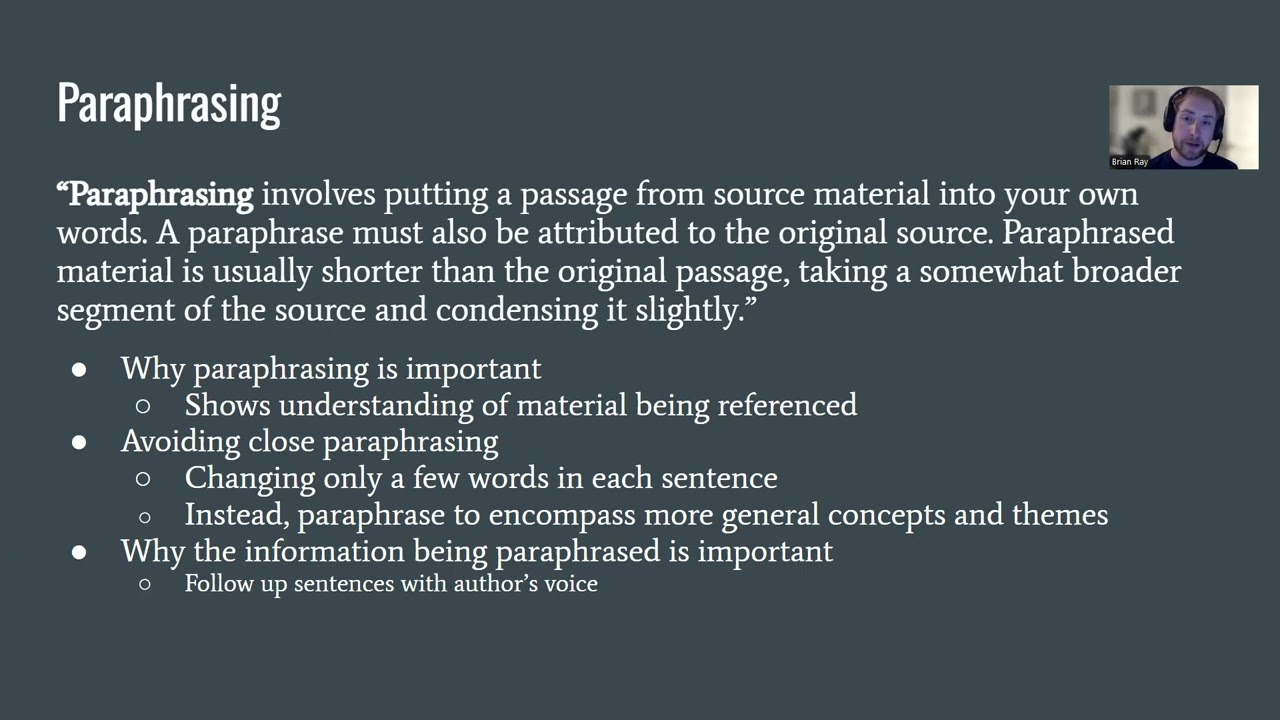
- Paraphrasing involves rephrasing source material in your own words while still attributing it correctly.
- This technique demonstrates understanding of the material but must avoid close paraphrasing that resembles direct quoting too closely.
Follow-Up Explanation
- Always follow up quotes or paraphrases with your own analysis or commentary explaining their significance within your argument.
Summarizing Key Ideas
Summary Techniques
- Summarizing condenses main ideas into shorter forms compared to paraphrasing, focusing on overarching themes rather than details.
Integration with Other Techniques
- Combining quoting, summarizing, and paraphrasing enhances paper strength by showcasing understanding from different perspectives.
Structuring Your Paper
Narrative Flow
- Maintain a logical organization throughout your essay as if telling a story; include an introductory paragraph with a thesis statement outlining main themes.
Balancing Voices
- Balance your voice with sourced information; ensure paragraphs conclude with explanations about why presented information matters.
APA Formatting Essentials
Importance of Correct Formatting
- Adhere strictly to APA formatting guidelines; small details matter significantly in academic writing. Resources are available through National Lewis for assistance.
Structuring an Effective Paragraph
Introduction to Paragraph Structure
- A paragraph should begin with a topic sentence or thesis statement, which can be placed at the start or end of the paragraph.
- The introductory paragraph sets the theme for the body paragraphs, aligning with the overall structure of the essay.
- Each body paragraph should introduce its specific theme through either section headers or topic sentences.
Developing Body Paragraphs
- Following the topic sentence, a claim is made that serves as a mini-argument supporting the thesis; for example, discussing high rent in Chicago.
- The first main paragraph might address wage stagnation relative to rising rents and include specific data to illustrate this point.
Incorporating Sources and Citations
- A signal phrase paired with an action verb is essential when introducing sources; varying language helps maintain reader engagement.
- It's important to mix source material presentation methods such as quotes, paraphrasing, and summarization to support claims effectively.
Analysis and Conclusion of Paragraphs
- Analysis is crucial; it explains how presented information supports claims made in the paper. This includes linking back to arguments made earlier.
- Concluding sentences should mirror introductory sentences while transitioning smoothly into subsequent topics within the essay.
Understanding Plagiarism
Definition and Scope of Plagiarism
- Plagiarism involves presenting another's work or ideas as one's own without proper acknowledgment, covering all forms of published and unpublished materials.
AI-related Plagiarism Guidelines
- Recent updates now include AI-generated content under plagiarism definitions; instructors may have varying rules regarding its use.
Proper Source Citation Practices
Importance of Accurate Citations
- Each in-text citation must correspond with a reference at the end of your paper; mismatches can lead to confusion about source credibility.
Resources for Citation Guidance
- Various guides are available online for APA style citations; ensure that every cited source has matching references listed correctly.
Tools for Writing Assistance
Utilizing Writing Tools Effectively
- Tools like Grammarly can assist in maintaining APA style accuracy while also catching grammar errors during proofreading processes.
Turn any video into a summary like this
YouTube links, meetings, lectures. With transcripts, search, and chat.