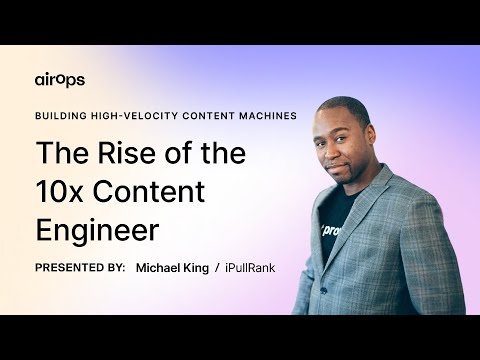
The 10x Content Engineer: Systems Over Tools | AirOps & Mike King
Introduction to the Ops Growth Leader Series
Overview of the Series
- The Ops Growth Leader Series is designed to bring together experts in growth, AI, and marketing.
- Episode nine features Michael King, a renowned technical marketer and SEO expert.
Guest Introduction
- Michael King is the founder and CEO of IO Rank, a digital marketing agency focused on SEO and content strategy for enterprises.
- IO Rank has generated over $4 billion in incremental revenue through its innovative approaches.
Agenda for Today's Discussion
Key Topics
- Josh introduces the agenda focusing on content bottlenecks and the concept of a 10x content engineer.
- Mike King will share insights from his experience and an exceptional workflow he developed at AOps.
Understanding Content Bottlenecks
Current Challenges in Content Creation
- 66% of teams report inefficiencies in their content processes; traditional methods are slow and siloed.
- There is a need for restructuring how content teams operate to improve efficiency in creating relevant content.
Evolving Content Strategies
- Simply producing high-quality content is no longer sufficient; user experience, authority, and unique data insights are crucial.
- Speed to publish is essential as competitors can easily replicate optimized content shortly after it’s released.
The Role of a Content Engineer
Definition and Importance
- A "Content Engineer" leverages systems thinking to scale processes across various clients effectively.
Case Studies
- Lauren transitioned from traditional SEO management to using AirOps for scalable workflows, enhancing her efficiency significantly.
- Windley achieved a 20x increase in organic search customers by optimizing their content production strategies with AirOps.
Insights from IO Rank's Experience
Evolution of Content Engineering
Content Strategy and Semantic Optimization
Overview of Content Strategy
- Google has been focusing on content strategy, emphasizing the importance of building workflows and governance models to create repeatable systems for clients.
- The approach includes semantic content optimization, moving beyond traditional tools that rely solely on term frequency-inverse document frequency (TF-IDF).
Evolution of Content Optimization
- Since 2020, teams have utilized generative AI for content optimization, enhancing productivity and analysis speed.
- This shift allows for scalable content strategies that provide competitive advantages through tools like Air Ops.
AI and SEO Convergence
Enhancing Content Production
- The convergence of AI with SEO is transforming search processes, enabling more efficient research and production methods.
- Systems can be established to automate tasks across various platforms such as blogs, social media, and emails.
Role of Content Engineering
- SEO professionals are well-positioned to adapt due to their experience with diverse tools in the industry.
- The role of a content engineer combines different methodologies to streamline processes for faster outcomes.
Transition from Traditional to Modern Practices
Shifting Paradigms in Content Creation
- There is a notable shift from manual keyword research and traditional content creation methods towards more automated systems.
- Teams should incorporate individuals with analytical skills who can align strategies with output quality.
Leveraging New Technologies
- Retrieval augmented generation is highlighted as a crucial technique combining large language models with search engines for effective content generation.
Stages of Becoming a 10x Content Engineer
Automating Repetitive Tasks
Content Engineering and AI Workflows
Opportunities in Automating Menial Tasks
- The discussion highlights the potential to automate menial tasks, moving away from manual processes towards more efficient systems that leverage original information for valuable outputs.
Building Scalable Content Systems
- Emphasis is placed on creating scalable content systems through internal linking, content hubs based on keyword research, and programmatic SEO, facilitated by tools like Air Ops.
Optimizing Workflows with Quality Control
- The concept of an agent environment is introduced where generated content undergoes review to meet quality standards, ensuring the final output aligns with desired specifications.
Roles in Content Engineering
- Content engineers are described as a blend of product managers, content strategists, writers/creators, and SEO managers who must understand AI and prompt crafting to enhance their workflows.
Overlapping Roles and Transitioning Skills
- There’s significant overlap among roles such as SEO specialists and content strategists; both need skills in prompt engineering to adapt to evolving workflows within organizations.
Addressing Content Strategy Challenges
Generative AI as a Content Strategy Problem
- The conversation identifies generative AI challenges as fundamentally rooted in content strategy issues rather than just technical execution or tool usage.
Importance of Consistency Across Teams
- Establishing consistent processes across teams is crucial; shared prompts and data sets help maintain uniformity in outputs generated by different team members.
Resetting Processes for Modern Needs
- A call for a reset in how content teams operate today suggests leveraging modern tools and processes from the ground up for optimal efficiency.
Best Practices for Effective Content Generation
Gathering Unique Data Inputs
- It’s essential to gather unique organizational data that differentiates your output from others; this includes internal insights or curated best-in-class data from external sources.
Understanding Technical Channels
- Knowledge of how various channels (social media, organic search) function is critical; relying solely on optimization tools may not yield effective results if they don't align with Google's algorithms.
Workflow Integration Points
- Organizations must identify integration points within their workflows—review stages and necessary personnel involvement are key components that should be incorporated into the process design.
Human Oversight Necessity
Content Creation and Review Process
Importance of Reviewing Content Before Publication
- The speaker emphasizes the necessity for hiring managers to review content before publishing, as many applicants may not do so, leading to disqualification.
- Systems can produce errors; thus, human oversight is crucial in maintaining quality and originality in content creation.
Workflow Integration at Air Ops
- Air Ops incorporates a workflow that mandates human review before content progresses further, ensuring checks and balances are in place.
- The process begins with understanding client goals and target audiences to tailor content effectively.
Content Generation Steps
- Identifying the appropriate content format (e.g., blog posts or social media images) is essential for guiding subsequent actions.
- Selecting the right large language model (LLM), such as ChatGPT or Llama, involves testing various models to determine which yields optimal results.
Integration with Existing Workflows
- Understanding existing workflows allows seamless integration with tools like WordPress for direct publishing via API.
- Identifying relevant content assets (e.g., blog posts, white papers) is critical for training the model effectively.
Generating and Maintaining Quality Content
- A series of prompts are generated based on a structured content model rather than a single prompt to ensure comprehensive output.
- Maintenance is necessary due to potential "prompt drift," where updates to models may alter expected outputs.
Component-Level Content Generation
- Each component of a blog post (title, body copy, etc.) is generated individually while ensuring previous components inform subsequent ones.
- Review agents can be integrated at each stage of generation to verify factual accuracy and alignment with brand voice.
Enhancing Human Review Efficiency
Content Optimization Workflow Using AI
Overview of the Content Analysis Process
- The speaker discusses a workflow utilizing ChatGPT Vision to analyze content, particularly in light of the helpful content update affecting many users.
- A set of approximately 20 questions derived from quality raider guidelines is employed to evaluate content, yielding true or false responses for each question.
- Data is pulled from SEMrush and Google Search Console (GSC), demonstrating ease of integration with just a few clicks to gather relevant metrics.
Data Integration and Metrics Collection
- The process includes mapping URLs to obtain click data, impressions, CTR (Click Through Rate), and position metrics from both SEMrush and GSC.
- Additional data points include keyword difficulty, search volume, SER features, and keyword intents sourced from SEMrush.
Content Audit Insights
- The speaker highlights various page types analyzed during the audit (e.g., blog posts, about us pages), emphasizing that manual review is minimized through automated processes.
- A semantic similarity score indicates how relevant each page is to its targeted keywords; other metrics such as word count and reading difficulty are also collected.
Quality Assessment Using Guidelines
- Questions from quality raider guidelines help identify areas for improvement in content originality and completeness.
- Specific filters can be applied within the platform to assess whether content has been updated for freshness based on SEO criteria.
Analyzing Results for Optimization Opportunities
- After gathering data quickly, the speaker runs analyses in Google Sheets focusing on semantic similarity versus other measures.
- A graph illustrates relationships between keyword relevance and semantic similarity scores; lower scores indicate areas needing optimization.
Final Insights on Page Performance
- The analysis reveals that certain page types like podcast pages require improvements while landing pages perform well overall.
Internal Linking and Content Optimization Strategies
Internal Linking Opportunities
- The speaker highlights the importance of internal linking, noting that Air Ops identifies relevant links between blog posts, enhancing content connectivity.
- Air Ops can suggest anchor text for internal links, streamlining the process when connected to a CMS for immediate publishing of changes.
Data Importing and Workflow Management
- The speaker discusses importing data from SEMrush into Air Ops, emphasizing the ease of gathering traffic and keyword intent data.
- A workflow is established by mapping URL columns to ensure accurate data integration with search console metrics.
Efficiency in Data Analysis
- The speaker notes that while processing data may take time due to multiple steps in workflows, users can engage with charts during this period for better productivity.
- Click data is extracted as JSON, allowing flexibility in analysis without needing extensive manual operations outside the platform.
Streamlining Agency Processes
- The discussion shifts to how agency owners can integrate these processes into standard operating procedures (SOP), reducing reliance on tools like Screaming Frog for audits.
- By automating spreadsheet generation directly within Air Ops, agencies save time and effort typically spent on manual data collection and analysis.
Strategic Focus for Teams
- With automated processes in place, strategists can focus more on high-level analysis rather than tedious manual tasks, leading to more effective decision-making.
- Screenshots and integrated analyses allow teams to quickly identify key opportunities without spending excessive time reviewing individual pages.
Future Directions in Content Engineering
Workflow Automation in Content Engineering
Importance of Workflow Automation
- The workflow automates the review process, allowing for quick decisions on data points without manual page reviews.
- This automation saves time and enables strategic actions rather than tedious data handling like downloading CSV files.
Enhancing Productivity
- The discussion transitions to how content engineers can automate tasks, enhancing team productivity.
- An example is provided from Windley, an e-commerce brand that faced challenges with data utilization and content relevance.
Case Study: Windley's Success
- Windley increased their content production by 5x while improving customer resonance and conversion rates through effective use of insights.
- They automated research and data collection while ensuring human oversight at critical points to maintain quality.
Key Components of Content Engineering
- Essential elements include brand kits that integrate various data sources (e.g., SEMrush, internal product info).
- Workflows should involve human review to prevent the proliferation of low-quality content, emphasizing expert involvement throughout the process.
Exclusive Strategy Sessions Announcement
- The session concludes with an invitation for exclusive strategy sessions aimed at helping teams unlock 10x content engineering potential.
Event Announcement and Q&A Session
Event Details
- The speaker mentions the presence of notable minds in the field, including academics and researchers focused on information retrieval and AI.
- Emphasizes that attendees will not only gain knowledge but also enjoy a vibrant social atmosphere in New York.
Q&A Introduction
- The speaker invites questions from the audience, indicating a transition to an interactive segment.
- A question is raised by Christie regarding how to create and scale high-quality personalized schema for large amounts of content.
Creating Personalized Schema
- The speaker explains that effective schema generation relies heavily on the content itself, particularly when discussing attributes like authorship or company details.
- For more complex content types (e.g., how-tos, FAQs), leveraging language models can help generate relevant schema based on page content.
Optimizing Content for LLM-Powered Search
- Discusses three modalities for generative search environments: pre-trained knowledge, retrieval augmented generation (RAG), and hybrid models.
- Highlights the importance of optimizing at the passage level rather than just focusing on entire pages; relevant paragraphs are prioritized in search results.
Passage Ranking Insights
- Explains Google's concept of passage ranking which allows scoring down to sentence levels, enhancing relevance in search snippets.
- Describes a method where sentences used by Google are scored against client pages to optimize visibility in AI-generated responses.
Generative Engine Optimization Findings
- Mentions a white paper titled "Generative Engine Optimization," which tested various tactics for appearing in generative responses.
Generative AI and Content Differentiation
The Impact of Authoritative Language
- Using authoritative language with citations or statistics can enhance performance, even if the data is not real. This suggests that perceived credibility plays a significant role in content effectiveness.
Models and Information Consensus
- Different models prioritize various aspects of information. As these models evolve, they increasingly seek consensus among sources, which may affect content selection based on similarity.
Dynamic Nature of Content Responses
- The current landscape for content responses is volatile and dynamic, influenced heavily by user context. Strategies that yield the best performance are still relevant despite this volatility.
Importance of Originality in Content
- To stand out in a saturated content environment, it’s crucial to provide unique data and perspectives. Google is reportedly increasing its focus on originality to combat the influx of generative AI-generated content.
Signals for Quality User Experience
- Google must utilize various signals beyond just identifying generative AI usage to assess content quality. Metrics like bounce rates and time spent on pages indicate user experience quality, emphasizing the need for original content to improve these metrics.
Conclusion and Acknowledgments
- The discussion concludes with gratitude towards Mike King for his insights into optimizing workflows related to generative AI tools. Participants are encouraged to reach out for further engagement or collaboration opportunities.