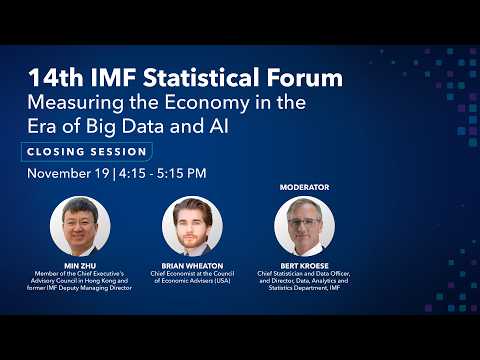
14th IMF Statistical Forum: One on One Discussion — Embracing transformation responsibly
Overview of the Statistical Forum
Introduction to the Last Session
- The final session of the statistical forum is anticipated with mixed feelings, as participants reflect on valuable discussions over two days regarding big data and AI in macroeconomic statistics.
- Topics covered include enhancing traditional economic measures like GDP and ensuring their relevance amidst rapid changes in technology and society.
Importance of Policymaker Engagement
- Emphasis on the necessity for statisticians to communicate effectively with policymakers about what information is needed for informed decision-making.
- Acknowledgment that more data does not equate to better analysis; understanding limitations and context is crucial for effective policy insights.
Panel Introduction
Introducing Economists
- Brian Whitten, Chief Economist at the Council of Economic Advisers (CEA), brings expertise from academia and government, focusing on unintended consequences of policies.
- Min Zhu, former IMF Deputy Managing Director, offers a global perspective on economic decisions influenced by evidence-based statistics.
Role of the Council of Economic Advisers
Functionality Explained
- The CEA acts as an internal consulting firm for the White House, providing analyses on potential impacts of policies related to GDP, inflation, and wages.
- Comprising around 40 economists specializing in various fields within economics, they support policymaking through rigorous analysis.
Information Needs for Effective Policy
Identifying Key Questions
- Policymakers require clear answers regarding productivity improvements and living standards to assess economic performance accurately.
- Traditional macroeconomic statistics remain essential but face challenges due to evolving technologies that complicate historical price comparisons.
Evaluating Government Policies
Importance of Data Analysis
- Unlike market-driven corrections, government policies lack self-correcting mechanisms; thus, robust data collection is vital for retrospective evaluations.
- While perfect data isn't necessary for all functions in a market economy, improved data quality enhances tracking productivity and policy effectiveness.
Addressing Information Gaps
Supply Chain Insights
- Current input-output tables used by policymakers are limited in granularity; this restrictiveness hampers detailed analysis necessary for identifying critical supply chain choke points.
Perspectives from China
Challenges in Measurement
- Min Zhu highlights significant gaps between rapidly changing economies/technologies and existing measurement capabilities across countries like China.
Utilizing Big Data & AI
- China's statistical bureaus have made strides using big data and AI to enhance efficiency in gathering agricultural statistics through digital tools like satellite systems.
Measuring Structural Changes
- Capturing shifts within labor-intensive industries versus tech manufacturing poses challenges; accurate measurement remains crucial amid these transitions.
Defining Digital Economy Metrics
China's definitions differentiate between narrow (11% GDP from AI sector alone vs. broad definition including 55%) metrics reflecting varying impacts across sectors.
Ownership Issues with Data
- China categorizes data ownership into holding rights, production rights, and trading functions which aids clarity in evaluating statistical contributions.
Conclusion: Future Directions
Need for Enhanced Information Systems
- Both panelists agree that understanding how AI affects job markets requires timely information about changing responsibilities rather than just occupation titles.
Key Changes in OBBBA and Expensing Policies
Overview of OBBBA Changes
- The OBBBA introduced significant changes focused on expensing, including full expensing for equipment and temporary full expensing for factory construction.
- There was a strong interest in how to structure these incentives, particularly whether they should be limited to factories or applied more broadly.
Challenges with Data Timeliness
Issues with Data Lag
- Policymakers often rely on data that is outdated, sometimes lagging by several quarters or even years, complicating timely decision-making.
- While private sector data sources can provide more current information, they also come with their own limitations and issues.
Bridging the Gap Between Data Sources
Need for Improved Data Quality
- There is a need for better integration between official statistics and private sector data to enhance timeliness and accuracy.
- Official statistics are not as timely as fast indicators from the private sector but have their own reliability concerns.
AI's Impact on Economic Measurement
Academic Symposium Insights
- A symposium highlighted how AI could transform international financial systems; presentations utilized alternative data sources effectively.
- Concerns were raised about the completeness of big data used in labor market analysis presented at the conference.
Communicating Data Quality to Policymakers
Importance of Clear Communication
- Statisticians must effectively communicate the quality and limitations of various data sources to policymakers who require fast information.
- Understanding where data comes from and its classification is crucial for informed policy decisions.
Role of Statisticians in Policy Formation
Need for Statistical Expertise
- It’s suggested that having a chief statistician alongside economists could improve understanding during policy formation processes.
- Distinguishing between official national accounts and big data is essential for effective policy review.
Understanding Big Data Limitations
Challenges with Non-Traditional Data
- Big data can help forecast future trends but lacks historical alignment with traditional statistics due to its non-structured nature.
- Policymakers need guidance on interpreting big data's origins, qualifications, and confidence levels.
The Role of Statistical Agencies
Balancing Traditional and New Methods
- Official statistical agencies play an important role by providing credible statistics amidst growing private sector data collection efforts.
- Public trust in official statistics remains vital; discrepancies between different types of data can undermine this trust.
Future Directions for Official Statistics
Adapting to Technological Advances
- Official statistical agencies must adapt by incorporating AI and big data into their processes while maintaining credibility.
- Collaboration between traditional statisticians and new technology will be essential moving forward.
Practical Priorities for Statisticians
Recommendations Moving Forward
- The first priority should be integrating big data tools without compromising public trust in official institutions.
- Statistical agencies should explore using simulations comparing classical national accounts against outputs from big datasets.
Closing Thoughts on Future Measurements
Summary of Forum Discussions
- Emphasis was placed on producing better evidence rather than just accumulating more data; clarity about limitations is crucial.
- Collaboration among various stakeholders will enhance economic measurement effectiveness while preserving institutional credibility.
Turn any video into a summary like this
YouTube links, meetings, lectures. With transcripts, search, and chat.