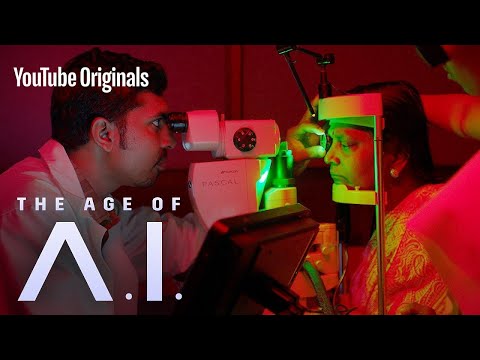
Healed through A.I. | The Age of A.I.
New Section
In this section, the speaker discusses the advancements in healthcare and the increase in life expectancy over the years.
Healthcare Progress
- Life expectancy has significantly increased over the years.
- 100 years ago, life expectancy was only 45, but today it is almost 80.
- Healthcare has made huge progress in eradicating epidemics and improving overall well-being.
New Section
The speaker highlights that despite healthcare progress, people still get sick or pass away from incurable diseases.
Need for Improved Diagnosis
- There is a need to improve diagnosis and predict illnesses rather than just reacting to them.
- Innovations in machine learning can help combat diseases and improve healthcare outcomes.
New Section
This section introduces how machine learning is being used to combat blindness and enable communication for individuals with neurological diseases.
Machine Learning's Impact
- Machine learning is being used to combat one of the leading causes of blindness.
- It also enables a son with a neurological disease to communicate with his family.
- AI is changing our perspective on mind and body, life and death, and what we value most - our human experience.
New Section
The speaker emphasizes that AI is transforming our understanding of human experiences related to mind, body, life, death, and values.
Changing Perspectives
- AI challenges our traditional notions of mind-body connection.
- It prompts us to reconsider what we value most in our human experience.
New Section
The speaker introduces Tim Shaw as a football player who had dreams of playing in the NFL.
Tim Shaw's Football Dream
- Tim Shaw had dreams of becoming an NFL player since sixth grade.
- He was dedicated, hardworking, and took his football career seriously.
New Section
Tim Shaw's journey as a professional football player is highlighted.
Tim Shaw's NFL Career
- Tim Shaw's dedication and talent led him to be drafted into the pros.
- He enjoyed playing professional football and had a strong passion for the game.
New Section
Tim Shaw's life takes an unexpected turn when his body starts experiencing unusual symptoms.
Health Decline
- In 2012, Tim Shaw noticed changes in his body, such as muscle twitching and stumbling.
- He realized he wasn't the same athlete or football player he used to be.
New Section
The speaker reveals that Tim Shaw was diagnosed with ALS (amyotrophic lateral sclerosis), also known as Lou Gehrig's Disease.
ALS Diagnosis
- The doctor informed Tim Shaw that he had ALS, a disease that causes the death of neurons controlling voluntary muscles.
- This diagnosis changed the course of Tim's life dramatically.
New Section
The impact of ALS on Tim Shaw's daily life is discussed.
Challenges of Living with ALS
- As ALS progresses, muscles weaken, making simple actions like walking, talking, and eating extremely difficult.
- Tim requires assistance with basic tasks and has to think about every step he takes.
New Section
A personal interview with Tim highlights his experience living with ALS.
Personal Experience
- In 2015 interview footage, Tim shares how his body started behaving differently after being diagnosed with ALS.
- He reflects on no longer being the same athlete or football player he once was.
New Section
The impact of ALS on Tim Shaw's ability to communicate is discussed.
Communication Challenges
- ALS affects Tim's ability to speak and communicate effectively.
- He has to rely on alternative methods, such as voice recognition technology, to communicate with others.
New Section
The speaker explains the significance of ALS and its effects on Tim Shaw's life.
Understanding ALS
- ALS, also known as Lou Gehrig's Disease, is a condition that causes the death of neurons controlling voluntary muscles.
- It severely impacts physical abilities and communication skills.
New Section
The speaker discusses the challenges faced by Tim Shaw due to his limited mobility caused by ALS.
Daily Struggles
- Simple tasks like scratching his head become challenging for Tim due to muscle weakness caused by ALS.
- He requires assistance with basic activities and relies on specialized food containers for nutrition.
New Section
The impact of ALS on Tim Shaw's communication abilities is further explored through personal anecdotes.
Loss of Communication
- Tim's ability to communicate has significantly declined due to the progression of ALS.
- His family members miss his previous level of interaction and conversation.
New Section
The importance of language and communication in human experiences is highlighted, along with the potential role of AI in restoring communication abilities for individuals with speech impairments.
Language and Communication
- Language plays a crucial role in human communication and identity.
- AI can potentially help recreate lost voices for individuals with speech impairments caused by various medical conditions.
New Section
Julie Cattiau introduces Project Euphonia, which aims to improve speech recognition and restore individuals' voices.
Project Euphonia
- Project Euphonia has two goals: improving speech recognition for people with medical conditions and giving them their voice back.
- The project aims to recreate the way individuals used to sound before their diagnosis.
New Section
Tim Shaw's struggle with communication due to ALS is further discussed, highlighting the impact of AI in restoring his voice.
Restoring Communication
- Tim's ability to communicate has been significantly affected by ALS.
- AI technology can potentially help him regain his voice and improve his communication abilities.
New Section
The speaker emphasizes the significance of communication as a fundamental aspect of human interaction and the potential impact of AI in restoring it for individuals with speech impairments.
Importance of Communication
- Communication is a vital part of human interaction and identity.
- AI advancements offer hope in restoring communication abilities for those who have lost their voices.
New Section
Julie Cattiau collaborates with a big thinker to address the challenges associated with speech impairments and find innovative solutions.
Collaborative Efforts
- Julie partners with a big thinker to tackle the challenges related to acquired speech impairments caused by various medical conditions.
- Their collaboration aims to find innovative solutions and make a positive impact.
New Section
This section discusses how AI-powered Live Transcribe helps a person with ALS communicate and the process of training a speech recognition model.
Training a Speech Recognition Model
- [Downey] Technology cannot help Dimitri hear his own voice in English.
- Dimitri uses AI-powered Live Transcribe to communicate.
- Dimitri partnered with Google to train a recognizer that better recognizes his voice.
- The model used for recognition is trained on specific data.
How Speech Recognition Works
- Sound of our voice is converted into a waveform, which represents the sound.
- Waveforms are matched to transcriptions or labels for each word.
- Machine learning is used to map input sounds to output words using millions of voice samples.
- Algorithms use rules like grammar and syntax to predict each word in a sentence.
Challenges for People with Unique Voices
- The speech recognition model works well for people whose voices sound similar to the examples used for training.
- For someone like Dimitri, who has ALS, the existing model does not work at all.
- Building unique models with unique data for every individual is slow and inefficient.
New Section
This section explores the partnership between Google and ALS TDI in collecting voice samples from people with ALS to build a machine learning model that recognizes different individuals' voices.
Collecting Data from People with ALS
- Google partnered with ALS TDI in Boston to collect voice samples from people with ALS.
- The ice bucket challenge helped raise funds for ALS research, enabling them to reach out to people in their programs and gather data sets.
Building a Recognizer for Different Individuals
- Fernando Vieira partnered with Michael Brenner from Google's Euphonia Project.
- Tim Shaw recorded thousands of utterances, providing valuable data for building a recognizer that understands him.
- The challenge is to make the recognizer work on a smaller set of recordings from an individual.
New Section
This section highlights Tim Shaw's dedication to helping others and the collaboration between Fernando Vieira, Michael Brenner, and Tim Shaw in applying technology to assist people with ALS.
Tim Shaw's Dedication
- Tim Shaw is dedicated to finding every way he can help others.
- His enthusiasm and willingness to record voice samples inspire others.
Collaboration for Real Help
- Fernando Vieira partnered with Michael Brenner, a Google research scientist, to apply technology in understanding Tim's recordings.
- They aim to turn the collected data into real help for individuals with ALS.
New Section
This section discusses the challenges faced in making the speech recognition model work outside of recorded samples and the iterative process of adjusting parameters for better understanding.
Challenges in Expanding Recognition
- The goal is to make the recognizer work beyond recorded samples.
- It is unclear how well it will work on a larger set of data.
- Dimitri had recorded a significant amount of sentences, but expecting others to do the same is not feasible.
Iterative Process for Better Understanding
- When the recognizer does not recognize correctly, parameters are adjusted.
- The idea is to keep refining until better understanding is achieved.
Timestamps have been associated with bullet points as requested.
Can AI Predict and Prevent Blindness?
This section discusses the potential of AI in predicting and preventing blindness caused by diabetic retinopathy.
The Impact of Diabetes on Vision
- Santhi, who has diabetes, is at risk of vision loss due to diabetic retinopathy.
- Diabetic retinopathy is a major cause of blindness worldwide, particularly in India.
Early Detection and Screening
- Early stages of diabetic retinopathy are symptomless but treatable. Early screening is crucial to prevent vision loss.
- Doctors can examine the eye or take pictures of the retina to detect bleeding spots, an early sign of the disease.
- However, there is a shortage of ophthalmologists in India to screen all diabetic patients effectively.
Using AI for Screening
- Dr. Kim collaborated with a team at Google to explore using machine learning to screen for diabetic retinopathy.
- Machine learning algorithms were trained using over 100,000 eye scans graded by doctors on a scale from healthy to diseased.
- The AI model learned to predict signs of disease in eye scans without human assistance.
Implementing AI Technology
- Verily, the life sciences unit at Alphabet, partnered with Google's team to implement the AI-enabled eye scanners in rural areas like Aravind Eye Clinics in India.
- The algorithm analyzes eye images in real-time and provides referral recommendations instantly to doctors and patients.
Potential Impact
- By speeding up diagnosis and augmenting clinical care with AI technology, blindness caused by diabetic retinopathy can be prevented.
- Diabetes affects millions of people worldwide, and AI-enabled screening can have a significant impact on patient outcomes.
The summary has been written in English as per the given instructions.
The Impact of AI in Healthcare
This section discusses the positive impact of AI in healthcare, particularly in providing timely treatment and early detection of diseases.
AI for Timely Treatment and Early Detection
- With new technology, patients like Santhi can receive immediate treatment for diabetes-related eye problems, preventing blindness.
- Thousands of patients who would have waited weeks or months for treatment can now get help before it's too late.
- AI can be used as an early detection system for retinopathy, a condition caused by high blood sugar damaging the retina.
- AI makes healthcare more accessible in areas with limited access to doctors.
Potential Applications of AI in Healthcare
- AI has the potential to make a significant impact on healthcare, especially in places where doctors are scarce.
- Diabetic retinopathy research is opening doors to other potential applications of AI in detecting risk factors for heart disease and aiding diagnosis.
- AI could potentially help researchers understand how cells work and find better treatments for cancer and mental health disorders like depression and anxiety.
- Using smartphones, AI can flag potential mental health issues and provide well-being checkups.
Voice Synthesis with AI
- Voice synthesis using AI can help individuals regain their voice. A model has been developed to imitate former NFL star Tim Shaw's voice after he lost his ability to speak due to ALS.
- Reconstructing a person's unique voice is challenging but possible with machine learning techniques.
- DeepMind and Google teams are working on a model to imitate Tim Shaw's voice, allowing him to communicate using text-to-speech technology.
Tim Shaw's Speech Recognition Model
This section follows the progress of Tim Shaw's speech recognition model and his interaction with the team working on it.
- The team visits Tim Shaw's house for a practice run of his speech recognition model.
- Tim welcomes the team into his home.
- The team interacts with Tim and prepares for the practice run.
Timestamps are provided in seconds.
Lead the Way, Tim
In this section, Cattiau expresses excitement and nervousness about sharing their work with Tim and his parents. They discuss two versions of the app that were trained using recordings of Tim's voice and other participants from ALS TDI.
Sharing the App Versions
- Cattiau is excited to share their work with Tim and his parents.
- Two versions of the app were brought - one trained only using recordings of Tim's voice, and another trained using recordings from Tim and other participants from ALS TDI.
- Cattiau acknowledges that they are unsure if the app will behave as expected but is eager to learn from Tim's feedback.
Trying Out the App
Cattiau suggests trying out the app with Tim. They discuss phrases used for training and introduce the idea of recognizing phrases not part of the training set.
Trying Out Phrases
- Cattiau suggests trying out the app with some phrases.
- John asks who they are talking about.
- The app successfully recognizes a phrase, "It got it."
- Excitement ensues as everyone observes how well the app performs.
Testing Untrained Phrases
- Cattiau proposes trying some phrases that were not part of the training set.
- John explains that previously, they used phrases used for training, but now they want to see if it can recognize new phrases.
- They decide to give it a try.
Exploring Future Possibilities
The team discusses future possibilities for improving speech recognition technology beyond ALS patients. They mention adding options for users to correct recordings and collaborating with DeepMind on voice imitation and synthesis.
Correcting Errors in Recordings
- John asks if there is a way to correct errors made by the app when interpreting Tim's voice.
- Cattiau explains that they plan to add an option for users to fix recordings, but it is not available yet as this is their first attempt.
Expanding to Other Conditions and Languages
- The team aims to make the technology work for people with conditions other than ALS, such as stroke or traumatic brain injury.
- They express interest in making it work for other languages, like French.
- Collaboration with DeepMind on voice imitation and synthesis is mentioned.
The Power of Voice Imitation
Cattiau introduces a letter written by Tim to his younger self. They discuss using voice imitation technology to recreate Tim's voice from the past.
Tim's Letter
- A letter written by Tim to his younger self is mentioned.
- Cattiau expresses admiration for the letter and decides to try using it with the app.
Recreating Tim's Younger Voice
- Cattiau attempts to use the letter as input for the app.
- The app successfully imitates Tim's younger voice from the letter, evoking emotional reactions from everyone present.
The Future of AI in Healthcare
The team reflects on the potential impact of AI in healthcare and envisions a future where advanced AI technologies can revolutionize medical treatments.
Collaborating for Healthcare Solutions
- Mega highlights the opportunity to bring technology into life science and healthcare problem-solving.
- They believe that bringing together the best technologies can have a significant positive impact on people's lives.
- This project is seen as just the beginning of what AI can achieve in healthcare.
Imagining a Healthier Future
- Downey shares their vision of an imaginable future where AI directly communicates with one's immune system, potentially eliminating the need for traditional healthcare.
Conclusion
Cattiau acknowledges the unknowns and ongoing research in this field. They emphasize the importance of proof of concept and express their desire to expand the technology to help people with various neurological conditions and languages.
Expanding Beyond ALS
- The team recognizes that there is still much unknown and research to be conducted.
- They aim to have a proof of concept before expanding the technology to help people with conditions like stroke, traumatic brain injury, multiple sclerosis, and other neurological conditions.
- Cattiau expresses interest in making it work for other languages as well.
Technology for Healthcare
- Mega emphasizes the opportunity to bring technology into life science and healthcare problem-solving.
- They believe it would be a missed opportunity if they don't leverage the best technologies available to help people.
- This project is seen as just the beginning, with vast possibilities for AI in healthcare.
[Downey] Tim's Inspiring Story
This section highlights key moments from Tim's inspiring story, showcasing his resilience and positive mindset despite living with ALS.
Tim's Struggles and Determination
- Tim had never heard his own words read out loud before today. Neither had his parents.
- Tim shares that every day is a struggle for him, as he can barely move his arms.
- John mentions that he can't walk on his own and recently started using a wheelchair due to his condition.
- Despite difficulties in chewing and swallowing, Tim maintains a positive attitude and expresses his desire for a good pork chop.
- Tim emphasizes the importance of finding what's most important in life and living for that.
Overcoming Labels
- Downey encourages not letting three letters, NFL, define oneself.
- Downey refuses to let three letters define him either.
Living in the Present
- John reflects on the lessons learned from Tim. Medically speaking, Tim's life has an end to it, but he continues to live each day fully.
- John explains how focusing on yesterday or worrying about the future can spoil the present moment. He encourages everyone to see the good and blessings of each day.
**** The timestamps provided are associated with specific statements made by individuals in the transcript.
Turn any video into a summary like this
YouTube links, meetings, lectures — with transcripts, search, and chat.