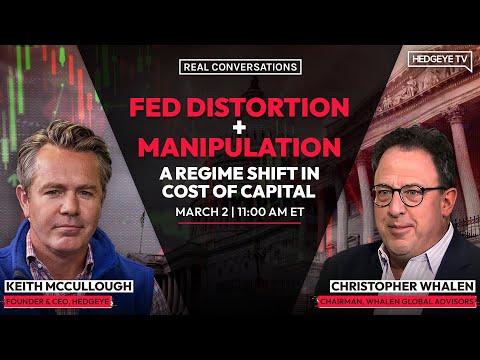
Real Conversations | Fed Distortion + Manipulation: Chris Whalen 1-On-1 With Keith McCullough
Introduction
Keith McCollum welcomes Chris Whalen to another real conversation. They discuss the Federal Reserve, credit, and liquidity traps.
The Fed's Dual Mandate
Chris Whalen discusses the Federal Reserve's dual mandate of full employment and price stability.
The Fed's Interventionist Approach
- The Fed has become more interventionist in pursuing its dual mandate.
- The Fed drove rates down by buying large numbers of securities, leading to a term structure of interest rates with a concentrated distribution of coupons.
- This concentration causes stress on the system when the Fed funds target is moved up.
Powell's Liquidity Trap
- Powell created a structural problem that could lead to an underwater situation like the SNL crisis in the 80s.
- U.S banks are sitting on a huge amount of securities with very low coupons that trade in the 70s or low 80s, making them impossible to sell.
- These unrealized losses make these securities difficult to sell if they go underwater.
Open Market Operations
- When open market operations become too involved, they violate Congress' power over market structure.
- The FED chairman should have the courage to go to Congress and say they're out of bullets instead of substituting their own judgment for Congress'.
- Janet Yellen can lecture Congress but Powell cannot.
The Federal Reserve's Mistake
In this section, the speaker discusses how the Federal Reserve's mistake of not considering rate of change can create non-linear moves based on prior illiquidity.
The Federal Reserve's Mistake
- Mortgage securities are most affected by interest rates because their duration changes.
- The FED doesn't consider rate of change and only focuses on levels, which creates a colossal mess of illiquidity.
- A small move in level but a large move in rate of change can create non-linear moves based on prior illiquidity.
- The speaker suggests that the Secretary of the Treasury should be put back on the Federal Reserve board to have someone who understands markets at the table.
Corporate Credit Risk
In this section, the speaker talks about corporate credit risk and how it is going to affect short-term finance.
Corporate Credit Risk
- Short-term finance gets priced off the bottom curve, and it's not a question of if but when there will be idiosyncratic risks for banks that weren't paying attention last year.
- People stopped hedging interest rates and just stayed long equities, leading to full correlation.
- Restoring correlations will lead to a big flip where U.S goes back to premium in swaps and no longer at discount. This indicates that we're headed for a U.S CR credit crisis.
- Credit risk is full-blown with Sovereign included; it's just a matter of cost if one cannot hold onto Jenny May 2 because their cost of funds is now high.
The Impact of Demographics on the Economy
In this section, the speaker discusses how demographics impact the economy and how it is felt at the end of a boom.
Demographics and Economic Impact
- Demographics have an impact on the economy.
- A big firm in Boston has macro strategists who fill out a series of questions every month. For the first time, they were asked about the probability of a U.S credit default.
- Causal factors and emergent properties are already in motion, and you cannot turn them back.
- There is a precise window of clock or market time where all this happens.
The Current State of the US Economy
In this section, the speaker talks about his negative GDP number for Q1 and how it relates to other risks in the US economy.
Risks in the US Economy
- The speaker has a negative GDP number for Q1 while Atlanta Fed's GDP forecast is almost plus three.
- Most of his case is based on cycle risk rather than government or credit risk.
- If people stop getting paid, that's how credit risk gets priced.
- QE was necessary to create new demand when demand disappeared after 2008. However, they didn't have the courage to stop it and got bullied by Congress led by Elizabeth Warren.
Changes in Society Due to COVID
In this section, the speaker talks about changes in society due to COVID and their impact on commercial space defaults.
Changes Due to COVID
- The speaker talks about the changes COVID has made to society and how it will impact commercial space defaults.
- Big guys will walk away from legacy office buildings in large American cities because there's no reason to put more money in.
- The bottom half of people who were already kicked around by COVID will be impacted as Corporate America lightens up, leading to job losses.
- This is social engineering on a planetary scale, yet nobody in Washington has the courage to say that maybe the FED ought to stop doing crazy things.
Inflation and Job Losses
In this section, the speaker talks about inflation and job losses.
Inflation and Job Losses
- Brian deese is like the captain of transitory inflation.
- Losing your job is worse than not having any money.
- 60-day auto delinquencies hit an all-time high. We are reverting to the mean.
Mortgage Industry and Interest Rates
In this section, the speaker discusses the mortgage industry and how interest rates impact it.
Mortgage Industry Capacity
- The mortgage industry had a lot of capacity last year in the mortgage space.
- Many big firms were losing money when they sold mortgages just to get cash balance.
- Low FICO High LTV borrowers were already in double-digit rates before the bond market rally in October.
Impact of Interest Rates on Mortgages
- As we get rid of capacity, mortgage lenders will want to make money today.
- Mortgage rates are going up because people would like to have at least a point difference.
- The difference between debenture rate on the mortgage security and loan is servicing fees.
Credit Risk and Volatility
In this section, the speaker discusses credit risk and volatility in relation to interest rates.
Setting Cost of Capital at a Higher Level
- Setting cost of capital at a level that is vertically higher than it's ever been can lead to rate shock which will become a credit shock.
Impact of Interest Rates on Non-Bank Finance
- The average credit card rate today is over 20% which impacts non-bank finance because they work off spreads.
Volatility and Market Risk
- What the FED has given us much like climate change right is volatility in terms of markets and economy rates that is frankly frightening.
- Banks are trying to replace assets as most big guys turn over 20% of their book every year.
- Banks are calping along and trying to find new loans every month.
Fidelity Cash Plus
In this section, the speaker discusses his big cash positions in his long-only accounts.
Fidelity Cash Plus
- The speaker's biggest cash position is the Fidelity cash plus thing which has a 4.7% yield.
- Transactions are being made inside of the account.
Investing Strategies
In this section, the speaker discusses his investment strategy and portfolio allocation.
Portfolio Allocation
- The speaker has 75% of his portfolio in bank preferred stocks.
- He deliberately got out of all common stocks in his portfolio.
- His portfolio is a barbell strategy with 60% in Nvidia, Chevron, and other stocks and 40% in bank preferred stocks.
- He suggests shopping for income from banks during market sell-offs.
- The speaker recommends restructuring cash flows to put more duration back into private hands.
Collateralized Mortgage Obligations (CMOs)
- CMO is a way of dealing with variable duration risk that you have in mortgages by slicing it vertically instead of horizontally.
- Institutional investors can buy AAA rated front pieces that pay off in three years while insurance companies or hedge funds can buy tasty zero coupon discount pieces for when the FED drops rates.
Asset Allocation
In this section, the speaker talks about asset allocation and how it affects markets.
Asset Allocation
- Investors should consider buying Fidelity's four-and-a-half to five percent payout with no volatility instead of twos fives tens twenty thirties during rising rate environments.
- Typical asset allocation for major Palm Beach families is 20%, 30%, or even 40% in alts (alternative investments).
Federal Reserve's Impact on Markets
- The FED has done damage to markets by messing around with stuff that is none other than everything.
- The FED allowed everyone to invest in alts, which don't move much, leading to a crowded equity-only long trade.
Misallocation of Resources and the Fed's Role
In this section, the speaker discusses how people are being driven into liquid investments and private equity, leading to a misallocation of resources. He also talks about the role of the Fed in creating this situation.
Liquid Alts Portfolio
- People are being driven into liquid investments and private equity, which is leading to a misallocation of resources.
- Fintech companies are borrowing to pay for earlier obligations, such as cashing out their employees' stocks.
- A lot of people who run these companies don't know what's going on but help them by putting them in investments with good returns.
Federal Home Loan Banks
- The Federal Home Loan Banks have hundreds of billions of dollars in low coupon paper that they're sitting on because they have a low cost of funds.
- The Fed needs to do some maturity transformation before investors are forced by GAP to start making decisions about pulling assets out of portfolios designated as healthy and matured.
Central Bank Isolation
- If the Fed takes $10 trillion dollars in notional duration out of the market and then raises target rates, it will have over $20 trillion dollars in effective duration adjusted weight inside its central bank.
- This isolation means there's no pressure or downward pressure on rates on the long end, which is why the curve looks abnormal.
Commercial Real Estate Failures and Biden Administration
In this section, the speaker talks about potential idiosyncratic failures in commercial real estate and how some banks may go down due to mark-to-market. He also discusses the Biden administration's approach to the economy.
Commercial Real Estate
- There may be some idiosyncratic failures in commercial real estate due to mark-to-market.
- Some banks may go down because of mark-to-market.
Biden Administration
- The speaker believes that Joe Biden has picked the wrong person to tell his story on the economy.
- He thinks that if there's an event, a new administration will come in and clean up the mess.
The Risks of Crypto for Financial Professionals
In this section, the speaker discusses the risks associated with crypto for financial professionals and how their actions can impact realtors and consumers.
Risks Associated with Crypto
- Paying more than 1.25 times book value for a bank increases risk.
- American Express is efficient because they turn assets, while Capital One and City are deep discount banks.
- Depositories that got involved in crypto will regret it.
- Signature Bank's involvement in crypto is unconscionable.
Regulatory Perspective on Crypto
- Regulators will call out those who touched crypto in the last few years.
- Brokers like Robin Hood or Interactive Brokers pass through to a third party, so technically it's a fin run matter.
- Regulators have made clear that they don't want Banks being custodians for crypto stuff.
- AML and KYC part of facilitating people on your platform is problematic.
Options Market Manipulation and SEC Regulation
The speaker discusses the potential for manipulation in the options market and the lack of regulation from the SEC. They also discuss recent proposals from Gary Gensler to change best execution rules and registration requirements.
Lack of Regulation in Options Market
- The speaker believes that conspiracy theories about manipulation in the options market may have some truth to them.
- The SEC has not yet regulated payment for order flow, but recent proposals from Gary Gensler suggest changes are coming.
- One proposal would get rid of payment for order flow altogether, which is a major change to best execution rules.
- The proposed changes would force many managers of funds and other entities into finra membership.
Changes to Best Execution Rules
- Gary Gensler is trying to create one virtual auction by changing best execution rules after all these years.
- Dealers will have to expose orders to the outside world before deciding whether they can execute them internally.
- In the past, orders had footprints that allowed others to see when someone was making a bet. With opacity, there may be bad acting according to Democrats on the SEC.
- This rule is significant and could lead to two standards since it's not something that Wall Street needs right now.
Impact on Order Flow
- Order flow has become an important factor in driving down immediate term volatility, which impacts big execution shops.
- Susquehanna has built a great business around options trading and pays close attention to regulatory changes.
Market Manipulation and Sophisticated Players
In this section, the speaker discusses the problem of market manipulation and how it affects investors. He talks about the highly sophisticated players who manipulate emotions on one side and the highly motivated institutional activity on the other side.
The Phenomenon of Market Manipulation
- The speaker talks about how highly sophisticated players know exactly what they are doing in the options market on zero days to expiration or weeklies.
- He mentions that there is explicit manipulation of a bunch of people who never understood Tesla's value, but think it's like a second coming of Jesus Christ.
- The speaker believes that if GameStop phenomenon had not occurred, it would not have been possible without QE.
- He worries about all these phenomena observed over the last three years and says that investors are rightly confused.
Federal Reserve Board and Market Manipulation
- The speaker talks about his experience working at Federal Reserve New York where they manipulated markets very gently but were always careful to make sure nobody noticed.
- He expresses doubt whether Fed could carry off a market manipulation right now because they operate like the post office.
Introduction
The speaker talks about the value of postage in a country with uncertain currency and introduces the topic of US default possibility.
Postage as Valuable Currency
- A century ago, in a country with uncertain currency, postage was actually quite valuable.
- This highlights the importance of understanding the value of different assets in different contexts.
US Default Possibility
- The speaker expresses concern about the possibility of US default due to increasing debt.
- When the cost of debt starts going up, it becomes a big drag on the federal government.
- Most of the debt out there is just being rolled over and not contributing to growth. It's a dead weight.
- Eventually, when the debt gets big enough, countries tend to default on it.
US Debt and Social Security
The speaker discusses how increasing US debt affects social security and proposes solutions for addressing this issue.
Impact on Social Security
- The dead weight of debt will become a big drag on social security.
- Higher taxes may be necessary to address this issue.
- Biden has talked about taking off the cap from social security.
Solutions for Addressing Debt Issue
- Quantitative easing (QE) is an answer to default risk but it's inflationary.
- QE is beneficial for economic growth but also benefits U.S Treasury more than private investors.
- MMT (Modern Monetary Theory) is still under discussion as opposed to practical implementation.
Consequences of Drunken Spending by Congress
The speaker discusses how drunken spending by Congress can lead to negative consequences such as loss of confidence in dollar and eventual default.
Loss of Confidence in Dollar
- The reason that U.S has a negative spread on swamps is because people want to hold dollars.
- If people are convinced not to hold dollars, it can lead to a loss of confidence in the dollar.
- Drunken spending by Congress can eventually convince people to go elsewhere.
Potential Default
- When countries continue to act like drunken spenders, they tend to default on their debt.
- The speaker believes that eventually, people will raise questions about spending and inflation.
Powell's Consistency and DeSantis' Perspective
The speaker discusses Powell's consistency and how DeSantis' perspective may affect his decisions.
Powell's Consistency
- Powell has been consistent in his messaging despite Wall Street's desire for dovishness and QE.
- He is now in the catbird seat looking at a potential DeSantis-like perspective.
DeSantis' Perspective
- The speaker believes that people like DeSantis will raise questions about spending and inflation.
- Americans are starting to figure out what inflation is again.
Refuting the Progressive Economic Model
In this section, the speaker discusses the need to refute the progressive economic model that has governed the Federal Reserve since its creation. He argues that low rates and high growth are possible if federal spending is controlled.
The Need for a New Economic Model
- The current progressive economic model needs to be refuted.
- Low rates and high growth are possible if federal spending is controlled.
- Crowding out is happening, which will impoverish people and lead to homelessness.
- A politician like DeSantis or former Governor Haley is needed to tell this story.
Lack of Leadership in Washington
In this section, the speaker talks about how there has been a lack of leadership in Washington when it comes to money printing. He also discusses how people are afraid to take risks and stand up for something.
Lack of Leadership at the Federal Reserve
- Republicans and Democrats have been the same on money printing.
- Greenspan did not provide any leadership from the FED.
- Yellen was not a leader either.
- Powell tells things occasionally but he's not a leader.
Fear of Taking Risks
- People are afraid to take risks in Washington today.
- Politicians need to be willing to take risks and stand up for something.
A New Political Message
In this section, the speaker talks about what his political message would be if he were a leader. He also discusses the importance of not spending the corn and eating it now.
A New Political Message
- The game is over, and we're going to have a recession just like 1981.
- We need to get rid of all this and focus on a strong dollar.
- We need to level the playing field by issuing less net debt.
- We can have a liberal society that protects all Americans and still be fiscally responsible.
Not Spending the Corn
- Don't spend the corn, don't eat it now.
- Most institutional clients would lose on that trade, but it's necessary for Middle America.
The Strength of the United States
In this section, the speaker talks about how the strength of the United States lies in its private bond market. He also discusses how important it is to count our pennies so that we can expand when necessary.
The Private Bond Market
- The strength of the United States is its private bond market.
- You don't want to mess that up by having the federal government as the biggest borrower in the market every month.
Counting Our Pennies
- We want to have the capacity to expand, which means counting our pennies.
- No further bullet points available.
Wall Street and Government Intervention
In this section, the speaker discusses the impact of government intervention on Wall Street and the private sector's response to COVID-19.
Impact of Government Intervention
- The speaker believes that Wall Street currently prices risk based on government intervention.
- The speaker argues that if the government got out of the way, the country would grow rapidly.
- The speaker questions how to take trillions of dollars out of the system and manage liquidity in money markets.
Private Sector Response to COVID-19
- The speaker attributes the success during COVID-19 to the private sector rather than government intervention.
- A question is asked about whether there are similarities between current market conditions and those leading up to Black Monday in 1987.
Market Volatility and Risk
In this section, the speaker discusses market volatility and risk associated with crowded equity markets.
Crowded Equity Markets
- The speaker notes that all managed strategies are looking for something to buy in crowded equity markets.
- Managers are parked in assets because they don't know where else to go, creating a big risk if ETF sponsors don't stand up.
Market Volatility
- The speaker warns that we have potential for enormous percentage drops due to banks not trading their portfolios under Volcker Rule.
- Performance chasing at start of 1987 created two worst things: NASDAQ best January since 2001 & S&P best January since 1987.
European Banks and Rising Rates
In this section, the speaker discusses the potential impact of rising rates on Europe and European banks.
European Banks
- The speaker notes that European banks' biggest problem is their lack of profitability.
- A question is asked about the potential impact of rising rates on Europe and European banks.
Nim and Asset Spreads
- The speaker explains that NIM is about spreads, not rates in the market.
- The speaker has been opportunistically buying Credit Suisse because they are getting out of the business.
European Banking and Asset Management
In this section, the speaker discusses the state of European banking and suggests that asset management is the only area worth investing in.
Investing in European Banking
- UBS trades at one and a half times books.
- The government takes a lot of the bread and butter financing in Europe.
- Little Niche pre-base and whatnot in Switzerland do asset management.
Middle Market Business
- Deutsche was always having trouble because they tried to be a global bank but didn't have the deposit base at home.
- They didn't have that core Middle Market business to feed them.
- City has consumer business and an okay Capital markets business but they don't have an asset manager.
Goldman Sachs' Future
In this section, the speaker talks about Goldman Sachs' future prospects and suggests that they should combine with a decent sized Regional bank.
Changes Needed for Goldman Sachs
- The speaker thinks that Goldman Sachs will have to make some changes.
- They should have combined voluntarily with a decent sized Regional bank like Key 100 billion dollars in Main Street core deposits.
- The guys at Goldman today are regulated like a broker dealer not so much like a bank.
Culture Clash
- Combining with a big bank would be dramatic as it would be different culture.
- David got the cards he was dealt; he doesn't have much choice.
Universal Banks vs. Asset Management Component
In this section, the speaker discusses how all banks will need to have a big Asset Management component because it provides stability.
Risk Adjusted Returns
- Jamie Dimon's half Securities okay he's running a mutual fund uh hedge fund whatever you want to call it, and then the other half is the bank.
- If he could spin off Chase into credit cards tomorrow would he do it? Yes, because the risk adjusted returns are just not there.
- Wells is pulling back because they've been spanked enough in fines and they just don't want to do it anymore.
Asset Management Component
- All banks will have to have a big Asset Management component because it provides stability.
- Charles Schwab is the seventh largest bank holding company in the United States 600 billion dollars right so all core deposits from advisors and their clients they make mortgage loans to the clients and keep them.
Introduction and Community Building
In this section, Chris Whalen and Keith McCullough introduce themselves and discuss the importance of building a community.
Importance of Community Building
- Chris Whalen emphasizes the importance of having good corroborators in their community.
- They acknowledge that they have a small community but appreciate the people who are part of it.
Conclusion
This section is just music with no relevant content.