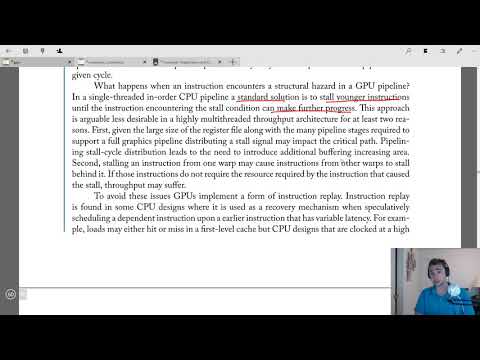
Fundamentals of GPU Architecture: SIMT Core Part 5
Understanding Instruction Replay in GPU Architecture
Introduction to Instruction Replay
- Nick introduces the topic of instruction replay as a method to handle structural hazards in GPU pipelines, setting the stage for a discussion on its significance.
Structural Hazards and Their Impact
- The video discusses various scheduling loops and how instructions are selected from an instruction buffer, emphasizing the complexity of managing register reads without excessive costs.
- It highlights that structural hazards can arise from limited operand collector units during the read stage for registers, which can disrupt pipeline efficiency.
Consequences of Stalling in GPUs
- In traditional CPU pipelines, stalling younger actions is a common solution; however, this approach is less effective for GPUs due to their architecture and performance requirements.
- The large size of register files and multiple pipeline stages mean that distributing stall signals can negatively affect critical paths, impacting graphics quality and frame processing speed.
Buffering Needs During Stalls
- When stalls occur, additional buffering is necessary to prevent data loss during these periods. This requirement increases area usage within the GPU architecture.
Throughput Challenges with Warps
- If one warp causes another warp to stall unnecessarily, it may lead to reduced throughput. This inefficiency underscores the need for better management strategies in GPU operations.
Instruction Replay as a Solution
- Instruction replay is introduced as a strategy used not only in GPUs but also in CPUs for recovery during speculative execution when dealing with variable latency from memory systems.
- Unlike CPUs that utilize speculative execution and branch predictors, GPUs rely on massive multithreading. Thus, instruction replay helps avoid pipeline congestion without wasting energy or resources.
Implementation of Instruction Replay
- The implementation involves holding instructions within an instruction buffer until all parts have executed or completion is confirmed. This ensures that no information is lost while waiting for stalled instructions to proceed.
Conclusion and Further Resources
- Nick concludes by inviting viewers to explore other videos in the series related to GPU microbenchmarking and CUDA programming available on their GitHub page.
Turn any video into a summary like this
YouTube links, meetings, lectures — with transcripts, search, and chat.