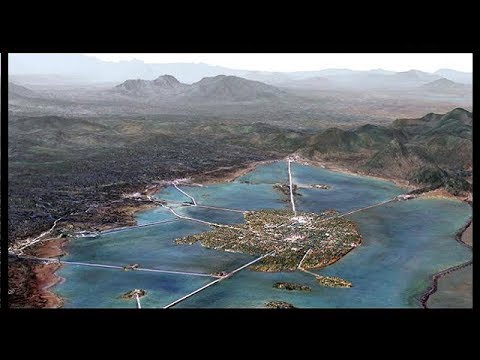
La cuenca de México, documental
The Historical Context of Mexico City
Foundation and Transformation
- Mexico City, currently home to 23 million people, was built on five ancient lakes in a hydrological basin, erasing its historical memory as a lake city.
- The Mexica capital was founded on water but was destroyed by Spanish conquerors who replaced it with a European-style city, leading to the sacred water being treated as an enemy.
Ecological Changes
- Over 400 years, 1,100 square kilometers of water disappeared from the Mexico Basin due to radical ecological transformations.
- The geographical area is surrounded by mountains and volcanoes like Popocatépetl and Iztaccíhuatl; historically, it featured interconnected lakes that separated during dry periods.
Early Settlements and Agricultural Practices
Emergence of Agriculture
- Sedentary communities began forming around the lakes before agriculture emerged; chinampas (floating gardens) were developed for farming along the shores.
- Cuicuilco became a significant cultural center around 800 BCE until its decline due to volcanic eruptions led to migrations that established Teotihuacán.
Cultural Significance of Water
- Mesoamerican civilizations had profound knowledge of water's dual nature as both creator and destroyer, essential for their economic and military strength.
Rise of Tenochtitlán
Mexica Migration
- Guided by Huitzilopochtli, the Mexicas migrated from Aztlán to establish their capital in the Mexico Basin, which resembled their mythical homeland.
- Upon arrival at Coatepec, they settled near abundant resources symbolizing prosperity.
Urban Development
- Tenochtitlán was founded in 1325 using chinampa techniques inherited from earlier cultures; "altepetl" reflects the connection between cities and water.
Religious Practices Related to Water
Deities and Rituals
- Tenochtitlán's Temple Mayor housed deities like Tláloc (god of rain), emphasizing agricultural production's importance through rituals involving offerings for rain.
Human Sacrifice
- Spectacular processions occurred towards sacred mountains where human sacrifices were made to ensure rainfall abundance.
Hydraulic Engineering Innovations
Infrastructure Development
- The Mexicas created an advanced lacustrine culture with extensive hydraulic works including aqueduct systems for potable water supply.
Challenges Faced
- Nezahualcóyotl constructed significant barriers against flooding; however, these efforts sometimes failed against natural disasters leading to severe consequences.
Spanish Conquest Impact
Arrival of Hernán Cortés
- In spring 1519, Hernán Cortés arrived with over 600 soldiers; alliances with local tribes facilitated his conquest against the Mexicas' superior military tactics.
Strategic Warfare
- To weaken Tenochtitlán’s defenses, Cortés cut off access to fresh water while constructing ships for naval battles crucial for capturing the city.
Aftermath of Conquest
Destruction of Indigenous Culture
- Following conquest in 1521, Spaniards demolished indigenous symbols including temples while attempting to erase pre-Hispanic religious practices linked closely with water management.
Urban Planning Changes
The new colonial city faced challenges managing its location atop former Tenochtitlán due to flooding issues exacerbated by poor understanding of local hydrology.
Colonial Urbanization Efforts
- Viceroy Antonio de Mendoza initiated urban planning based on grid patterns while addressing persistent flooding through drainage systems.
Continued Flooding Issues
- Despite efforts such as filling canals or converting them into drains , frequent floods persisted throughout colonial times leading authorities back toward traditional indigenous solutions.
Urban Planning and Water Management in Mexico City
Historical Context of Urban Drainage
- The post-revolution urban planning in Mexico City utilized rivers as drainage systems, with Polanco employing two Welsh-named rivers since the late 1920s.
- By 1930, Mexico City covered 46 square kilometers with a population of 950,000; rapid growth led to severe flooding due to inadequate Porfirio Díaz-era infrastructure.
- A significant flood in July 1950 prompted further urban planning efforts, leading to the entubation of several rivers functioning as drains by 1953.
- The Miguel Alemán Viaduct was constructed to manage wastewater; originally proposed by architect Carlos Contreras in the early 1930s, it became crucial for urban development.
- The concept of using viaducts for wastewater management shaped the growth of modern neighborhoods like Chapultepec and Interlomas.
Development of Deep Drainage Systems
- Construction began on the first stage of a deep drainage system in 1966, aimed at preventing floods; it concluded in 1975 with two major interceptors.
- President Luis Echeverría inaugurated the deep drainage system, emphasizing its importance for flood prevention and efficient wastewater expulsion.
- Originally designed only for rainwater, the deep drainage system faced challenges due to land subsidence affecting its functionality by the early '90s.
- Current operations allow gravity-based sewage discharge through tunnels from Mexico City to nearby rivers, ultimately reaching the Gulf of Mexico.
- The combined drainage system struggles with separating municipal waste from stormwater due to increased urbanization.
Ongoing Infrastructure Challenges
- CONAGUA is constructing a new eastern emitter tunnel—considered one of the largest hydraulic infrastructures globally—to enhance flood management during rainy seasons.
- Maintenance efforts have reinforced existing systems over four years but still face capacity issues amid growing urban demands and climate impacts.
- New projects aim to mitigate flooding risks across various neighborhoods while addressing historical inadequacies in water management infrastructure.
- Despite ongoing improvements, many areas continue experiencing severe flooding due to outdated designs that do not accommodate current population levels or land use changes.
- There is a need for innovative approaches beyond large-scale tunnels; strategies should include water storage solutions at higher elevations.
Societal Implications and Future Directions
- Persistent flooding issues highlight systemic failures within existing infrastructure designed over three decades ago for a much smaller city population.
- Urban expansion has exacerbated runoff problems as previously uninhabited areas are now developed, increasing pressure on drainage systems.
- Significant investments are required for protective measures against flooding; however, relocating entire communities may be more cost-effective than building extensive infrastructure.
- Political and social challenges complicate relocation efforts despite potential benefits from moving vulnerable populations away from high-risk zones.
- The historical legacy of river entubation reflects broader cultural attitudes towards water management that have resulted in lost opportunities for sustainable practices.
Turn any video into a summary like this
YouTube links, meetings, lectures. With transcripts, search, and chat.