Autophagy | Macroautophagy & Importance in Health

Autophagy | Macroautophagy & Importance in Health

Understanding Macroautophagy

What is Autophagy?

  • Autophagy translates to "self-eating," a crucial protein degradation system present in all life forms, alongside the proteasomal degradation pathway.
  • There are three types of autophagy in mammalian cells: macroautophagy, microautophagy, and chaperone-mediated autophagy; this video focuses on macroautophagy.

Importance of Macroautophagy

  • Macroautophagy plays a vital role in cellular waste clearance by recycling nutrients like amino acids, contributing significantly to homeostasis.
  • It is also involved in autophagic cell death and is critical during disease processes.

Types of Macroautophagy

  • Macroautophagy encompasses various processes that utilize autophagosomes for bulk degradation; examples include mitophagy (mitochondria), reticulophagy (endoplasmic reticulum), nucleophagy (nucleus), lipophagy (lipid droplets), and xenophagy (foreign microorganisms).
  • Each type targets specific substrates but follows a similar process involving the formation of an omegasome from the endoplasmic reticulum.

Steps Involved in Macroautophagy

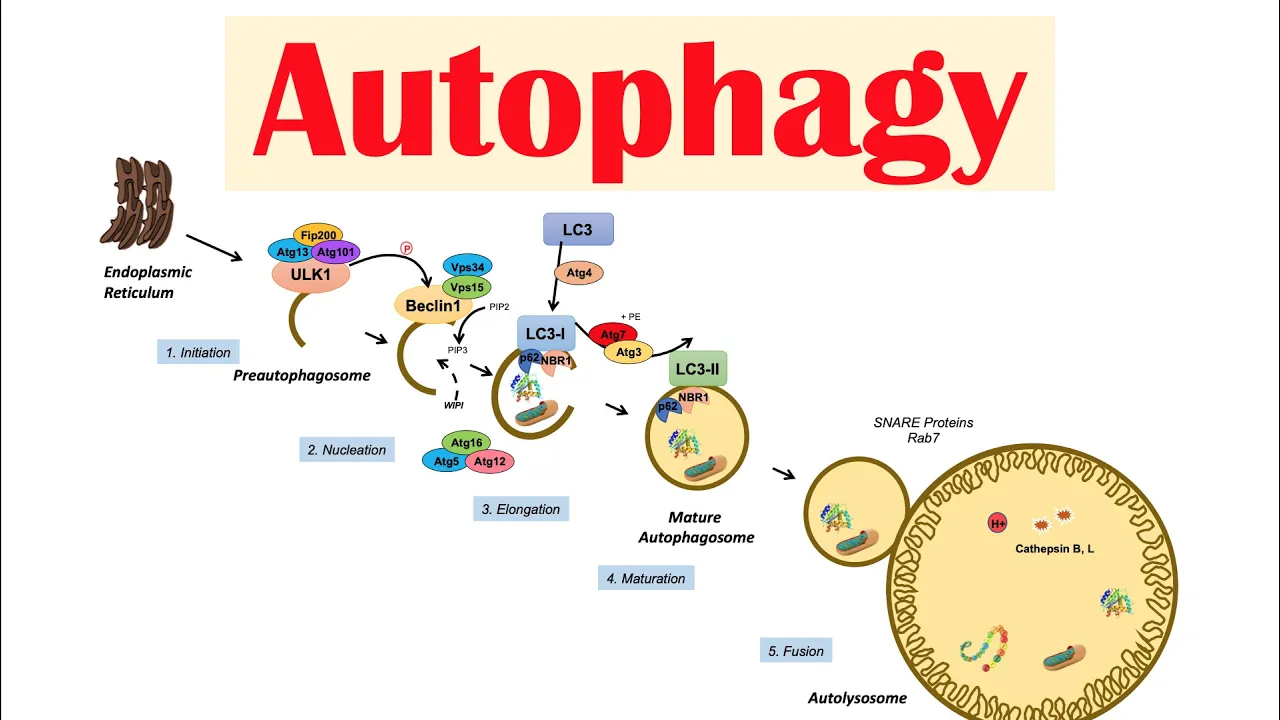
  • The process begins with omegasome formation at the endoplasmic reticulum, requiring a protein complex including ULK1 and ATG13.
  • As the pre-autophagosome develops, another protein complex involving VPS34, VPS15, and Beclin 1 is activated by ULK1 through phosphorylation.

Elongation and Maturation of Autophagosomes

  • Increasing PIP3 concentration recruits WIPI proteins to the pre-autophagosomal membrane, facilitating further recruitment of proteins like P62 and NBR1 for substrate targeting.
  • LC3-I converts to LC3-II through cleavage by ATG4; this conversion is essential for forming mature autolysosomes that fuse with lysosomes for degradation.

Fusion with Lysosomes

  • Once matured, autolysosomes fuse with lysosomes via SNARE proteins and Rab7; contents are then degraded by lysosomal proteases such as cathepsins B and L.

Regulation of Macroautophagy

Key Regulatory Mechanisms

  • AMPK activates ULK1 while mTOR inhibits it; BCL2 can bind Beclin 1 to inhibit its function as well.
  • At the lysosomal interface, V ATPase senses amino acid levels which influence mTOR activity through rag proteins.

Role of TFEB in Autophagic Regulation

  • TFEB acts as a master regulator for lysosomal biogenesis; when not phosphorylated by mTOR, it promotes transcription of genes involved in autophagic pathways.

Summary Insights on Macroautphogy

Main Points about Macroautopahgy

  • Growth factors inhibit macroautphogy via mTOR activation while starvation or cellular stress upregulates it.
  • Upregulated macroautphogy recycles nutrients essential for homeostasis and removes damaged organelles or misfolded proteins.

Turn any video into a summary like this

YouTube links, meetings, lectures. With transcripts, search, and chat.

Video description

Macroautophagy: Steps, Regulation, and Importance in Health Hey guys! In this lesson, you will learn about the macroautophagy pathway, how the pathway is initiated, how the pathway operates, what regulates the pathway and why the pathway is important in human health. You will also learn how different types of pharmaceutical drugs act to inhibit or activate the macroautophagy pathway. Thanks for watching! Please like and subscribe if you found this lesson helpful :) *Subscribe for more free medical lessons* https://www.youtube.com/channel/UCFPvnkCZbHfBvV8ApBBE0vA?sub_confirmation=1 Try Audible and Get A Free Audiobook https://www.amazon.com/dp/B00NB86OYE/?_encoding=UTF8&ref_=sv_adbl_subnav_ref1_1 ----------------------------------------------------------------------------------------------------------- *Check Out Some of My Other Lessons* To learn the Basics of Medical Terminology, please check out this lesson: https://www.youtube.com/watch?v=04Wh2E9oNug To learn how Fasting and Starvation Regulate Macroautophagy, please check out this lesson: https://www.youtube.com/watch?v=RY6SrG_umI4 For more information on Chaperone-mediated autophagy (CMA), please check out this lesson: https://www.youtube.com/watch?v=M5kr1W8sWV0 For an in-depth review of the mTOR signaling pathway, please check out this lesson: https://www.youtube.com/watch?v=-2pXbSpDPQE For an introduction to the Insulin Signaling Pathway, please check out this lesson: https://www.youtube.com/watch?v=Dmnrz7ylH_o To learn about the Pentose Phosphate Pathway, check out this lesson: https://www.youtube.com/watch?v=bgu3_WJY62w Lesson on Iron Absorption, Metabolism and Transport:https://www.youtube.com/watch?v=498haH-rMVg Lesson on Vitamin D and Calcium Absorption: https://www.youtube.com/watch?v=YEnxruA-bsk Lesson on Glucose Transporters (GLUT and SGLT transporters):https://www.youtube.com/watch?v=DzN0geHb86I Lesson on the Ras Raf MEK ERK Pathway: https://www.youtube.com/watch?v=i1f2RbogiDw Lesson on AMPK Signaling Pathway: https://www.youtube.com/watch?v=4G56m9fyNWY Lesson on AKT Signaling Pathway: https://www.youtube.com/watch?v=W3ZASYwqjNc Lesson on the Gluconeogenesis Pathway: https://www.youtube.com/watch?v=2dmr3-kJu_M Lesson on the Fatty Acid Synthesis Pathway: https://www.youtube.com/watch?v=WuQS_LpNMzo Lesson on Branched Chain Amino Acid Metabolism: https://www.youtube.com/watch?v=PO6fBr9HlZo Lesson on Wnt/B Catenin Signaling Pathway: https://www.youtube.com/watch?v=NGVP4J9jpgs Lesson on Cholesterol Synthesis Pathway: https://www.youtube.com/watch?v=3utYm3ouzaU Lesson on Fructose Metabolism: https://www.youtube.com/watch?v=yHmAARLd4yE Lesson on Hemolytic Anemia: https://www.youtube.com/watch?v=7rnWYmJ0SZA Lesson on NOTCH Signaling Pathway: https://www.youtube.com/edit?o=U&video_id=Pm35bSqlh6c Lesson on the Cori Cycle and Lactic Acid Metabolism: https://www.youtube.com/watch?v=M0y7aGCFv0Q Lesson on the Catecholamine Biosynthesis Pathway: https://www.youtube.com/watch?v=yuMP6lQ-Ueo Lesson on the Glucose-Alanine Cycle (Cahill Cycle): https://www.youtube.com/edit?o=U&video_id=7WPnvub1kEM Lesson on the Heme Synthesis Pathway: https://www.youtube.com/watch?v=Q_WkjA4ZcjY Lesson on the Pyrimidine Synthesis and Salvage Pathway: https://www.youtube.com/watch?v=mjFDukNpVE4 Lesson on the Purine Synthesis and Salvage Pathway: https://www.youtube.com/watch?v=e2KFVvI8Akk ------------------------------------------------------------------------------------------------------------- For books and more information on these topics https://www.amazon.com/shop/jjmedicine Microphone I use to record these lessons https://www.amazon.com/dp/B00N1YPXW2/?tag=aiponsite-20&linkCode=ic5&ascsubtag=amzn1.idea.1K2H9Z4RF77DB&creativeASIN=B00N1YPXW2&ref=exp_jjmedicine_dp_vv_d Stethoscope I use in my clinical work https://www.amazon.com/dp/B01M0I4KOZ/?tag=aiponsite-20&linkCode=ic5&ascsubtag=amzn1.idea.1K2H9Z4RF77DB&creativeASIN=B01M0I4KOZ&ref=exp_jjmedicine_dp_vv_d Support future lessons and lectures ➜ https://www.patreon.com/jjmedicine Start your own website with BlueHost ➜ https://www.bluehost.com/track/jjmedicine/ Check out the best tool to help grow your YouTube channel (it’s helped me!) https://www.tubebuddy.com/jjmedicine Follow me on Twitter! ➜ https://twitter.com/JJ_Medicine Come join me on Facebook! ➜ https://www.facebook.com/JJ-Medicine-100642648161192/ -------------------------------------------------------------------------------------------------------------