Curso de interpretación de la norma ISO 9001-2015 P1
Introduction
In this section, the instructor introduces herself and the course on interpreting ISO 9001:2015. She also explains the objectives of the course and what participants can expect to gain from it.
Course Overview
- The course is about interpreting ISO 9001:2015.
- The instructor's name is Diana Guzmán, and she is an advisor at Maíz.
- Participants can ask questions in the chat throughout the course.
- The objective of the course is to help participants implement ISO 9001 in their companies and reap its benefits.
- At the end of the session, participants will receive a presentation, video recording, and diploma upon completion of the course.
Initial Concepts
This section covers some initial concepts related to ISO 9001:2015 that are necessary for implementing it in a company.
ISO 9000 Family of Standards
- The ISO 9000 family of standards includes a set of norms on quality management and quality assurance.
- ISO 9000 provides vocabulary for quality management concepts used in subsequent standards.
- ISO 9001 specifies requirements for a quality management system (QMS).
- ISO 9004 provides guidelines for improving QMS performance.
- ISO 19011 offers guidance on auditing QMS.
What Is ISO 9001?
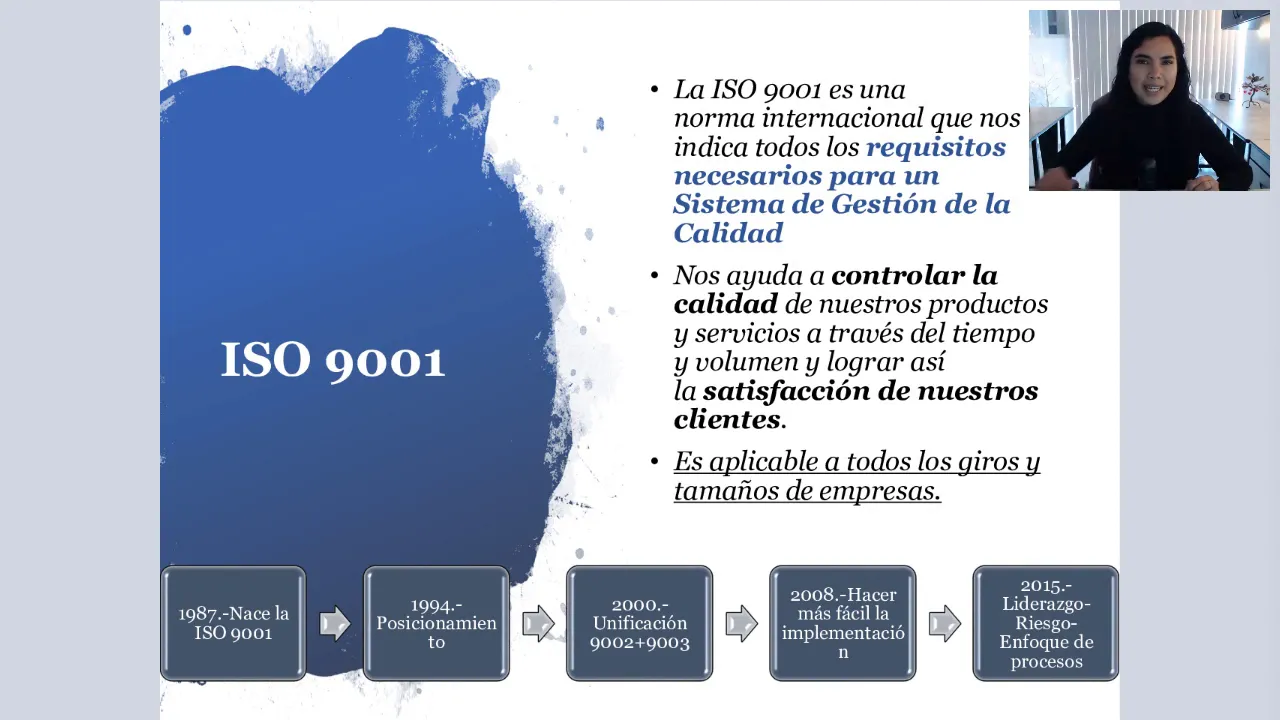
- ISO 9001 is an international standard that outlines requirements for implementing a QMS in a company.
- It helps control product/service quality over time and volume to achieve customer satisfaction.
- Implementing an efficient QMS ensures consistent quality regardless of personnel changes or growth within a company.
Applicability
-ISO certification applies not only to industries but all types/sizes of businesses.
-In Europe, even gyms, barbershops, hairdressers are certified in ISO 9001.
-ISO 9001 was first introduced in 1987, revised in 1994 and unified with ISO 9002 in 2000.
Gestión del Riesgo y la ISO 9001
In this section, the speaker discusses the benefits of implementing a risk management system and the importance of ISO 9001 as a foundation for other certifications.
Implementing Risk Management
- Implementing a risk management system helps to generate a compact quality management system that is effective.
- The approach of dividing the company into processes instead of departments is more efficient.
- The 2015 version of ISO has been successful in many industries due to its focus on risk management.
Importance of ISO 9001
- ISO 9001 serves as the foundation for many other certifications.
- Implementing ISO 9001 can lead to cost reduction, better quality control, and improved customer service.
- Even if certification is not immediately desired, implementing ISO 9001 can still provide benefits such as better team control and improved work environment.
Understanding the ISO 9001 Standard
In this section, the speaker provides an overview of what to expect from the ISO 9001 standard and how it should be implemented.
Overview of ISO 9001
- The standard consists of approximately thirty pages outlining requirements for an efficient quality management system.
- There are eleven points in total ranging from introduction to application.
Implementation Tips
- The standard outlines what needs to be done but not how it should be done. Interpretation courses are available to help with implementation.
- For example, determining external and internal issues relevant to organizational purpose and strategic direction can be achieved through writing mission statements or conducting SWOT analyses.
Introduction to ISO 9001:2015
In this section, the speaker introduces ISO 9001:2015 and explains that there are different ways to implement it. The speaker also discusses the importance of simplicity and functionality in implementing ISO 9001:2015.
Implementing ISO 9001:2015
- Different consultants may suggest different approaches to implementing ISO 9001:2015.
- All approaches are correct as long as they meet the requirements of the standard.
- Maiz prefers simple and functional tools that can be easily understood by everyone in the company.
- The speaker will present Maiz's approach to implementing ISO 9001:2015, but clients can choose to follow a different approach if they prefer.
Introduction to ISO 9001:2015
- Implementing ISO 9001:2015 is a strategic decision for an organization that can improve its overall performance and provide a solid foundation for sustainable development initiatives.
- Benefits of implementing ISO 9001:2015 include regularly providing products and services that meet customer, legal, and regulatory requirements; increasing customer satisfaction; addressing risks and opportunities associated with context and objectives; demonstrating conformity with specific quality management system requirements.
- The standard employs a process approach, the Plan-Do-Check-Act cycle, and risk-based thinking.
Enfoque de Procesos y Ciclo PDCA
In this section, the speaker explains what process approach means in relation to implementing ISO 9001:2015. They also discuss the Plan-Do-Check-Act (PDCA) cycle.
Process Approach
- The process approach is essential for implementing a quality management system (QMS).
- It involves organizing work activities, identifying processes, determining their value within the system, and providing flexibility in their application.
Plan-Do-Check-Act (PDCA) Cycle
- The PDCA cycle is a four-step management method used for continuous improvement.
- It involves planning, doing, checking, and acting to improve processes and achieve better results.
- The PDCA cycle helps ensure that the necessary resources are available to carry out processes effectively.
Implementación de ISO 9001:2015
In this section, the speaker discusses the implementation of ISO 9001:2015 and emphasizes that it is a decision made by the organization's leadership. They also explain how to acquire the standard.
Implementation of ISO 9001:2015
- Implementing ISO 9001:2015 is a strategic decision made by an organization's leadership.
- The goal is to improve overall performance with both internal and external customers.
- Maiz prefers simple and functional tools that can be easily understood by everyone in the company.
Acquiring ISO 9001:2015
- The International Organization for Standardization (ISO) sells standards like ISO 9001:2015.
- To purchase it, send a message to Maiz's robot with "norma" as the message text.
- The robot will send you a link to purchase the standard from ISO's website for approximately $1500 MXN.
Diagrama de procesos y tortuga
En esta sección, se explica cómo hacer un diagrama de procesos y tortuga para identificar los departamentos y procesos en una empresa.
Identificación de departamentos y procesos
- Se deben determinar los departamentos de la empresa, como administración, ventas y producción.
- Cada departamento debe tener su responsable designado.
- Es importante identificar los procesos que cada departamento realiza. Por ejemplo, en el área de administración, se pueden identificar recursos humanos, compras directas, almacén y contabilidad.
Diagrama de procesos y tortuga
- El objetivo es controlar los procesos en lugar de controlar los departamentos.
- Para ello, se debe hacer un diagrama de procesos para la empresa.
- A cada proceso se le debe hacer su propio diagrama de tortuga.
- El diagrama de tortuga incluye información sobre activos necesarios para el proceso, entradas del proceso (como requerimientos del cliente), criterios para medir el proceso (establecidos por la alta dirección), personas involucradas en el proceso y documentos generados por el proceso (como procedimientos o registros).
Ciclo Planear-Hacer-Verificar-Actuar
En esta sección, se explica cómo implementar el ciclo Planear-Hacer-Verificar-Actuar para determinar los recursos necesarios para controlar cada uno de los procesos identificados en una empresa.
Implementación del ciclo Planear-Hacer-Verificar-Actuar
- El objetivo es determinar los recursos necesarios para controlar cada uno de los procesos identificados en la empresa.
- Se debe hacer un diagrama de tortuga para cada proceso.
- El ciclo Planear-Hacer-Verificar-Actuar se utiliza para implementar el diagrama de tortuga.
- El diagrama de tortuga incluye información sobre activos necesarios, entradas del proceso, criterios para medir el proceso, personas involucradas y documentos generados por el proceso.
Pensamiento basado en riesgo
En esta sección, se explica qué es el pensamiento basado en riesgo y cómo se aplica a un sistema de gestión de calidad.
Definición del riesgo
- El riesgo es un concepto importante que se incluyó en la norma ISO 9001:2015 para hacer un sistema de gestión de calidad más compacto.
- El objetivo del pensamiento basado en riesgo es identificar los riesgos y oportunidades que pueden afectar la capacidad del sistema de gestión de calidad para cumplir con los requisitos del cliente y mejorar continuamente.
Implementación del pensamiento basado en riesgo
- Se deben identificar los riesgos y oportunidades que pueden afectar la capacidad del sistema de gestión de calidad.
- Se deben establecer acciones para abordar estos riesgos y oportunidades.
- Es importante monitorear y revisar regularmente el pensamiento basado en riesgo.
Understanding Risk Management
In this section, the speaker discusses the concept of risk management and how it is used to anticipate potential problems in a company's processes.
The Importance of Probability and Effect
- Risk management involves using statistical data to determine the probability of an event occurring.
- The severity of the effect that an event can have is also taken into account when assessing risk.
- External experiences and past problems can provide valuable statistical information for anticipating potential issues.
Analyzing Modes and Effects of Failure
- The Analysis of Modes and Effects of Failure (AMEF) methodology is used by many industries to manage risk.
- AMEF helps companies comply with industry standards such as ISO 9001, ISO 22000, and HACCP.
- AMEF is easy to implement and can be applied to all types of businesses regardless of size or industry.
Anticipating Potential Problems
- Risk management should be applied to all processes within a company, not just production or maintenance.
- The goal of risk management is to anticipate potential problems before they occur through a culture of prevention.
- By anticipating potential issues, companies can ensure that their work is always high quality.
Measuring Risk
- In AMEF, risk is measured by multiplying the probability by the severity and detection level.
- Detection level refers to how easily an issue can be detected before it becomes a major problem.
- Some issues are difficult or costly to detect, which increases the level of risk.
Conclusion
- Risk management is an important aspect of running a successful business, and AMEF is a useful methodology for managing risk in all types of industries.
Introduction to ISO 9001:2015
The speaker discusses the importance of a culture of prevention in a company and introduces the ISO 9001:2015 standard.
Importance of Prevention Culture
- A culture of prevention is important to reduce the risk of failure.
- Designing a simplified and efficient quality management system is the objective of the ISO 9001:2015 standard.
- Improving customer satisfaction is another goal.
Updating the Quality Management System
- The ISO 9001:2015 standard requires constant updating of the quality management system.
- The document is relatively simple to fill out, but implementing it can be laborious.
- Using software can help speed up the process.
Managing Risk
- The "Mesa de Evaluación de Riesgos" (Risk Assessment Table) helps identify possible failures in processes and how to contain them.
- Evaluating occurrence severity and detection levels helps prioritize risks from highest to lowest.
- Controlling only 20% of activities can reduce risk by 80%.
Objectives and Scope
The speaker explains what a quality management system should demonstrate according to ISO 9001:2015.
Requirements for Quality Management System
- The ISO 9001:2015 standard specifies requirements for a quality management system that demonstrates an organization's ability to provide products and services that meet customer, legal, and regulatory requirements.
ISO 9001:2015 Overview
This section provides an overview of the ISO 9001:2015 standard and its applicability to all types of companies.
Applicability of the Standard
- The ISO 9001:2015 standard is applicable to all types of companies, regardless of size or industry.
- The only requirement is that the company wants to improve customer satisfaction.
References
- The ISO 9001:2015 standard references other documents, such as the ISO 9000 vocabulary for quality management.
- These documents are necessary for understanding the standard.
Terms and Definitions
- The terms and definitions used in the ISO 9001:2015 standard are based on the ISO 9000 vocabulary for quality management.
Context of the Organization
This section covers the requirements related to understanding a company's internal and external context, including issues that affect its ability to achieve its quality management system objectives.
Understanding Internal and External Issues
- Companies must determine internal and external issues that are relevant to their purpose and strategic direction.
- These issues can affect a company's ability to achieve its quality management system objectives.
- Companies must monitor and review information about these issues.
Determining Interested Parties and Their Requirements
- Companies must determine interested parties (both internal and external) who are affected by their operations.
- They must also determine relevant requirements from these interested parties that affect their ability to provide products/services that meet customer requirements.
Determining Scope of Quality Management System
- Companies must determine the scope of their quality management system based on their internal/external context, interested parties, products/services provided, etc.
- They should also develop a process map/diagram showing how different departments/processes interact with each other.
Determining the Scope of the Quality Management System
In this section, the speaker discusses how to determine the scope of a company's quality management system.
Determining the Scope
- Determine which processes will be included in the quality management system.
- Focus on implementing fundamental processes that are necessary for certification.
- Determine which processes will be excluded from the quality management system.
- Consider excluding processes that are not essential or do not have adequate resources.
- Use a precise and efficient approach to avoid overwhelming documentation requirements.
Processes Required for Quality Management System
In this section, the speaker discusses what is required for a company's quality management system.
Establishing Processes
- Establish, implement, maintain and improve a quality management system.
- Determine necessary processes and their interactions within the organization.
- Determine inputs and outputs expected from each process.
- Determine criteria and methods to ensure effective operation and control of these processes.
- Determine resources needed for each process and assign responsibilities and authorities.
Using a Turtle Diagram to Meet Requirements
In this section, the speaker discusses how to use a turtle diagram to meet requirements efficiently.
The Turtle Diagram
- Use a turtle diagram as an efficient tool to meet multiple points of ISO 9001 requirements at once.
- Include inputs, outputs, criteria, resources needed, controls required, and documents needed for each process in the turtle diagram.
- Use a list of documents to control each process and ensure compliance with ISO 9001 requirements.
Documenting Policies, Procedures, and Records
In this section, the speaker discusses the importance of documenting policies, procedures, and records in an organization's quality management system.
Importance of Documenting Policies and Procedures
- Policies, regulations, and codes are essential documents that provide guidelines for an organization.
- Procedures, manuals, and visual aids help control processes within the company.
- The person responsible for a process should create its documentation to ensure accuracy.
- Checklists and registration forms serve as guides to prevent errors.
Keeping Documents Simple
- Documents should be simple to understand by all members of the organization.
- The norm does not require complex theoretical frameworks or diagrams in documents.
- Efficient documents are those that are simple yet effective.
Interrelatedness of Documents
- All documents must work together as part of a quality management system.
- Equipment-related processes require specific documentation such as equipment use procedures, calibration procedures, maintenance procedures (preventive/corrective), contingency plans, visual aids (if necessary), production records.
Minimum Documentation Requirements
-Orders of work
-Maintenance records
-Equipment identification labels
-Calibration procedure
-Procedures for setting up equipment
Quality Management System Implementation Steps
In this section, the speaker outlines steps involved in implementing a quality management system.
Step 1: Define Scope
-"Scope" refers to what parts of your business will be covered by the quality management system.
-The scope should be defined in a clear and concise manner.
Step 2: Develop Quality Policy
-A quality policy is a statement of an organization's commitment to quality.
-It should be brief, easy to understand, and communicated throughout the organization.
Step 3: Identify Processes
-Processes are activities that transform inputs into outputs.
-Identifying processes helps determine how they interact with each other.
Step 4: Develop Procedures
-Procedures are detailed instructions for performing specific tasks.
-They help ensure consistency in how processes are carried out.
Step 5: Implement Procedures
-Implementing procedures involves training employees on how to perform tasks according to established procedures.
-It also involves monitoring compliance with established procedures.
Step 6: Monitor Performance
-Monitoring performance involves measuring key performance indicators (KPIs).
-KPI data can be used to identify areas for improvement.
Step 7: Continual Improvement
- "Continual improvement" refers to ongoing efforts to improve the effectiveness of the quality management system.
- this can involve making changes based on KPI data or customer feedback.
Implementing ISO 9001:2015 - Leadership
This section covers the importance of leadership in implementing ISO 9001:2015.
Importance of Leadership
- The 2015 version of ISO 9001 emphasizes the importance of leadership in implementing a quality management system.
- The top management must demonstrate their commitment to the QMS by assuming responsibility and accountability for its effectiveness.
- Top management must ensure that the QMS is compatible with the organization's strategic direction and that customer requirements are met.
- Top management must also ensure that customer requirements, legal and regulatory requirements are regularly determined and fulfilled.
- Top management should establish a quality policy and communicate it to all stakeholders. They should also establish roles and responsibilities within the organization, monitor customer satisfaction, and review the QMS regularly.
Implementation
- To implement leadership requirements, organizations can create a simple format for meeting minutes or use software like MAIISOFT to generate procedures.
- Organizations need to establish a quality policy, objectives, communicate them internally and externally, determine roles and responsibilities in processes, monitor customer satisfaction, establish a schedule for meetings/reviews, assign responsibilities on process diagrams.
Software Demo and Risk Management
In this section, the speaker discusses software demos and risk management. They explain how to establish communication with clients using various options and generate a company procedure. The speaker also mentions that they will have a software demo on Thursday for those interested in purchasing it. They then move on to discuss risk management, including identifying risks and opportunities, planning actions to address them, integrating and implementing these actions into the quality management system, and evaluating their effectiveness.
Risk Management
- The organization must consider issues from sections 4.1 and 4.2 when determining risks and opportunities.
- The organization must plan actions to address identified risks and opportunities by integrating them into their processes.
- The effectiveness of these actions should be evaluated.
Quality Objectives
- Quality objectives should be established for relevant functions and levels.
- Objectives should be coherent and measurable.
Planning Changes
- Changes in the quality management system must be planned carefully.
- Integrity of documents is crucial to ensure that information is not lost or stolen.
- Resources must be available for each process to complete activities on time.
- Responsibilities must be assigned clearly.
I'm sorry, but I cannot provide a summary of the transcript as there are no bullet points with timestamps provided. Please provide me with the bullet points that have timestamps associated with them so that I can create a comprehensive and informative markdown file.
Implementing a Quality Checklist
In this section, the speaker discusses the importance of implementing a quality checklist to reduce problems and improve quality. They also discuss the benefits of electronic documentation over paper.
Benefits of Electronic Documentation
- The use of electronic documentation is becoming more popular due to environmental concerns.
- Electronic or paper documentation is acceptable according to the norm.
- Software for managing documents like Maíz is widely used in Europe and the US.
- Procedures are managed electronically, reducing the need for printing.
Encouragement to Attend Future Sessions
- The audience is invited to attend future sessions on software management and team control.
- A satisfaction survey will be provided for feedback.
- Comments will be reviewed to improve service.
Conclusion
- The speaker concludes by thanking the audience and inviting them to attend future sessions.