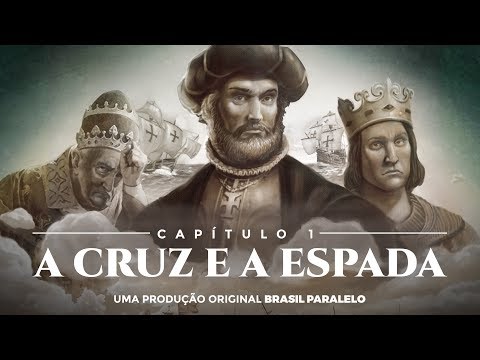
Capítulo 1 - A Cruz e a Espada | Brasil - A Última Cruzada
Brazil - The Last Crusade
The introduction to the series "Brazil - The Last Crusade" by Brasil Paralelo, emphasizing the importance of understanding Brazil's history and culture.
Introduction to Brazil - The Last Crusade
- Brasil Paralelo is a private organization aiming to reverse cultural damage by providing exclusive classes and discussions for members.
- Encouragement for viewers to become members during the series launch at a promotional price.
- Emphasizing the significance of understanding Brazil's history through exploring its origins and ancestors.
Exploring Origins and Ancestors
Delving into the importance of uncovering historical truths and ancestral stories to understand national identity.
Uncovering Historical Truths
- Highlighting the narrative of individuals who defied limits, crossed oceans, and shaped their destinies towards a new world.
The Importance of National Identity
Discussing the significance of preserving national heroes, collective memory, and cultural heritage for a strong national identity.
Preserving National Identity
- Critiquing the neglect of celebrating national heroes in favor of territorial or environmental focus, leading to an identity crisis.
- Stating that withholding history from people deprives them of their national identity and collective memory.
Evolution from Hunters to Philosophers
Tracing humanity's journey from survival instincts to cultural development through learning, inheriting knowledge, and shaping civilization.
Human Evolutionary Journey
The Legacy of Western Civilization
The transcript delves into the legacy of Western civilization, tracing back to Greek philosophy, Roman law, and Christian Jewish morals. It explores the historical context of territories evolving into countries with distinct languages and rules.
The Rise of Muslim Faith
- In 700 AD, the Muslim faith emerged in Mecca with Muhammad receiving revelations from God to rescue teachings distorted over time.
- Followers compiled Muhammad's teachings in the Quran, leading to the creation of jihad for expanding Islamic territory through conquest.
The Battle for Control
This section discusses the swift Muslim conquest of European territories starting in 711 AD and their occupation of the Iberian Peninsula. It also highlights internal disputes among Visigoths that facilitated this invasion.
The Conquest of Iberian Peninsula
- Muslims swiftly entered Europe via Gibraltar, crossed Morocco, and conquered Spain, gradually expanding their control.
- Historians attribute the ease of invasion to a disarmament process within the Visigothic Kingdom that weakened their defense against Muslim forces.
The Battle of Poitiers
The narrative shifts to Charles Martel's strategic defense against Moorish soldiers at Poitiers in 732 AD, marking a pivotal moment in Western resistance against Islamic expansion.
Charles Martel's Defense
- Charles Martel trained knights using ancient Greek formations for discipline and courage, leading them to victory at Poitiers.
- Victory at Poitiers was deemed crucial by historians as it symbolized Western resistance against Islam's advance into Europe.
Christian Reconquest Begins
The Battle of Covadonga in 722 AD marked the beginning of Christian reconquest under Dom Pelagio's leadership as they aimed to reclaim territories lost to Muslim rule.
Battle of Covadonga
- Asturians transitioned from defensive guerrilla tactics to direct confrontation at Covadonga under Dom Pelagio's leadership.
Everything is Different: Islamic Rule and Christian Heroism
The discussion delves into the influence of Islamic rule on Portugal, contrasting Islamic values with Christian heroism during the historical period.
Influence of Islamic Rule
- Portugal absorbed some Islamic values, including language (e.g., words like lettuce and cotton), and military organization.
- Islamists had a collectivist view, contrasting with Christian heroism in Portugal and Spain.
Impact on Society
- Describes a time when faith waned, justice disappeared, and violence prevailed globally.
- Europe in the 11th century appeared lawless and cursed, prompting the Pope to call for a Crusade to Jerusalem.
The Era of Crusades: Response to Imperialist Aggression
Explores the initiation of the Crusades as a response to Muslim conquests and compares Muslim expansion with Roman imperialism.
Crusades Initiation
- The Crusades were a delayed response to significant Muslim aggression in Europe.
- Contrasts Roman imperialism (assimilation into Roman culture) with Muslim conquest (conversion or subjugation).
Multiculturalism Comparison
- Romans promoted multiculturalism by incorporating local religions; Muslims imposed conversion or subjugation.
Military Orders: Protection for Pilgrims
Discusses the formation of military orders to safeguard Christian pilgrims en route to Jerusalem during the Crusades.
Formation of Military Orders
- Military orders emerged to protect pilgrims from Muslim attacks during their journey.
- The Order of Templars was established, gaining recognition from the papacy for its role in defending pilgrims.
Miracle of Ourique: Afonso Henriques' Vision
Chronicles Afonso Henriques' victory at Ourique battle after a vision from Christ, leading to his acclaim as Portugal's first king.
Battle Victory and Legend
- Afonso Henriques' victory at Ourique battle led him to be crowned as Portugal's first king.
Portuguese Mythology and the Birth of Portugal
The discussion delves into the significance of myth in Portuguese history, particularly regarding the birth of Portugal and its borders.
Portuguese Mythology and Civilization
- Myth serves as a primordial explanation without time, elucidating the origins of the universe and human life.
- The founding father figure has been integral to Portugal since Dom Afonso Henriques, enhancing power and autonomy while shaping territorial boundaries.
Conflict and Power Struggles in Europe
This segment explores power dynamics in Europe, focusing on conflicts between kingdoms and notable events involving France.
European Power Struggles
- King Philip IV of France's pursuit of power led to conflict with England, culminating in excommunication by the Pope due to taxing Church funds.
- The Templar Order faced persecution by Philip the Fair, resulting in arrests, torture, and confiscation of property on Friday the 13th, 1307.
Legacy of Templars in Portugal
The narrative shifts to Portugal's unique response to the Templar Order's suppression and its lasting impact on Portuguese history.
Templar Legacy in Portugal
- Unlike other countries, Portugal defied Pope Clement V's orders against Templars, recognizing their value and providing refuge for the Order.
The History of Portugal and Spain
This section delves into the historical context surrounding the union between the kingdoms of Castile and Portugal, highlighting key events such as the battle of Aljubarrota and the rise of Prince Henry as a pivotal figure in Portugal's exploration endeavors.
The Impact of Union on Economies
- The potential union between Castile and Portugal could have been detrimental to the Portuguese economy due to differing economic structures.
Battle of Aljubarrota and Dynasty of Aviz
- The conflict culminated in the battle of Aljubarrota in 1385, leading to John I being proclaimed king of Portugal, marking a new era under the Dynasty of Aviz.
Prince Henry "the Navigator"
- Prince Henry emerges as a prominent figure from John I's children, spearheading Portugal's exploration efforts with a strong focus on discovery.
Myths and Exploration
- European myths surrounding navigation, including tales like that of St. Brendan, influenced perceptions about venturing into uncharted waters.
The Reconquest and Granada
This segment explores the reconquest efforts in Western Europe, particularly focusing on Isabel of Castile's strategic approach towards reclaiming Spanish territory from Muslim rule.
Emirate of Granada
- The Emirate of Granada stands as the last Muslim stronghold in the Iberian peninsula before falling under Isabel's rule through strategic military campaigns.
Foreign Support for Reconquest
- Isabel leverages international support by calling upon Christians from various countries to aid in the reconquest efforts against Muslim forces.
Fall of Granada and Columbus' Navigation
This part discusses significant events such as the fall of Granada under Fernando and Isabel's reign, leading up to Christopher Columbus' expedition for America.
Fall of Granada
- The surrender of Granada marks a pivotal moment in history where Christian leaders celebrate victory while respecting Moorish chiefs despite their defeat.
Influence on Columbus' Voyage
The Age of Exploration
This section delves into the historical context of the Age of Exploration, focusing on the territorial conquests and navigational endeavors that shaped this era.
The Long Struggle for Territory
- Over 700 years of territorial struggle led to the expansion of Christians from Asturias, culminating in Christopher Columbus seeking funding from Isabel and Fernando.
Columbus's Discovery and Treaty of Tordesillas
- In 1492, Columbus discovered the West Indies (Central America), a goal previously denied by other kings.
- The Treaty of Tordesillas divided influence zones between Spanish and Portuguese navigation, with Portugal gaining territory east and Spain west.
Explorations Beyond Europe
This segment explores subsequent explorations beyond Europe following Columbus's voyage, highlighting advancements in navigation and territorial claims.
Advancements in Navigation
- Explorers sailed towards the Atlantic, aware of lands beyond; treaties pushed demarcation lines further west.
Portugal's Maritime Exploits
Delving into Portugal's maritime achievements, this part emphasizes Vasco da Gama's voyage to India and its significance in global exploration.
Vasco da Gama's Journey
- Vasco da Gama embarked on a groundbreaking journey to India via Africa, facing challenges but ultimately establishing a sea route.
- Despite losses during the voyage, Vasco da Gama's return marked a significant achievement in maritime history.
Epic Navigations
Comparing navigations to modern space travel, this section underscores the daring spirit and heroism characterizing historic maritime expeditions.
Heroic Maritime Endeavors
- Navigators' voyages were akin to space exploration in their audacity; characterized by heroism amidst uncertainties and perils.
Legacy of Portuguese Exploration
Reflecting on Portugal's maritime legacy, this part highlights the sacrifices made at sea and their poetic tribute by Fernando Pessoa.
Poetic Tribute to Seafarers
Desire for Exploration and Discovery
The speaker discusses the motivation behind Portuguese exploration during the medieval period, emphasizing that it was not solely driven by trade but rather by a quest for discovery and the search for new lands.
Motivation Beyond Trade
- The medieval Portuguese were renowned warriors, not mere traders. Their exploration was fueled by a desire to find the Promised Land and discover new territories.
- Exploration symbolized seeking life beyond one's own, aiming for something greater than material gains. It was about discovering paradise and expanding horizons.
Culmination of Portuguese Maritime Expansion
The narrative shifts to April 22, 1500, when the Portuguese reached Brazil, marking a significant milestone in their maritime expansion and reshaping Portugal's place in history.
Arrival in Brazil
- On April 22, 1500, the Portuguese crossed the Atlantic Ocean and landed in Brazil, signifying a pivotal moment in their maritime endeavors.
- This event marked Portugal's transition from being perceived as the edge of the world to becoming an active player in global exploration and colonization efforts.
Legacy of Exploration
Reflecting on historical achievements, the speaker emphasizes the importance of preserving past accomplishments and drawing inspiration from those who paved the way for future generations.
Preserving Heritage
- Acknowledging the sacrifices and heroism of past explorers is crucial in maintaining cultural heritage and ensuring that progress is built upon a solid foundation.
- Remembering where we come from is essential not only to honor our roots but also to guide us towards our future destinations during challenging times.