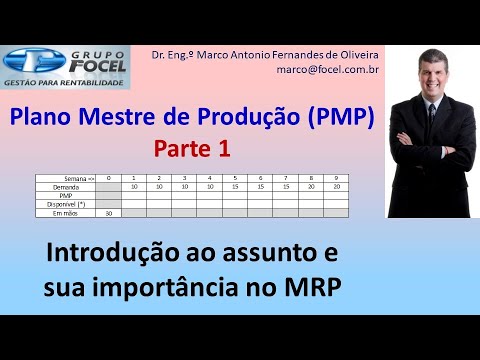
Plano mestre de produção 1/8 - Introdução e importância
New Section
In this section, the speaker introduces the topic of production planning and control, focusing on the master production schedule as a key element governing the entire process. The nature of planning and control is discussed in relation to balancing demand and supply.
Understanding Demand and Supply
- The speaker emphasizes the need to balance demand, dictated by the market, with supply, controlled by production. The goal of planning and control is to ensure competence in responding to demand effectively.
- Three critical aspects of demand are highlighted: deadlines, quantities/volumes, and quality. Quality will be further explored in a separate module on quality management.
Dependent vs. Independent Demand
- A distinction is made between dependent and independent demand using examples of supplying tires to an automaker (dependent) versus individual consumers (independent).
- Dependent demand is predictable based on production quantities (e.g., number of cars), while independent demand fluctuates unpredictably based on consumer needs.
New Section
This section delves into four essential activities within planning and control: scheduling, loading, sequencing, and controlling operations.
Activities in Planning and Control
- Scheduling involves determining when to produce based on two approaches: pull production (on-demand like à la carte restaurants) or push production (anticipatory like buffet restaurants).
- Loading refers to deciding how much to produce; it can be finite (e.g., airline seats limited by capacity) or infinite (e.g., hospital beds accepting all patients).
Sequencing Operations
- Sequencing determines the order of production; two common methods are FIFO (first in, first out) and LIFO (last in, first out), akin to elevator passengers exiting.
Control Mechanisms
- Controlling ensures activities align with plans. An example using Gantt charts illustrates monitoring progress over a seven-day period.
New Section
In this section, the speaker discusses production planning using a furniture factory as an example. They explain the progress of different tasks and the significance of visual representations like Gantt charts.
Production Planning in a Furniture Factory
- The speaker uses a Gantt chart to illustrate production progress in a furniture factory.
- Tasks are color-coded, with green indicating completed work and empty spaces representing pending tasks.
- Different items such as tables, kitchen units, and beds are tracked for completion within specific timeframes.
- The importance of monitoring task completion daily is emphasized through visual representations like Gantt charts.
- The speaker highlights the significance of staying on schedule to avoid delays in production.
New Section
This part delves into Material Requirements Planning (MRP) and breaks down the components required for assembling a pen, emphasizing the importance of understanding product structures.
Material Requirements Planning (MRP) and Product Structure
- MRP stands for Material Requirements Planning, focusing on managing material needs efficiently.
- The speaker uses a pen assembly as an example to explain product structure breakdown.
- Components like tube caps, plastic tubes, ink cartridges, and pen tips are essential for pen assembly.
- Understanding product structures involves recognizing parent components (final product) and child components (individual parts).
- Proper assembly ensures the final product meets consumer expectations.
New Section
This segment explores Demand Dependent Systems like MRP that calculate material needs based on sales orders or forecasts to streamline production planning effectively.
Demand Dependent Systems: MRP Calculation
- Demand Dependent Systems like MRP calculate material requirements based on known or forecasted sales orders.
- These systems generate Production Master Plans (PMP) aligning with predicted customer demands.
- Sales order portfolios and sales forecasts drive Production Master Plans for efficient resource allocation.
- Engineering teams create Bill of Materials detailing component requirements for each product.
- Accurate inventory records facilitate precise material planning essential for seamless operations.
New Section
This part emphasizes the critical role of accurate data in generating purchase orders, material plans, and work orders necessary for operational success within companies utilizing MRP systems.
Operational Efficiency with MRP Systems
- Accurate data feeds into Purchase Orders, Material Plans, and Work Orders crucial for company operations under MRP systems.
- Detailed Bill of Materials from engineering teams forms the basis for effective resource planning within MRP software.
- Inventory management plays a pivotal role in determining material requirements accurately during production planning stages.
- Purchase Orders initiate procurement processes while Work Orders trigger manufacturing activities ensuring timely production cycles.
Detailed Production Management Insights
In this section, the speaker discusses the importance of efficient production management to avoid overloading and idleness, emphasizing the need for balanced production capacity utilization to minimize costs effectively.
Efficient Production Management
- The speaker stresses the significance of having resources ready to prevent overloading or generating idleness in production. Efficient utilization of production capacity is crucial for maintaining low production costs.
- High machine utilization and efficiency might seem beneficial from a production manager's perspective; however, it is essential to consider that low production costs only translate into actual savings when products are sold and demand is met.
- While reducing production costs theoretically appears advantageous, in practice, producing at low costs without meeting demand can lead to losses. Balancing production with demand is vital to leverage high efficiencies effectively.