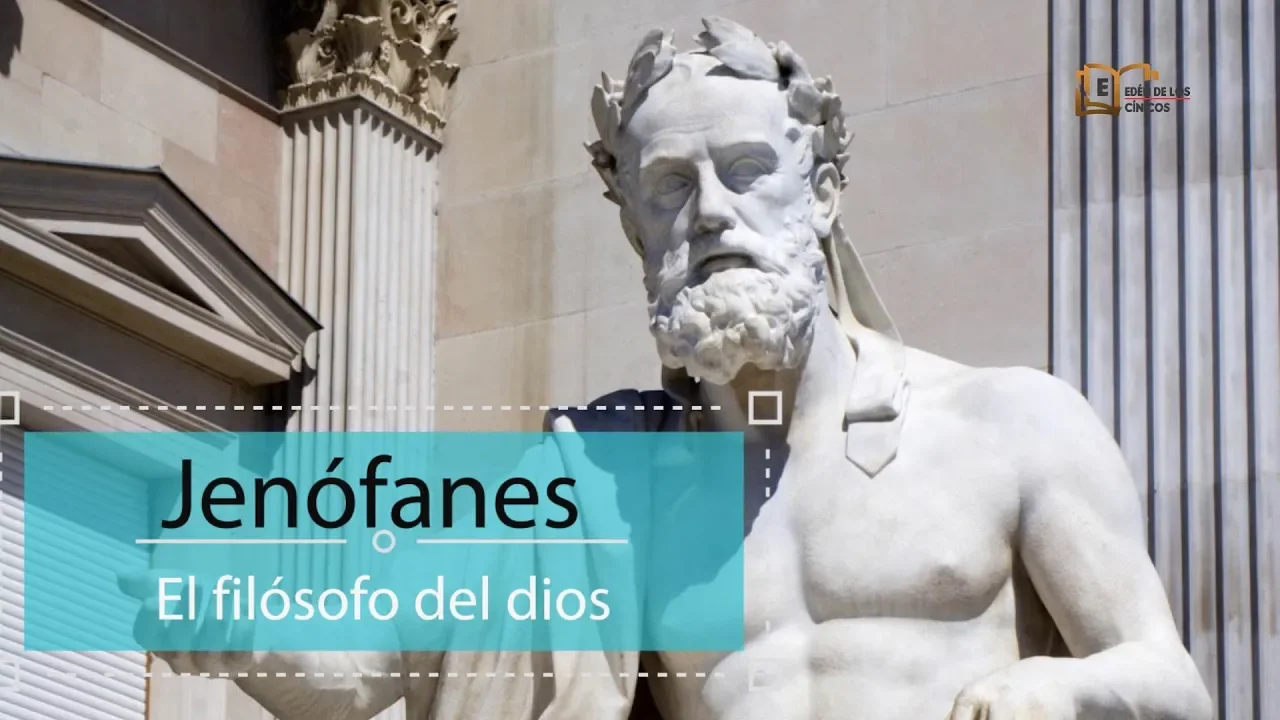
Jenófanes: el filósofo presocrático del dios monoteísta. Escuela de Elea
Jenófanes: A Revolutionary Philosopher
This section provides an introduction to Jenófanes, a philosopher who challenged the traditional conception of gods and revolutionized the understanding of the cosmos.
Jenófanes' Life and Works
- Jenófanes was born in Colophon around 580 BCE and is believed to have lived for about 100 years or close to it. He was known for his unique perspective on the cosmos and his daring challenge to the traditional beliefs about gods presented by Homer and Hesiod.
- Not much is known about his biography, as all available information comes from later doxographers who wrote centuries after his time.
- None of Jenófanes' original works have survived, only fragments of his poetry that were copied by later scribes. These fragments amount to approximately 120 verses.
- Some scholars attribute the foundation of the School of Elea to Jenófanes, but this cannot be confirmed.
- According to Diogenes Laertius, Jenófanes wrote numerous poems and made a living by reciting verses as a rhapsode at symposia and banquets.
Challenging Traditional Beliefs
- Unlike other rhapsodes who recited classical poems like those of Homer, Jenófanes opposed Homer and Hesiod due to his different worldview regarding gods and the world.
- In terms of theology, he made significant contributions by denying that gods could engage in immoral actions such as stealing, killing, or raping, which were common themes in traditional mythological stories.
- Jenófanes rejected the anthropomorphic nature attributed to gods by asserting that they are not physically similar to humans. Some scholars even suggest that he laid the groundwork for monotheism by proposing the existence of a single omnipotent god.
- He famously stated that if Ethiopians could depict their gods, they would portray them as flat and black like themselves, while the Thracians, who are blond with blue eyes, would see divinity with those physical characteristics.
- Jenófanes introduced the concept of a god that neither creates nor is created but has existed eternally. He challenged the traditional beliefs by emphasizing observation and empirical investigation over divine revelation.
Cosmological Views
- While there is limited information about Jenófanes' cosmological views, it is believed that he interpreted celestial bodies as composed of particles of fire. His aim was to provide rational explanations for the mythical heavens.
- Based on his observations of fossils left by seawater on rocks now on land, he deduced that all life originated from the sea and creation emerged from mud. According to him, marine creatures were the first creations, followed by humans.
- He proposed a cyclical process where water transforms earth into mud and then solidifies again. Creation and destruction occur in a repetitive manner.
Intellectual Knowledge vs. Athletic Glory
- In ancient Greece, athletes who achieved glory in various sports events like the Olympics were immortalized through statues and honors. This culture prioritized athletic achievements over intellectual pursuits.
- Jenófanes criticized this behavior and argued that intellectual knowledge should be celebrated above physical prowess.
The Importance of Intellectual Knowledge
This section focuses on Jenófanes' critique of prioritizing athletic achievements over intellectual knowledge.
Valuing Intellectual Pursuits
- Jenófanes expressed a strong criticism against glorifying athletes while neglecting intellectuals.
- He emphasized that intellectual knowledge should be esteemed more highly than physical accomplishments.
Timestamps are not available for some parts of the transcript.