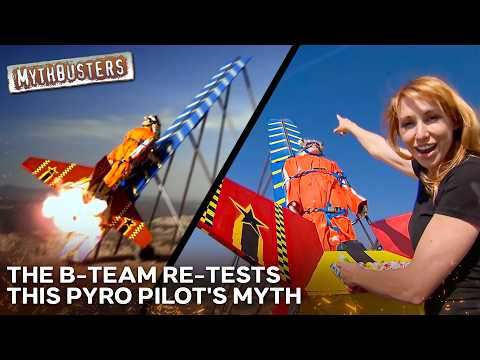
Can Someone REALLY Fly Using Only Fireworks? | MythBusters
Revisiting Fireworks Man: The Myth Reexamined
Introduction to Fireworks Man
- The team introduces the concept of revisiting "Fireworks Man," a previous myth that fans want to see tested again.
- The original story involved a pyro pilot who attempted to fly 150 ft using 500 sky rockets, but initial tests were unsuccessful.
Analyzing Previous Failures
- Discussion highlights that the first attempt failed due to the curvature of the surfboard causing premature lift and misalignment between thrust and center of gravity.
- Grant identifies two main issues: the surfboard's shape and Buster's center of gravity being above the thrust line, leading to instability during launch.
Design Improvements
- To address these problems, Tory proposes replacing the surfboard with a straight plank and adjusting Buster’s position for better stability.
- Tory also adds aerodynamic features like a nose cone and larger stabilization fins to enhance flight stability.
Wind Tunnel Testing
- The team conducts wind tunnel tests at NASA, aiming for improved aerodynamics compared to their last attempt which lacked such testing.
- Initial tests show instability as the model flips in high winds, prompting discussions on repositioning rockets for better balance.
Small Scale Launch Attempts
First Test Launch
- After modifications, they conduct a small-scale test launch; however, it fails to achieve desired height or distance.
Adjustments Made
- Following failure analysis from high-speed footage, adjustments are made regarding weight distribution before another launch attempt.
Successful Small Scale Flight
- A second small-scale launch is executed successfully, achieving an estimated height of 300 ft and confirming improvements in design stability.
Transitioning to Full Scale
Building Full Size Model
- With successful small-scale results, the team begins constructing a full-size version of Fireworks Man with enhanced features based on previous learnings.
Ramp Redesign
- Grant revamps the ramp design by integrating wheels into the launch vehicle instead of using a trolley system for smoother launches.
Preparing for Full Scale Launch
Final Preparations
- The ramp is set up at an optimal angle while Buster is secured into place with all necessary safety measures taken before launching.
Rocket Setup
- They prepare 500 sky rockets capable of reaching heights over 1,200 ft while ensuring proper load management for effective thrust generation.
The Big Launch Day
Safety Measures
- Extensive safety precautions are discussed including involving bomb tech experts due to potential hazards associated with launching fireworks man.
Successful Full Scale Launch
- In contrast to earlier attempts, Fireworks Man flies straight and true this time, achieving over 150 ft in height before crashing down safely downstream.
Conclusion on Fireworks Man Myth
Confirmation of Physics
- The physics behind the myth are confirmed; however, concerns about survivability from such heights remain evident.
New Myth: Bird Balance on Car Hood
Introduction to New Myth
- A new myth involves testing if a bird landing on a car hood can tip it off balance; suggestions include using a longer limousine for better leverage.
Previous Testing Insights
- Past attempts showed that only heavy weights could tip cars; thus fans suggest utilizing fake birds for more controlled experiments.
Experiment Preparation
- Tory constructs an animatronic Kori Bustard weighing around 40 lbs as part of their experimental setup alongside plans for multiple bird drops from cranes.
Execution Phase
Turkey Chandelier Concept
- Grant builds a chandelier-like device capable of dropping multiple turkeys onto the limo hood simultaneously as part of their experiment strategy.
Cliff Setup Process
- They find an ideal cliff location where they will balance their limo at its edge while preparing safety measures against potential accidents during testing.
Tipping Point Analysis
Finding Pivot Points
- Using teeter-totter methods helps determine where best to position their limo so that even slight weight changes can lead it tipping off effectively.
Single Bird Drop Attempt
- Initial drop attempts with one heavy bird fail as no significant shift occurs despite expectations based on lever principles discussed earlier.
Final Results & Conclusions
Multiple Birds Required
- It takes dropping numerous turkeys (upwards of 700 lbs total weight), indicating that even long limousines require substantial mass shifts before tipping occurs.
Overall Outcome
- Ultimately concluding this myth as busted since neither single nor multiple birds could cause sufficient imbalance needed for tipping off cliffs under controlled conditions.
Turn any video into a summary like this
YouTube links, meetings, lectures. With transcripts, search, and chat.