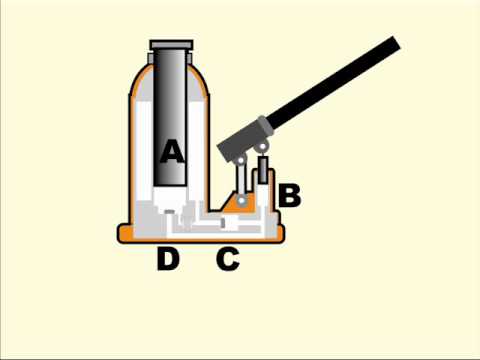
Funcionamiento de un gato hidraulico
Hydraulic Jack Mechanism Explained
Introduction to Hydraulic Jacks
- The hydraulic jack is a small device capable of lifting heavy loads with minimal effort from the operator, based on the principle of leverage.
- By using a lever under a heavy object, one can lift it by raising the free end of the lever; this results in a significant force multiplication.
Mechanics of Force Multiplication
- The distance that the lever's free end travels has limitations, which restricts how high an object can be lifted.
- To overcome this limitation, mechanisms are employed that allow for repeated lowering and raising without losing elevation on the load being lifted.
Components of a Hydraulic Jack
- A hydraulic jack consists of two pistons (or cylinders), each containing hydraulic oil, which prevents corrosion and enhances lubrication.
- The operation begins with positioning the jack correctly and moving a smaller piston (B) upward to draw oil into its cylinder through an automatic valve (C).
Lifting Process
- As oil is pumped into the larger piston (A), it moves upward due to pressure from the smaller piston’s movement, effectively multiplying force applied.
- This process is repeated multiple times until sufficient height is achieved to lift heavy objects like cars with minimal effort.
Lowering Mechanism
- To lower the lifted object, an opening in a butterfly valve (E) allows oil to return to its reservoir, enabling controlled descent.