Can Can't Cannot | Learn English Grammar | Basic English Lesson by Woodward English

Can Can't Cannot | Learn English Grammar | Basic English Lesson by Woodward English

Understanding the Use of "Can" in English

Introduction to "Can"

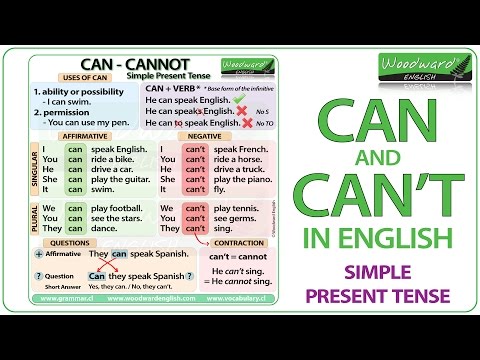
  • The word "can" indicates ability or possibility, e.g., "I can speak English" signifies the speaker's capability.
  • It also conveys permission, as in "You can use my pen," which grants someone the right to use it.

Forming Sentences with "Can"

  • The structure for sentences using "can" remains consistent across subjects: I can, you can, he can, etc.
  • After "can," the verb is always in its base form; there is no 's' added (e.g., “he can speak” vs. “he can speaks”).

Correct Usage Examples

  • Example sentences include:
  • “He can speak English” (correct)
  • “He can speaks English” (incorrect due to incorrect verb form).

Negative Sentences with "Can't"

  • To create negative sentences, use “can't” or “cannot.” Pronunciation varies between American ("can't") and British ("cannot") English.
  • Examples of usage:
  • “I can't swim” means lacking ability.
  • “You can't use my pen” indicates lack of permission.

Formulating Questions with "Can"

Structure of Questions

  • To convert affirmative statements into questions, invert the subject and "can":
  • From “You can speak Spanish” to “Can you speak Spanish?”

Short Answers

  • Responses to questions about ability are typically short:
  • Affirmative: “Yes, I can.”
  • Negative: “No, I can't.”

Additional Uses of "Can"

  • Inquiries using "can" may ask about abilities or possibilities (e.g., “Can you swim?”).
  • It’s also used for making offers (“Can I help you?”), asking for permission (“Can we go home now?”), and giving instructions (“Can you open the window please?”).

Expanding Questions

  • For more detailed responses, incorporate question words like where or when before "can":
  • Example: “Where can you swim?” or “When can I see you again?”
Video description

A grammar lesson about CAN in English. We show you how to use CAN to make both positive and negative sentences, as well as how to make questions using CAN. There are lots of example sentences with Can. We also mention the difference pronunciation of CAN'T in American English vs. British English. This entire English lesson is about using CAN in the present simple tense. NEXT ACTIVITIES For more details about CAN see our website: https://www.grammar.cl/Basic/Can_Cannot.htm We also have an interactive game for you to play: https://www.grammar.cl/Games/Can_Cannot.htm There is also a page about the difference between CAN and COULD: https://www.grammar.cl/english/can-could.htm #BasicEnglish #EnglishLesson #CanCannot 💚💚💚 How to support WOODWARD ENGLISH 💚💚💚 📗 ENGLISH LANGUAGE RESOURCES 📗 🌿 https://www.woodwardenglish.com/shop/ English Resources for Teachers and Parents. (PDF and PPT - Ideal for ESOL students or homeschool). These PDFs are also great for those studying English alone. 🎥 JOIN Woodward English on YouTube 🎥 🌿 https://www.youtube.com/user/WoodwardEnglish/join - Exclusive videos only for members. - Exclusive members only posts in our YT community tab - Loyalty badges next to your name in comments and live chat - Custom emoji to use in live chat 💚💚💚 Do you like WOODWARD ENGLISH and want to learn more? 💚💚💚 Here are the next steps to improving your English: 1) SUBSCRIBE to the WOODWARD ENGLISH channel so you know when I create new videos to help you improve your English. 🌿 https://www.youtube.com/subscription_center?add_user=WoodwardEnglish Make sure you click the notification bell so you know immediately when I upload a new English lesson. 2) See our FREE ENGLISH LESSONS and language learning articles: 🌿 https://www.grammar.cl (Grammar lessons) 🌿 https://www.vocabulary.cl (Vocabulary lessons) 🌿 https://www.woodwardenglish.com (Free English courses) 3) LET'S CONNECT! 🌿 https://twitter.com/WoodwardEnglish 🌿 https://www.instagram.com/woodwardenglish/ ✉️ Send us a postcard from your country ✉️ Rob Woodward P.O. Box 38438 Howick Auckland 2145 New Zealand NOTE: Our English lessons and English language resources are for people over the age of 13. Have an awesome day! - Rob Woodward