Can Can't Cannot | Learn English Grammar | Basic English Lesson by Woodward English
Understanding the Use of "Can" in English
Introduction to "Can"
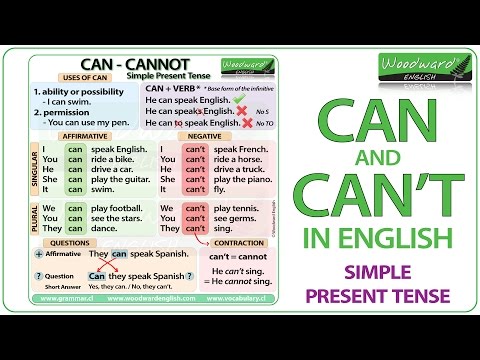
- The word "can" indicates ability or possibility, e.g., "I can speak English" signifies the speaker's capability.
- It also conveys permission, as in "You can use my pen," which grants someone the right to use it.
Forming Sentences with "Can"
- The structure for sentences using "can" remains consistent across subjects: I can, you can, he can, etc.
- After "can," the verb is always in its base form; there is no 's' added (e.g., “he can speak” vs. “he can speaks”).
Correct Usage Examples
- Example sentences include:
- “He can speak English” (correct)
- “He can speaks English” (incorrect due to incorrect verb form).
Negative Sentences with "Can't"
- To create negative sentences, use “can't” or “cannot.” Pronunciation varies between American ("can't") and British ("cannot") English.
- Examples of usage:
- “I can't swim” means lacking ability.
- “You can't use my pen” indicates lack of permission.
Formulating Questions with "Can"
Structure of Questions
- To convert affirmative statements into questions, invert the subject and "can":
- From “You can speak Spanish” to “Can you speak Spanish?”
Short Answers
- Responses to questions about ability are typically short:
- Affirmative: “Yes, I can.”
- Negative: “No, I can't.”
Additional Uses of "Can"
- Inquiries using "can" may ask about abilities or possibilities (e.g., “Can you swim?”).
- It’s also used for making offers (“Can I help you?”), asking for permission (“Can we go home now?”), and giving instructions (“Can you open the window please?”).
Expanding Questions
- For more detailed responses, incorporate question words like where or when before "can":
- Example: “Where can you swim?” or “When can I see you again?”