Ideal Gas Law Practice Problems with Density
Understanding Density and Molar Mass with the Ideal Gas Law
Introduction to the Ideal Gas Law
- The video begins by introducing the ideal gas law equation: PV = nRT, which allows solving for pressure, volume, moles, and temperature of a gas sample if three variables are known.
- A challenge arises when trying to determine the density of a gas since it is not one of the four primary variables in this equation.
Transforming the Ideal Gas Law
- To solve for density (D) and molar mass (M), an alternate form of the ideal gas law is used instead of PV = nRT. This transformation enables calculations involving density and molar mass alongside pressure and temperature.
- The speaker promises to explain how this transformation occurs at the end of the video.
Solving for Density Example
Given Variables
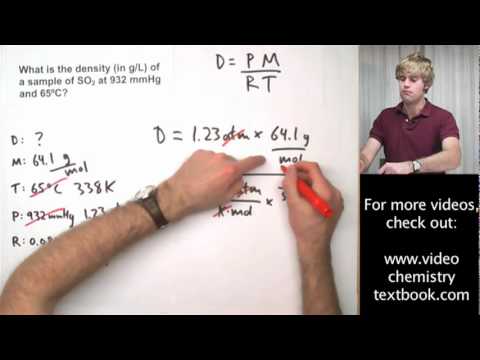
- The example problem involves calculating density at 65°C, which must be converted to Kelvin (K) by adding 273, resulting in 338 K.
- Pressure is initially given in millimeters of mercury (mmHg) but needs conversion to atmospheres (ATM). After conversion, it equals 1.23 ATM.
- The molar mass for sulfur dioxide (SO2) is calculated as 64.1 g/mol by summing the atomic masses of sulfur and two oxygen atoms.
Calculating Density
- Using the modified ideal gas law formula leads to a complex fraction where density can be expressed as:
[ D = P times M/R times T ]
where P = pressure, M = molar mass, R = ideal gas constant, T = temperature in Kelvin.
Unit Cancellation Process
- The speaker demonstrates unit cancellation within a multi-layered fraction:
- Grams cancel with grams.
- Liters cancel with liters.
- Kelvin cancels with Kelvin.
This results in final units being grams per liter (g/L), confirming that it aligns with how density is reported. The final calculated density is 2.84 g/L after performing calculations correctly.
Second Problem: Finding Molar Mass from Density
Given Conditions
- In this second example, a gas has a known density of 3.01 g/L at standard temperature and pressure (STP), defined as 0°C and 1 ATM.
Setting Up Variables
- Temperature must be converted from Celsius to Kelvin by adding 273; thus, STP becomes 273 K.
Rearranging Equation for Molar Mass Calculation
- Instead of rearranging step-by-step through all variables again, the speaker simplifies it using:
[ M = RTD/P ]
where R remains constant at 0.0821 L·ATM/(K·mol).
Final Steps in Calculation
- As before, unit cancellation occurs within this new fraction setup:
- Liters cancel out,
- Kelvins cancel out,
resulting in an expression that will yield molar mass once numerical values are plugged into their respective places.
This structured approach provides clarity on how both problems utilize variations of the ideal gas law effectively while emphasizing unit management throughout calculations.
How to Calculate Molar Mass Using Density and the Ideal Gas Law
Introduction to Molar Mass Calculation
- The discussion begins with the concept of molar mass, which is consistently reported in grams per mole. The speaker emphasizes this point as a foundational aspect of the calculation.
- The method for calculating molar mass involves using the ideal gas law equation PV = nRT . The speaker plans to solve for moles (n) first.
Deriving Moles from Mass and Molar Mass
- To find moles, the formula n = mass/molar mass is introduced. This highlights that knowing the mass of a sample allows one to determine how many moles are present.
- The speaker substitutes n in the ideal gas law with mass/molar mass , leading to an equation that incorporates both mass and molar mass into the ideal gas law framework.
Incorporating Density into the Equation
- Density is defined as density = mass/volume . The speaker indicates a need to rearrange this definition to integrate it into their calculations effectively.
- As they manipulate equations, they aim to express relationships between pressure, volume, temperature, density, and molar mass within a single framework.