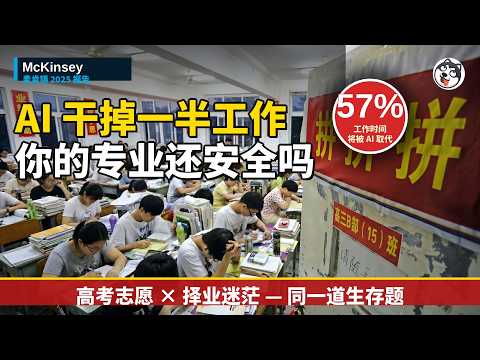
高考結束!麥肯錫警告 57% 工作將被 AI 幹掉,越「實用」的專業死得越快——揭祕一簽就拒的留學專業黑名單、國防七子之外的隱形雷區院校,以及 5 大全球溢價行當與 4 件無視學歷的終極元技能
High School Examination Reflections and Future Job Market Insights
Overview of High School Examination Outcomes
- The speaker acknowledges the end of high school examinations, congratulating those who performed well while reassuring those who may not have met their expectations that it is just one exam.
Critique of Educational System and Job Market Dynamics
- The speaker criticizes the notion that exams determine one's fate, labeling it as nonsense. They emphasize that economic value is tied to market demand rather than academic performance.
- A report from McKinsey predicts that AI could automate nearly 57% of work hours by 2025, particularly affecting jobs with clear rules and standardized processes—areas where many students trained under China's education system excel.
Implications for Graduates in an AI-Dominated Economy
- Students excelling in exams are described as obedient followers, making them prime targets for AI replacement. The education system is critiqued for producing individuals who can only regurgitate information rather than think critically.
- This educational approach leads to a generation accustomed to finding "correct answers," which does not prepare them for real-world scenarios lacking definitive solutions.
Navigating Uncertainty Post-Graduation
- Those with average results may actually possess an advantage due to their adaptability and willingness to explore uncharted territories—a crucial skill in the evolving job landscape shaped by AI.
Global Employment Trends and Skills Gap
- A World Economic Forum report indicates a net gain of 78 million jobs globally by 2030 due to new technologies, despite significant job losses. However, employers face a skills gap as they struggle to find qualified candidates.
Challenges for Chinese Students Seeking Education Abroad
- New regulations (PP10043), enacted under previous administrations, complicate visa applications for Chinese students involved with military-related institutions or funding sources.
Identifying Risky Academic Paths
- Certain universities associated with defense research pose higher risks for students applying abroad; even minor involvement in sensitive projects can trigger visa scrutiny.
Strategic Choices for International Studies
- To avoid pitfalls when studying abroad, students should consider foundational fields like mathematics or theoretical physics that are less likely to be flagged as sensitive areas.
The Value of Critical Thinking Skills
- As automation rises, skills such as analytical thinking become increasingly valuable. Employers prioritize these abilities over rote knowledge gained through traditional education systems.
Preparing for an Evolving Job Landscape
- Students must actively engage in critical analysis during their studies instead of passively accepting information. This includes questioning assumptions behind conclusions presented by educators or technology like AI.
Understanding AI's Limitations
- Recognizing that large language models operate on statistical predictions rather than true understanding is essential; this awareness helps users discern when outputs may be misleading.
Emphasizing Specialized Expertise
- Mastery within niche areas will become more valuable as general proficiency in using AI tools becomes commonplace; specialization creates competitive advantages in the job market.
Conclusion: Adapting to New Realities
- The speaker concludes that success will depend on recognizing underlying truths about the world beyond traditional educational frameworks and adapting accordingly amidst rapid technological changes.