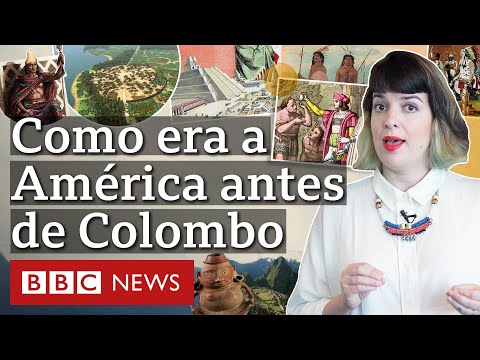
Como realmente era a América antes da chegada de Colombo?
The Complexity of Pre-Columbian America
Urban Centers and Societal Structures
- Urban centers existed in the Americas with populations up to 50,000, connected by four-lane roads and sidewalks.
- The arrival of Europeans led to significant population declines among indigenous peoples due to diseases, often spread before direct contact.
- Early written accounts misrepresented the continent's complexity, influenced by colonizers' narratives that depicted native societies as primitive.
Archaeological Discoveries
- Recent archaeological findings reveal a diverse and complex society among Native American populations, challenging previous misconceptions.
- Estimates suggest around 25 million people lived in South America around 1492, with many established in large urban-like centers integrated into the forest ecosystem.
- Indigenous practices included altering forest landscapes for agriculture without deforestation, enhancing resilience against climate events.
Evidence of Advanced Civilizations
- In Bolivia's Llanos de Moxos region, elevated farming platforms and extensive defensive trenches indicate organized and populous communities.
- Monumental earthworks were common; however, they have largely been reclaimed by nature over time.
Population Diversity Across the Continent
- By 1492, it is estimated that up to 60 million people inhabited the Americas, speaking approximately 1,200 different languages.
- North American societies often had less monumental but more egalitarian structures compared to their southern counterparts.
Governance and Social Organization
- The Haudenosaunee confederation exemplified democratic principles with shared governance between genders and collective decision-making processes.
The Advanced Civilizations of the Americas
The Transformation of Mexico City and Its Consequences
- The transformation of the original city into Mexico City led to increased flooding and outbreaks of typhus, highlighting environmental changes due to urbanization.
Mathematical and Astronomical Achievements of the Maya
- The Maya civilization was noted for its advanced mathematics and astronomy, contributing significantly by introducing the mathematical symbol for zero, which facilitated complex calculations.
- Their sophisticated calendar system integrated religious beliefs with astronomical phenomena like solar years and planetary cycles, showcasing their precision in timekeeping.
Information Storage Systems Across Civilizations
- Various civilizations developed unique systems for information storage; for instance, the Mexica used hieroglyphics while the Inca employed quipus—knotted wool cords—to record data efficiently.
- The Inca Empire was notable for its vast territorial expansion comparable to that of Rome, maintained through an impressive administrative system including public works like roads and bridges.
Agricultural Innovations from the Americas
- Mesoamerican agriculture revolutionized global diets with crops such as maize, which resulted from ancient genetic manipulation by humans. This crop had already diversified across regions before European contact.
- Other significant crops domesticated by Native Americans included potatoes, tomatoes, avocados, pumpkins, and cassava—all integral to European diets post-contact.
Societal Complexity in Pre-Columbian America
- Despite diversity and complexity within American societies—including inequality and brutality—they had established adaptive ways of living suited to their environments prior to European arrival.