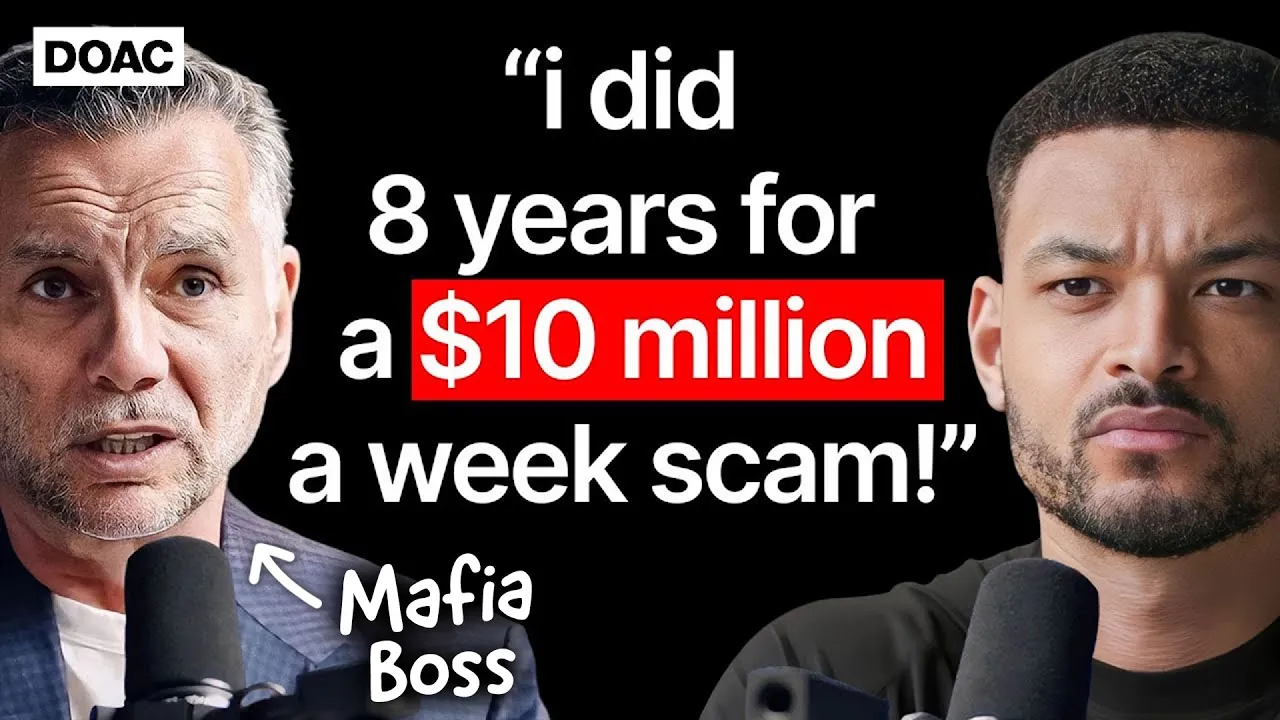
Former Mafia Boss: "I Was Running The Biggest Scam In The World! $1.4 Million A Day!"
What Lessons Can Be Learned from a Life in the Mafia?
Insights from Michael Franzese's Mafia Experience
- Michael Franzese reveals that during his time in the mafia, he witnessed significant events, including earning $910 million weekly and being arrested 18 times. He reflects on the harsh realities of life in organized crime.
- He distinguishes between two roles within the mafia: racketeers, who generate income for the family, and gangsters. Franzese identifies as a racketeer, managing 18 companies and defrauding the government to bring in substantial revenue.
- Discussing negotiation skills learned from his experiences, he emphasizes adherence to rules within mafia operations. Violating these rules can lead to severe consequences, illustrated by personal stories of betrayal and loss.
- Franzese shares a painful experience involving his father's betrayal while holding a powerful position in the mafia. This moment significantly impacted him emotionally.
- Reflecting on his past actions, he acknowledges having done many bad things but expresses a desire to escape that life. He notes that leaving such a lifestyle is not an option for those involved.
Transitioning from Mafia Life to Public Speaking
- The conversation shifts as Steve thanks viewers for reaching 7 million subscribers on YouTube and announces ongoing raffles for subscribers with exclusive prizes.
- When asked about his identity post-mafia life, Franzese recounts how Jordan Peterson challenged him regarding self-perception after years of criminal activity. He discusses separating himself from uncomfortable actions taken during that time.
- He explains how he initially entered the mafia world to help his father overturn a wrongful conviction stemming from a lengthy prison sentence rather than pursuing his original goal of becoming a doctor.
Impact of Upbringing on Criminal Choices
- Franzese describes growing up with strict parental guidance amidst turmoil due to his father's high-profile criminal activities. His father's frequent legal troubles shaped their family dynamic significantly.
- Despite facing challenges at home, he reflects on how this environment influenced his worldview towards law enforcement negatively due to constant harassment experienced by their family.
- He recalls intense surveillance by multiple law enforcement agencies throughout his childhood due to his father's notoriety, which contributed further to animosity towards police forces.
Understanding the Dual Life of a Mafia Family Member
Insights into Family Dynamics
- The speaker reflects on their father's dual nature, initially perceiving him as a good person and father, despite his involvement in organized crime.
- The father was charismatic and aimed for his child to pursue education and stay away from street life, showcasing a desire for a better future.
- Witnessed moments of aggression from the father that revealed an unexpected violent side, contrasting with his nurturing demeanor at home.
Key Experiences Shaping Perception
- A significant incident involved the father displaying extreme anger towards an associate, which left a lasting impression on the speaker about their father's hidden life.
- Another experience involved the father physically confronting a carpenter who failed to complete work on time, illustrating his volatile temperament when provoked.
Understanding His Father's Other Life
- The speaker recounts memories of their father's absence during dangerous times due to family conflicts within organized crime, highlighting the risks associated with that lifestyle.
- At four years old, they observed their father's return home after being away during family turmoil related to mafia wars without fully understanding its implications.
Mafia Structure Explained
- The speaker describes their father's high-ranking position as both captain and underboss within the mafia hierarchy, indicating significant power and influence.
- An explanation of mafia structure is provided: it includes roles such as boss, underboss, consigliere (advisor), capos (street bosses), soldiers (made members), and associates (non-members).
Clarifying Mafia Roles
- Soldiers are recognized as the first official rank upon taking an oath; they report to capos who can communicate directly with higher-ups like the boss or underboss.
Understanding the Origins and Structure of the Mafia
Historical Context of the Mafia
- The mafia originated in Sicily, Italy, initially formed to protect towns from marauders.
- Italian immigrants began arriving in New York around 1885, establishing a presence in American cities.
- Early mafia activities included loan sharking and extortion, primarily targeting their own communities.
Prohibition's Impact on Mafia Growth
- The U.S. government inadvertently strengthened the mafia during Prohibition by banning alcohol.
- In New York alone, there were 36,000 speakeasies controlled by the mafia, leading to immense profits.
- This era marked a significant shift as organized crime became more lucrative and structured.
Formation of Mafia Families
- In the 1940s, Lucky Luciano restructured the mafia into families to reduce internal conflicts over power and control.
- Luciano created the Mafia Commission with nine families nationwide; each family had its own boss.
Structure and Governance of Families
- The term "family" was used loosely; members were not necessarily related but operated under a hierarchical structure.
- To participate in the Commission (the ruling body), one had to be designated as a boss or representative of their family.
Internal Dynamics and Conflicts
- While policies were created by the Commission, individual bosses maintained autonomy over their families' operations.
- In New York City, five major families existed with approximately 750 made men collectively involved in organized crime activities.
Power Struggles Within Families
- Prior to the establishment of the Commission, families often engaged in violent conflicts for power; this changed post-establishment.
- The Columbo family experienced three internal wars during this period due to leadership struggles.
Conflict Resolution Mechanisms
Business Meetings and Decision-Making
The Importance of Structured Sit-Downs
- The speaker emphasizes the value of structured sit-down meetings in business, contrasting them with traditional meetings filled with emails and discussions.
- In these sit-downs, the boss holds ultimate authority, ensuring that decisions are made efficiently without disputes over leadership roles.
- Respect is crucial during these meetings; calling someone a liar can undermine one's position and lead to losing the argument.
Resolving Business Disputes
- Sit-down meetings are used to resolve various business disputes, including serious matters where someone's fate may be at stake.
- These discussions involve representatives speaking for or against individuals involved in significant policy violations or mistakes.
Personal Impact of Family Dynamics
- The speaker reflects on personal experiences related to family dynamics during critical decision-making moments, particularly regarding life-altering situations.
Life Changes Due to Family Circumstances
Father’s Imprisonment
- The speaker shares how their father's imprisonment at age 19 profoundly affected their life trajectory and responsibilities within the family.
- Despite his incarceration, the father instilled values such as listening and responsibility in his children, which shaped their character.
Emotional Toll of Imprisonment
- Discussing the emotional impact of his father's imprisonment reveals it as a defining moment that altered familial roles and expectations significantly.
Career Aspirations vs. Reality
Shift from Medicine to Other Paths
- Initially studying medicine, the speaker's life took an unexpected turn following their father's legal troubles, leading them toward a different lifestyle influenced by familial circumstances.
Claims of Wrongful Conviction
- The speaker asserts that their father was wrongfully imprisoned for crimes he did not commit, specifically bank robberies he was accused of masterminding.
Belief in Father's Innocence
Trusting Family Values
- The speaker recounted a pivotal conversation with their father about innocence regarding bank robbery charges; this trust stemmed from lifelong teachings against dishonesty and drug use.
Motivation for Justice
The Influence of Family and Choices in a Criminal Life
The Impact of Family Expectations
- The speaker reflects on how family connections influenced his decisions, particularly the pressure from his father's friends to abandon school and assist his father, who was imprisoned.
- Despite his father's disapproval, the speaker felt compelled to drop out of school to help prevent his father from dying in prison, showcasing the weight of familial loyalty.
- The conversation with his father revealed a strong bond; despite disappointment, the father acknowledged the speaker's determination and desire to be involved in "the life."
Embracing a Criminal Identity
- A pivotal moment occurred when the father asked if he could kill someone under certain circumstances; this question marked a turning point in their relationship and expectations.
- The father's response indicated acceptance of the speaker's choice to join organized crime, emphasizing that it was essential for him to follow through without detailed instructions.
Navigating Legal Challenges
- Joining the mafia was seen as a means to help secure legal assistance for his father; he utilized business acumen to track down witnesses who could recant their testimonies against him.
- The speaker successfully worked with lawyers and managed to get three witnesses to change their statements, highlighting an active role in navigating legal challenges.
Allegations Against His Father
- Discussion about media attention surrounding his father's case reveals systemic issues within law enforcement; there were claims that FBI agents may have been complicit in framing him.
- Witnesses admitted they were coerced into implicating others during investigations, indicating manipulation by authorities rather than genuine evidence against those accused.
Reflections on Morality and Legacy
- The speaker grapples with complex feelings about his father's character—acknowledging both admiration for being well-liked yet recognizing allegations of serious crimes including murder.
The Role of Government and Law Enforcement
The Legality of Government Actions
- The speaker argues that the government should never break the law to uphold it, as this could lead to a monarchy-like system where citizens are unprotected.
- Emphasizes that the government has sufficient tools to enforce laws without violating them, maintaining a high success rate in lawful enforcement.
Understanding Oaths and Criminal Life
- Discusses the oath taken by individuals in organized crime, clarifying it is not an oath to lie or commit crimes but rather to maintain silence about certain activities.
- Highlights strict rules within organized crime, such as prohibitions against drug dealing and violence against family members, which are enforced with severe consequences.
Justification of Actions in Organized Crime
- The speaker reflects on how individuals justify their actions within criminal life, acknowledging that while murder is wrong, there are complex moral frameworks at play.
- Clarifies that while some may claim they only kill their own, this is not universally true; different individuals have different experiences regarding violence.
Personal Reflections on Violence and Crime
Reluctance to Discuss Violence
- The speaker expresses discomfort discussing personal involvement in violence or murder due to its ugly nature and potential legal repercussions.
- Acknowledges societal perceptions around discussing murder and suggests multiple reasons for his reluctance including legal concerns and personal values.
Observations on Others' Admissions
- Notes that many former criminals openly discuss their past murders online after striking deals with the government for immunity.
- Contrasts his own experience with those who have cooperated with authorities; he does not have immunity for his past actions.
Becoming Part of Organized Crime
Initiation into Mafia Life
- Describes the process of joining organized crime, emphasizing that one cannot simply ask to join; they must be proposed by someone already involved.
Understanding Loyalty and Sacrifice in a Cult-like Environment
The Primacy of Service
- The speaker emphasizes that loyalty to the organization supersedes personal obligations, stating that if a member's mother is dying, they must prioritize service to the group.
- Acceptance into this life involves a rigorous pledge period where members must demonstrate their worthiness through obedience and discipline.
Discipline and Authority
- Punctuality is critical; being late for meetings is unacceptable regardless of circumstances. Members are expected to plan ahead to avoid tardiness.
- There are severe consequences for mistakes, such as being sidelined for two weeks to reinforce the importance of adherence to rules.
The Nature of Violence
- The speaker acknowledges that violence is an inherent aspect of this lifestyle, asserting that anyone claiming otherwise may not be truthful or experienced in the life.
- During the probationary period, members are tested on both menial tasks and their capacity for violence, indicating a dual expectation from them.
Personal Reflection on Loyalty
- When asked about leaving his dying mother for service, the speaker reflects on his indoctrination into this life and suggests he might have complied due to his upbringing.
- He describes the experience as cult-like but clarifies there were no elaborate rituals beyond initial pledging.
Skills Acquired Through Experience
- Interaction with influential figures taught him valuable people skills, including negotiation tactics essential for success within this environment.
- A distinction is made between "racketeers" who benefit from business acumen versus "gangsters" who lack such skills but still contribute in other ways.
Negotiation Tactics Learned
- The speaker highlights learning negotiation strategies during business disputes, emphasizing preparation and understanding personalities before meetings.
Negotiation Techniques and Insights
The Importance of Punctuality and Respect in Negotiations
- The speaker emphasizes that punctuality is a key aspect of respect in negotiations, suggesting that small gestures can significantly impact the outcome.
- Listening is highlighted as a crucial skill; allowing others to speak can reveal valuable insights about their personalities and perspectives.
- Remaining quiet can be a strategic advantage, especially when one may not be the most knowledgeable person in the room, creating an air of mystery.
- The stakes in negotiations can be high; poor decisions could lead to severe financial consequences, underscoring the need for thorough preparation.
Insights from Experience in Business Operations
- The speaker shares experiences from working in the gas tax business, describing it as a significant scam against government tax collection processes.
- A detailed explanation follows on how shell companies were established in Panama to facilitate tax evasion by collecting taxes without proper oversight.
Operational Strategies for Success
- The operation involved sophisticated strategies to delay government intervention for nearly a year while maintaining compliance on paper.
- Gas was sourced from major oil companies via barges from the Middle East, with operations structured around licensed Panamanian companies.
Competitive Pricing Tactics
- To dominate market share, the speaker employed aggressive pricing strategies by undercutting competitors by two cents per gallon consistently.
- This approach led to widespread adoption among retailers who benefited financially from purchasing cheaper gas, effectively driving competition out of business.
Realization of Potential Profits
Winning Arguments and Building Wealth
The Dynamics of Argument and Loyalty
- The speaker emphasizes the importance of winning arguments, stating that regardless of the family dynamics, he insists on being right to ensure financial success.
- He recalls a conversation with Steve, where he promised significant financial returns in exchange for loyalty, highlighting his ability to generate $2 million weekly.
Business Operations and Payment Issues
- The speaker discusses the competitive nature of his business, noting that while others wanted to buy gas from them, payment was non-negotiable; failure to pay led to consequences.
- His success in generating substantial revenue (up to $10 million weekly) allowed him to rise in rank within the organization, living a lavish lifestyle.
Becoming a Made Man: The Process
Transitioning into Mafia Life
- The speaker reflects on his decision to leave the gas business behind due to its temptations and risks associated with becoming a "made man."
- He describes the initiation process into mafia life as somewhat cult-like, involving a probationary period before officially joining.
Historical Context of Membership
- For 25 years prior to his initiation in 1975, no new members were accepted into the mafia due to security concerns; only replacements for deceased members were allowed.
- When membership opened again in the mid-'70s, many individuals had been waiting decades for their chance.
The Oath: A Serious Commitment
Taking the Blood Oath
- Upon becoming a made man on Halloween night 1975, he describes a solemn ceremony where he took an oath involving blood symbolism and commitment.
- During this ritual, he experienced exhilaration rather than fear as it represented a deeper bond with his father and acceptance into mafia life.
Reflections on Motivation
- Despite familial influence from his father’s status within organized crime, he admits that joining this life was not something he aspired to; it was more complex than mere admiration.
Understanding the Mafia Experience
The Journey into the Mafia Life
- The speaker reflects on their initial motivation to help their father, which evolved into a desire to succeed and complete their journey in the mafia life.
- They discuss how being around mentors provided insight into the realities of mafia life, contrasting their intentions with those of others involved.
Motivations and Personality Types in the Mafia
- The speaker identifies two types of people in the mafia: those who enjoy killing and those who follow orders. They categorize themselves as someone who followed orders.
- A notable figure mentioned is Roy DeMeo, described as a serial killer whose violent tendencies existed independently of his involvement in organized crime.
Human Nature and Violence
- The conversation shifts to human nature, suggesting that everyone has a potential for violence under certain circumstances, challenging the notion that people are inherently good.
- The speaker emphasizes that triggers can lead individuals to commit acts of violence, whether for defense or other reasons.
Perspectives on Murder
- They assert that murder is part of human nature but differentiate between motivations behind it; military actions are framed as noble yet still involve killing.
- The speaker believes everyone possesses an inherent capability for violence, regardless of their personality traits prior to exposure to such environments.
Personal Impact and Defining Moments
- Reflecting on personal experiences, they describe how witnessing violence affected them emotionally but also led them to develop coping mechanisms like compartmentalization.
- A poignant memory involves attending a funeral where they saw a loved one’s body; this moment had a profound impact on them despite their ability to move past it.
Regrets and Reflections
Understanding Grief and Trauma in Life Choices
The Impact of Grief on Relationships
- The speaker reflects on a personal experience where grief influenced a relationship, emphasizing that the act was sincere but unnecessary for him to witness.
- He discusses having vivid dreams about conflicts, indicating that unresolved emotions often surface during sleep rather than waking hours.
Compartmentalization of Trauma
- The speaker describes compartmentalization as a short-term strategy for dealing with grief and trauma but questions its long-term effectiveness.
- He shares a poignant story about losing a close friend due to circumstances beyond his control, highlighting the emotional toll of such experiences.
Consequences of Mafia Life
- The discussion shifts to the harsh realities of life within organized crime, where mistakes can lead to fatal consequences.
- He recounts witnessing friends disappear suddenly, illustrating the severe repercussions associated with this lifestyle.
Family Dynamics and Destruction
- The speaker contrasts corporate greed with mafia life, noting that while corporate failures may lead to job loss, mafia life results in irreversible damage.
- He reflects on how extreme actions are taken against those who betray trust within this world, underscoring the severity of loyalty violations.
Personal Reflections on Family Tragedies
- A harrowing anecdote is shared about a man who killed his father due to infidelity; this illustrates the deep familial rifts caused by mafia involvement.
- The speaker emphasizes that such tragedies are not everyday occurrences but highlight the darker aspects of mafia life which devastate families.
Conclusion: Recognizing an Evil Lifestyle
- He concludes that any lifestyle causing family devastation is inherently bad or evil. His own family suffered greatly from his father's choices in organized crime.
The Journey from Crime to Redemption
Early Life and Legal Troubles
- The speaker recounts a tumultuous past, having faced five trials, received seven indictments, and been arrested 18 times. He describes the overwhelming pressure from a 14-agency task force aimed at imprisoning him indefinitely.
- Reflecting on his motivations, he questions whether love alone could have led him away from this life of crime, acknowledging that personal betrayal played a significant role in his decision-making.
Family Betrayal and Its Impact
- The speaker discusses a pivotal moment involving his father’s betrayal, which made him reconsider the value of their relationship and the life he was leading. This incident occurred two years before meeting his wife.
- He explains that an article falsely claimed he was becoming powerful enough to start his own crime family, which heightened tensions within his existing family structure.
Financial Status and Criminal Operations
- At age 30, he reflects on his financial status during this period, indicating that while he had substantial cash reserves amounting to millions, exact figures were hard to determine due to the nature of his dealings.
- Despite claims of defrauding the government out of $2 billion being exaggerated, it highlights how rumors can escalate quickly in criminal circles.
Confrontation with Authority
- A confrontation with higher-ups reveals deep-seated issues within familial loyalty. The speaker expresses frustration over being questioned despite bringing in significant revenue for the organization.
- He emphasizes the importance of maintaining distance between personal associates and organized crime members to protect them from potential fallout if things went wrong.
Reflection on Relationships and Loyalty
- After leaving a tense meeting with mob leaders, he confronts a friend who failed to warn him about the trap set by their superiors. This conversation underscores themes of loyalty and trust within criminal networks.
- His friend's revelation about his father's lack of support during this critical moment leads him to realize how isolated he truly was in navigating these dangerous waters.
Business Ventures Beyond Crime
How Mafia Involvement Influenced Business Practices
Lending Money and Tax Obligations
- The speaker discusses lending money to associates, who would then lend it further, indicating a network of informal financial transactions.
- If the money earned was illegitimate, there was an obligation to pay a tax to the mafia; however, legitimate earnings did not incur such taxes unless mafia members contributed in some way.
Business Strategies and Aggression
- The speaker reflects on how his reputation within the mafia helped him secure business deals despite being financially broke at one point.
- He emphasizes his aggressive approach in business negotiations, leveraging his connections and knowledge of the industry to obtain a dealership.
Financing and Operations
- The concept of "floor planning" is introduced as a financing method for purchasing cars from manufacturers without upfront capital.
- The speaker successfully secured floor planning by appealing to someone at General Electric Credit who was intrigued by his lifestyle.
Legal Troubles and Betrayal
- Despite winning multiple trials, the speaker's downfall began with a gasoline tax case involving a partner who became an informant under pressure from authorities.
- He describes how he took a plea deal after assessing that cooperating with law enforcement could mitigate potential prison time.
Reflections on Relationships and Responsibility
- The speaker shares insights about his relationship with his partner, acknowledging their successful collaboration but recognizing inherent weaknesses in character.
The Dynamics of Criminal Decision-Making
Handling Internal Conflicts
- The speaker emphasizes a strategic approach to managing problematic individuals within their circle, asserting that they would not introduce such individuals to others who could be compromised.
- There is an acknowledgment from associates about wanting to eliminate a problematic figure, indicating a willingness to take drastic measures for the sake of business continuity.
Ordering and Executing Murders
- The ease with which a boss can order a murder is discussed; it’s portrayed as straightforward when dealing with someone within their organization.
- Failure to execute an assigned task could lead to severe consequences, including being held responsible if the target causes harm afterward.
Legal Consequences and Plea Deals
- The speaker reflects on their own legal troubles, revealing they pled guilty in a racketeering case involving tax fraud, resulting in significant prison time and financial restitution.
- Negotiating plea deals allowed the speaker to retain some assets for family support during incarceration.
Cash Transactions and Money Laundering
- A discussion on cash transactions highlights that while many dealings were in cash, wire transfers were also common due to the volume of sales.
- The speaker recounts seeing large sums of cash (up to $50 million), emphasizing the challenges of handling such amounts discreetly.
Managing Cash Flow and Smell Issues
- To manage excess cash flow, small bills were given away as gifts due to storage issues.
- An anecdote reveals how money's smell led to complications at banks; baking soda was used creatively to mask odors associated with gas money.
Fear of Arrest and Resourcefulness
- The speaker expresses concern over potential arrest but notes resourcefulness in planning for financial security amidst uncertainty.
Insights into Financial Maneuvering and Legal Challenges
Early Financial Strategies
- The speaker discusses how unexpected legal issues disrupted their financial plans, leading to an earlier incarceration than anticipated.
- They reveal a strategy of moving large sums of physical cash between various locations, indicating a high level of financial maneuvering.
Covert Banking Operations
- The speaker describes a secretive banking arrangement in Austria with a partner, involving a numbered account split between them to avoid temptation.
- After the partner became an informant, the speaker attempted to secure the funds for his family despite facing legal challenges.
Legal Proceedings and Outcomes
- Following testimony against him, the government struggled to secure convictions due to inconsistencies in the informant's statements.
- Negotiations for a plea deal initially proposed severe penalties but were ultimately reduced significantly after revealing account details.
Losses and Recovery Attempts
- Despite negotiating down from 25 years and $100 million fines to 10 years and $15 million, significant losses were incurred due to cooperation from his former partner.
- The partner received some restitution from the original funds after testifying against the speaker.
Hidden Assets and Ongoing Investigations
- The speaker confirms having money physically buried in safes as a precautionary measure during their criminal activities.
- An investigator was hired by authorities over suspicions about hidden assets; however, no substantial evidence was found.
Perceptions of Surveillance
- While not currently concerned about being watched, the speaker acknowledges that they could easily become a target again at any moment.
- Retired agents have expressed beliefs that hidden assets exist, suggesting ongoing interest in recovering these funds.
Understanding Solitary Confinement and Personal Resilience
The Role of LinkedIn in B2B Marketing
- LinkedIn is highlighted as the highest returning paid social platform for B2B marketing, emphasizing its effectiveness in driving results and building relationships.
- A promotional offer from LinkedIn includes a $100 credit to launch the first advertising campaign, encouraging users to explore this opportunity.
Reflections on Prison Experience
- The speaker shares a personal fear of being imprisoned for a crime they did not commit, describing it as a recurring nightmare.
- They discuss the importance of navigating prison life effectively, sharing advice from their father about respect and communication: "please," "thank you," and "excuse me."
Coping Mechanisms in Solitary Confinement
- The speaker recounts their 29 months and 7 days spent in solitary confinement, noting that many inmates struggle with such isolation.
- They express strong opposition to solitary confinement for young people, labeling it as a form of torture that can cause emotional harm.
Reasons for Solitary Confinement
- The speaker was placed in solitary due to non-cooperation with authorities regarding testimony against a friend, leading to punitive measures.
- They describe the harsh realities faced by inmates who resorted to self-harm or extreme actions just to escape solitary conditions.
Mental Resilience During Isolation
- Despite the challenges of solitary confinement, the speaker emphasizes their mental strength and ability to cope without losing sanity.
The Impact of Communication on Relationships
The Importance of Connection
- The speaker reflects on the uplifting influence of a friend's morning radio show, emphasizing how such connections can provide emotional support during difficult times.
- Concerns about losing touch with family arise when discussing limited communication options while incarcerated, highlighting the detrimental effects of isolation on familial relationships.
Fear of Isolation
- The speaker expresses a strong desire to maintain phone calls and visits while imprisoned, indicating that these connections are vital for preserving his relationship with his wife.
- Acknowledgment of his wife's unwavering support throughout his eight-year sentence is made, showcasing the strength and resilience required in such challenging circumstances.
Struggles During Incarceration
- The speaker recounts a particularly tough period after being released from prison, marked by threats against his life and pressure from authorities to become a witness.
- His wife's breakdown due to the stress of their situation is mentioned, illustrating the emotional toll that incarceration takes not only on the individual but also on their loved ones.
Betrayal and Trust Issues
- The narrative shifts to feelings of betrayal when discussing an incident involving his father. This moment is pivotal as it reveals deep-seated issues regarding trust within familial relationships.
- The fear experienced during a critical meeting with mob bosses highlights the dangers associated with this lifestyle and sets up discussions about loyalty and survival.
Reflection on Choices
- Speculation arises about whether he was brought into that room to intimidate him or if there were ulterior motives at play regarding control over business operations.
- A complex relationship with his father emerges as he grapples with feelings of betrayal versus understanding the pressures faced by family members involved in organized crime.
Forgiveness and Understanding
- Despite feelings of hurt from past betrayals, the speaker emphasizes forgiveness towards his father, suggesting personal growth through understanding life's complexities within their shared environment.
Reflections on Family and Loyalty
The Consequences of Leaving a Dangerous Life
- The speaker reflects on the life-threatening consequences faced after leaving a criminal lifestyle, highlighting that their former boss took it personally when they walked away.
- The speaker's father disowned them for years due to concerns about potential testimony against others in the organization, illustrating the intense loyalty expected within that life.
- Despite love for his father, the speaker struggles with understanding how familial love coexists with betrayal and danger in their past interactions.
Complex Family Dynamics
- The speaker describes their mother as a difficult woman who may have influenced their father's perception of them, suggesting jealousy or envy played a role in family tensions.
- There is an acknowledgment of mutual love between the speaker and both parents, yet confusion remains regarding the dynamics that led to estrangement and conflict.
Reconciliation Attempts
- After years apart, the speaker recounts a pivotal meeting with their father post-incarceration where they discussed past grievances openly.
- Their conversation revealed deep-seated issues but also allowed for healing; however, trust remained fragile as they navigated their new lives apart from crime.
Navigating Grief and Respect
- The decision not to attend the father's funeral stemmed from respect and concern over potential confrontations with others from their past life.
Insights on Personal Struggles and Mafia Life
The Complexity of Family Relationships
- The speaker reflects on public perceptions regarding his relationship with his father, emphasizing that outsiders do not understand the complexities involved.
- He acknowledges there are untold stories from his time in the mafia, hinting at sensitive topics he cannot disclose.
Consequences of Mafia Life
- A personal anecdote is shared about a former associate who faced dire consequences after getting involved in a drug deal, illustrating the high stakes of mafia life.
- The tragic outcome of this associate's fear leads to suicide, highlighting the intense pressure and fear prevalent in that lifestyle.
Personal Struggles and Family Dynamics
- When asked about personal struggles, he mentions feeling unappreciated by his family despite his efforts to provide for them.
- He expresses frustration over perceived disrespect from others, indicating it deeply affects him due to his upbringing.
Public Speaking and Audience Engagement
- Over 25 years of public speaking have revealed that audiences are often more interested in personal experiences than typical mob stories.
- There is a global fascination with mafia culture driven by media portrayals, which contrasts with the reality of those who lived it.
Mentorship and Community Building
- The speaker notes an increasing demand for mentorship as people relate their struggles to his past experiences.
Understanding the Intrigue of Mafia Culture
Fascination with the Mafia
- The speaker expresses intrigue about mafia culture, noting a lack of prior knowledge and interest in mafia movies. They feel enlightened after the discussion and are motivated to explore more about it.
Lessons from Divergent Paths
- The speaker reflects on how individuals who have lived unconventional lives can offer unique insights and fundamental truths about navigating life, regardless of their backgrounds.
Business Insights from Mafia Principles
- There is a discussion on applicable principles learned from mafia experiences that can be beneficial in modern business practices, emphasizing the need for honesty and frank conversations over typical corporate communication methods.
The Balance of Micromanagement
Self-Awareness in Management Style
- The speaker discusses their management style, admitting to being both a micromanager in some areas while also allowing freedom in others. This duality reflects an ongoing self-assessment of their leadership approach.
Trust as Evidence
- Trust is described as evidence-based; one cannot simply demand trust without demonstrating competence. The speaker emphasizes that genuine trust comes from proven capabilities within team members.
Delegation and Personal Life Reflection
Effective Delegation Strategies
- The importance of delegating tasks effectively is highlighted, with the idea that leaders should focus on what they do best while empowering others to excel in their roles.
Interconnection Between Personal and Professional Life
- A strong connection between personal life organization and business success is discussed. The speaker believes that personal stability directly influences professional performance.
Defining Moments: Aha Experiences
Impactful Life Events
Transforming Life: A Journey of Redemption
Key Conversations and Influences
- The speaker reflects on two pivotal moments in his life, one involving his father and the other with Dr. Myin Taylor, a pastor who married him. These conversations were crucial in shaping his perspective on life.
- During a significant meeting with Dr. Taylor, the speaker confesses his troubled past and seeks forgiveness for his wrongdoings, highlighting the importance of this dialogue in understanding redemption.
- The conversation with Dr. Taylor was inspiring; it instilled hope that change was possible despite a history filled with bad choices, marking a turning point in the speaker's life.
- The speaker acknowledges that he initially struggled to accept faith due to his past but began to see potential for transformation through these discussions.
Message of Hope and Change
- The closing message emphasizes encouragement for those facing challenges, asserting that one's past does not have to define their future; change is achievable.
- The speaker shares personal experiences as proof that individuals can evolve beyond their past mistakes, aiming to inspire others through his journey of transformation.
- He expresses gratitude for receiving messages from people who found hope through his story, reinforcing the idea that change is possible regardless of one's background.
Seasons of Life and Identity
- The discussion touches on life's seasons and the permission individuals have to redefine themselves at any stage without being tied down by previous identities or associations.
- Reflecting on personal evolution, the speaker notes that while circumstances may change beliefs and values, fundamentally he remains the same person striving for better principles and purpose.
Humanity's Capacity for Forgiveness
- Emphasizing humanity's ability to evolve, he advocates for forgiveness as essential for moving forward from past actions while being judged by present behavior rather than historical mistakes.
Insights from "Mafia Democracy"
- The conversation shifts towards discussing the book "Mafia Democracy," co-authored by Rudy Giuliani. This juxtaposition highlights complexities within human relationships shaped by contrasting histories.
- Acknowledging shared human experiences despite different paths taken in life serves as an enlightening reminder of commonalities among people facing various struggles.
Inspiration Across Generations
- The speaker expresses admiration for younger generations who demonstrate hard work and determination, hoping they continue to serve as examples of success against odds.
Turn any video into a summary like this
YouTube links, meetings, lectures — with transcripts, search, and chat.