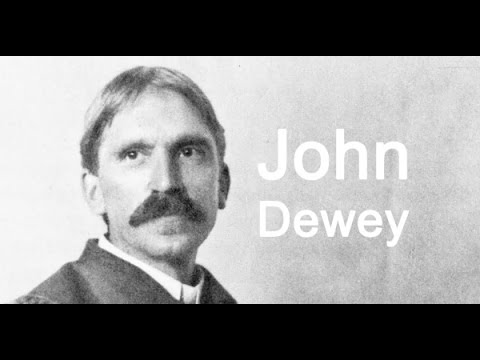
John Dewey
John Dewey: A Philosopher of Education
Early Life and Contributions
- John Dewey was born in 1859 in Burlington, United States, and had a prolific career as a thinker, scholar, and writer. He played a significant role in the organization and defense of the American labor movement while advocating for women's rights, civil liberties, and peace.
- Dewey is recognized as one of the most prominent American philosophers from the late 19th to early 20th century. His influence extended beyond philosophy into social life, making him a public figure involved in progressive causes.
Philosophy of Education
- Dewey emphasized that education should be at the center of contemporary philosophy; he viewed philosophy primarily as a reflection on educational issues. This perspective aligns with his belief that education can provide foundational support for modern democracy.
- While not the first to address education philosophically (notable predecessors include John Locke and Rousseau), Dewey's conviction about its importance marked a significant shift in philosophical thought during his time.
Academic Journey
- In 1882, at age 23, Dewey moved to Baltimore to attend Johns Hopkins University, where he initially embraced Hegelianism as an instrument for liberation but later shifted towards Darwinian evolutionary biology and new psychological theories.
- By integrating these influences, he developed a view termed "humanistic naturalism," focusing on reality as an evolving whole rather than adhering strictly to idealist philosophies. He earned his doctorate in 1884 with a thesis on psychology.
Teaching Career
- After marrying Alice Chipman—who significantly influenced his educational interests—Dewey taught at various institutions including the University of Michigan (1884–1894) and the University of Chicago (1894–1904), where he fostered dynamic studies particularly in logic.
- He continued teaching at Columbia University until 1929 while remaining active as a scholar and writer after retirement; he advocated for women's equality including voting rights and co-founded organizations promoting independent political action.
Legacy and Philosophical Views
- Dewey's work greatly impacted progressive pedagogy from the late 19th century through World War I; he is regarded as one of America's most original educators influencing multiple generations with his ideas on unifying thought with action across disciplines like science and ethics.
- One key aspect of Dewey's philosophy was rejecting dualisms between science/morality or theory/practice; instead, he argued that these paths converge within human experience—a central theme throughout his work emphasizing contextual understanding over mere empirical observation.
Understanding Human Experience and Naturalism
The Complexity of Human Experience
- The relationship between objects and their interactions is complex, blurring the lines between science and morality, leading to a holistic experience of life.
Naturalism Beyond Nature
- Dewey's concept of "naturalismo" transcends mere nature; it encompasses the entirety of human adventure as a dramatic event viewed from an immanent perspective.
Biological and Cultural Matrices
- Human thought is seen as a product of biological evolution, intertwined with cultural contexts that shape behavior and communication.
Instrumentalism in Thought
- Dewey posits that human thought serves as an instrument for nature to evolve from ambiguous situations to more coherent realities, enriching meaning in the process.
Pragmatism vs. Dewey's Perspective
- While aligning with pragmatism, Dewey critiques its central tenet equating truth with utility; he believes truth can be revealed through practice but should not be solely identified with effectiveness.
The Role of Knowledge and Action
Knowledge Intertwined with Conduct
- For Dewey, knowledge cannot be separated from action; understanding arises through engagement in practical activities.
Optimistic Relativism
- Despite life's inherent risks and ambiguities, there exists an optimistic belief in the constructive potential of social practices to navigate challenges.
Philosophy as Guiding Wisdom
- Philosophy must prove its validity by guiding life decisions during crises when optimism may falter, thus becoming a source of wisdom.
Communication and Values
Language as a Social Connector
- Communication is vital for sharing experiences and values among individuals, forming the basis for societal interaction.
Value Judgments Based on Desire
- Values emerge from the desire for enduring enjoyment; doubts about these values require rational inquiry to resolve effectively.
Rationality and Aesthetic Experience
Rationality Rooted in Experience
- Reason evolves through empirical successes and failures; rational principles are deemed effective based on their practical outcomes.
Art as Emotional Expression
- Artistic creation harmonizes past experiences into emotive expressions, requiring personal investment from artists to convey meaningful significance.
The Dramatic Adventure of Existence
Uncertainty in Human Life
- The human journey is characterized by uncertainty; knowledge involves navigating this complexity rather than merely acquiring information.
Understanding Pragmatism and Democracy
The Nature of Knowledge
- Knowledge is not merely about understanding the world but aims to alleviate uncertainty; it seeks control and security in our lives.
- Validity of knowledge is tied to human practice, emphasizing its role in overcoming uncertainty rather than just abstract truth.
Pragmatism: Origins and Implications
- William James popularized the term "pragmatism," drawing inspiration from John Dewey's earlier works.
- Dewey rejected the notion of thinking for its own sake, advocating that thought should yield practical results to manage uncertainty effectively.
Philosophy and Education
- Some critics view pragmatism as excessive utilitarianism, yet it counters philosophical whims that can cloud clear thinking.
- Dewey posits democracy as a form of pedagogy; education serves both to educate citizens and democratize society.
Democratic Ideals
- Dewey addresses the crisis of American civilization post-WWI, proposing a radical defense of democracy through humanistic values.
- He defines democracy not just as political organization but as an ethical ideal promoting equal participation in societal benefits like education and health.
The Role of Institutions
- A democratic society must adapt its institutions continuously through collective action, reflecting changing social dynamics.
- Political structures are tools for achieving broader human relational goals rather than ends in themselves; they facilitate democratic ideals based on faith in human capacity.
Interconnection Between Democracy and Education
- There exists a close relationship between democracy and education; both concepts reinforce each other by fostering responsibility among individuals within society.
- Schools should act as laboratories for democracy, promoting equality by eliminating class distinctions within educational settings.
Practical Approaches to Education
- Dewey advocates for reforms that prioritize manual labor in primary education, viewing schools as workshops where real-life discipline emerges organically.
- He emphasizes collaboration through work experience, which cultivates social habits essential for democratic life.
Legacy of John Dewey
- John Dewey's philosophy has gained renewed attention in contemporary thought, particularly among postmodern thinkers who appreciate his pragmatic approach.
Philosophy and the Future: Insights from Diwi
The Nature of Philosophical Inquiry
- The speaker reflects on the complexity of Diwi's ideas, suggesting that they may be better articulated by other authors who present them with more clarity and elegance.
- A significant point made is that philosophical efforts are seen as explorations towards the future, acknowledging our current uncertainty about what lies ahead.
- The task of philosophy is framed as an attempt to extend our intellectual reach ("pseudópodos intelectuales") to understand our present situation and potential future directions.
Philosophy's Focus on the Future
- Unlike traditional philosophies that emphasize eternity, Diwi introduces a forward-looking perspective in philosophical thought, which resonates with contemporary pragmatist philosophers.
- This characteristic of focusing on future knowledge rather than eternal truths is highlighted as a defining feature of modern philosophical discourse.