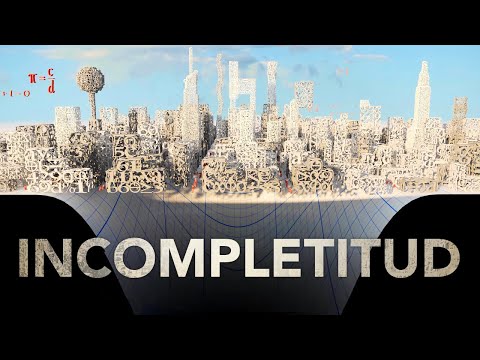
Las Matemáticas tienen una Terrible Falla
The Fallacy in Mathematics
This section discusses a fallacy in mathematics where there are assertions that cannot be proven. One example is the conjecture of twin prime numbers, which states that there are infinitely many pairs of prime numbers that differ by only one.
The Fallacy of Twin Prime Numbers
- There is a fallacy in mathematics where certain assertions cannot be proven.
- One such assertion is the conjecture of twin prime numbers, which suggests that there are infinitely many pairs of prime numbers that differ by only one.
- Despite extensive research, this conjecture remains unproven.
The Game of Life and Indecidability
This section introduces the Game of Life created by mathematician John Conway and explores its properties. It also discusses the concept of indecidability in mathematics.
The Game of Life
- The Game of Life was created by mathematician John Conway in 1970.
- It is played on an infinite grid with square cells, each cell being either alive or dead.
- Two rules govern the game: (1) Any dead cell with exactly three live neighbors becomes alive, and (2) Any live cell with fewer than two or more than three live neighbors dies.
- Despite its simple rules, the game can generate a wide variety of behaviors and patterns.
Indecidability in Mathematics
- In any mathematical system capable of basic arithmetic operations, there will always be true statements that cannot be proven.
- This concept applies to the Game of Life as well; it is impossible to determine the ultimate fate or behavior of a pattern within a finite amount of time.
- Many other systems, such as Wang tiles, quantum physics, airline ticket systems, and even games like Magic: The Gathering exhibit indecidability.
Cantor's Diagonalization and Incomparable Infinities
This section delves into the work of mathematician Georg Cantor and his contributions to set theory. It explores the concept of diagonalization and how it demonstrates the existence of different sizes of infinity.
Cantor's Set Theory
- In 1874, German mathematician Georg Cantor introduced set theory, a new branch of mathematics.
- Cantor studied sets of numbers, such as natural numbers (1, 2, 3...) and real numbers (including fractions and irrational numbers like pi).
- He posed the question: Are there more natural numbers or real numbers between 0 and 1?
Diagonalization Proof
- To compare the sizes of these sets, Cantor devised a diagonalization proof.
- He imagined creating an infinite list that pairs each natural number with a real number between 0 and 1.
- By constructing a new number that differs from every number on the list in at least one decimal place, he showed that there must be more real numbers than natural numbers.
- This proof established the existence of different sizes of infinity.
The Impact on Mathematics
This section discusses how Cantor's work revolutionized mathematics by challenging long-held beliefs about infinity.
Countable vs. Uncountable Infinity
- Cantor classified infinities as countable (like natural numbers) or uncountable (like real numbers).
- His work shattered the belief that all infinities were equal in size.
- Mathematicians began reevaluating their foundations, leading to discoveries like non-Euclidean geometries.
Conclusion
The transcript covers various topics related to mathematics. It starts by discussing a fallacy in mathematics regarding unprovable assertions, such as the conjecture of twin prime numbers. It then introduces the Game of Life and explores its properties, including indecidability. The transcript also delves into Cantor's set theory and his diagonalization proof, which demonstrates different sizes of infinity. Finally, it highlights the impact of Cantor's work on mathematics, challenging long-held beliefs about infinity.
The Controversy Surrounding Set Theory
This section discusses the controversy surrounding set theory and the different perspectives held by mathematicians.
Perspectives on Set Theory
- Enrico and Care believed that mathematics was a creation of the human mind, and they did not consider infinite sets like Cantor's to be real.
- They predicted that future generations would view set theory as a disease from which they had recovered.
- On the opposing side were the formalists, led by German mathematician David Hilbert.
- The formalists believed that mathematics could be based on logical and secure foundations through set theory.
Criticisms of Set Theory
- Leopold Kronecker called Cantor a charlatan and accused him of corrupting the youth.
- Kronecker worked to prevent Cantor from obtaining a desired job.
- In 1901, Bertrand Russell pointed out a serious problem in set theory known as Russell's paradox.
- Russell showed that if sets could contain anything, they could also contain themselves or other sets, leading to contradictions.
Attempts to Resolve Paradoxes
- Gilbert and other mathematicians restricted the concept of sets to eliminate self-referential paradoxes.
- This allowed them to survive this round of criticism, but self-reference continued to pose challenges.
David Hilbert's Formalism
This section explores David Hilbert's goal of establishing a formal system for mathematical proofs.
Hilbert's Vision
- David Hilbert aimed to develop a new system for mathematical proofs based on formalism.
- He wanted to express mathematical axioms as symbolic statements in a formal system with rigid rules for manipulating symbols.
Principia Mathematica
- Hilbert, along with Alfred North Whitehead, developed Principia Mathematica in three volumes, published in 1913.
- This extensive work consisted of about 2,000 pages of dense mathematical notes.
- It took 762 pages just to prove that one plus one equals two.
Benefits and Limitations
- Principia Mathematica provided a precise and accurate language for mathematics, eliminating room for errors or confusion.
- However, the complexity and length of the system made it challenging to use effectively.
Indecidability and Self-reference
This section discusses indecidability and self-reference in mathematics.
Hao Wang's Mosaic Problem
- Mathematician Hao Wang studied square mosaics with different colors on each side.
- The question was whether an arbitrary set of these mosaics could cover a plane without gaps.
- It was proven that it is impossible to determine if a given set of mosaics will cover the plane or not.
Connection to Self-reference
- The problem of determining mosaic coverage is an example of an undecidable problem.
- This problem ultimately stems from self-reference, similar to Russell's paradox.
Systems of Proof and Formalism
This section explores systems of proof and formalism in mathematics.
Ancient Greek Systems of Proof
- Systems of proof originated in ancient Greece with basic axioms assumed as true statements.
- Proofs were constructed using rules of inference to derive new statements while preserving truth.
Hilbert's Formal System
- Hilbert aimed to develop a formal system for proofs using symbolic logic and strict rules for manipulating symbols.
- Logical and mathematical statements could be translated into this system, ensuring accuracy and rigor.
Advantages and Challenges of Formal Systems
This section discusses the advantages and challenges associated with formal systems in mathematics.
Advantages of Formal Systems
- Formal systems, such as Hilbert's, provide precise and accurate languages for expressing mathematical statements.
- They eliminate ambiguity and allow for rigorous proofs without room for errors or confusion.
Challenges of Formal Systems
- The complexity and length of formal systems, like Principia Mathematica, make them difficult to use effectively.
- Navigating through dense mathematical notes can be exhausting and time-consuming.
Conclusion
This section concludes the discussion on set theory controversies, formalism, self-reference, and the challenges of formal systems in mathematics.
Summary
- Set theory has been a subject of controversy among mathematicians.
- David Hilbert aimed to establish a formal system for mathematical proofs through his work on Principia Mathematica.
- Self-reference poses challenges in mathematics, leading to undecidable problems.
- Formal systems offer precision and accuracy but can be complex and challenging to navigate.
Three Questions about Mathematics
In this section, Gilbert poses three fundamental questions about mathematics: (1) Is mathematics complete? Can every true statement be proven? (2) Is mathematics consistent? Is it free from contradictions? (3) Is mathematics decidable? Can an algorithm always determine if a statement follows from axioms?
Gilbert's Dream of Formalism
- Gilbert believed that the answers to these questions were affirmative.
- In 1930, he gave a passionate speech about these questions, expressing his dream of formalism.
- His slogan was "We must know, we will know," which is inscribed on his tomb.
The Collapse of Gilbert's Dream
This section discusses how Gilbert's dream started to crumble when Kurt Gödel found the answer to the question of completeness.
Gödel's Answer to Completeness
- At a conference in 1930, a young logician named Kurt Gödel explained that a complete formal system for mathematics was impossible.
- John von Neumann was the only one who paid attention to Gödel at first.
- The following year, Gödel published his proof of incompleteness theorem, gaining widespread recognition.
Google's Proof and Numbering System
This section explains how Google used logic and mathematics to answer questions about the system itself.
Using Numbers for Symbols
- Google assigned numbers to basic symbols in the mathematical system.
- For example, "not" symbol gets number 1 and "or" symbol gets number 2.
- By representing symbols with numbers, equations can be written using these numbers.
Representing Equations with Google Numbers
- Equations like "0 equals 0" can be represented using Google numbers.
- Each prime number is raised to the power corresponding to the symbol's number in the equation.
- The resulting number represents the equation.
Google Numbers for Axioms
- Axioms also have their own Google numbers, calculated in the same way as symbols.
- By substituting variables with specific numbers, proofs can be created.
Wood's Incompleteness Theorem
This section explains Wood's proof of incompleteness and its implications for mathematical systems.
Indemonstrable Statements
- Wood's proof shows that there are statements within a mathematical system that are true but have no proofs.
- If a false statement had a proof, it would lead to a contradiction and inconsistency in the system.
- Alternatively, if a true statement had no proof, it would indicate incompleteness of the system.
Paradoxical Self-reference
- The transcript mentions an example from "The Office" series that illustrates Good's paradoxical self-reference.
- It highlights how self-referential statements can lead to contradictions and paradoxes.
Conclusion: Incompleteness of Mathematical Systems
This section concludes by summarizing Wood's theorem and its implications for all mathematical systems.
Incompleteness of Mathematical Systems
- Wood's theorem proves that any mathematical system with basic arithmetic will have true statements without proofs.
- This demonstrates the inherent limitations of formal systems and their inability to capture all truths.
New Section
The incompleteness theorems of Google and the concept of truth and provability in mathematics are discussed. The limitations of formal systems in proving their own consistency are explored.
The Incompleteness Theorems
- Incompleteness of Google's Theorem: The theorem states that truth and provability are not the same in mathematics. There will always be true statements about mathematics that cannot be proven.
- Google's Second Incompleteness Theorem: It demonstrates that any consistent formal system of mathematics is unable to prove its own consistency.
- Implications of the Incompleteness Theorems: A consistent but incomplete system of mathematics cannot prove its own consistency, which means contradictions may arise, revealing inconsistencies in the system.
New Section
Alan Turing's contribution to answering Gilbert's question about decidability in mathematics is discussed. Turing's concept of a universal machine and its ability to simulate any computable algorithm is explained.
Alan Turing and Computability
- Turing's Contribution: In 1936, Alan Turing found a way to determine if a statement follows from axioms by inventing the modern computer.
- The Universal Machine: Turing imagined a mechanical machine with an infinite tape containing cells with either 0 or 1. It could read one digit at a time and perform various tasks like rewriting, moving left or right, or stopping.
- Computable Algorithms: Turing machines can execute any computable algorithm given enough time. They have arbitrary memory capacity and can perform operations from simple addition to complex computations.
- Turing Machines and Halting Problem: Turing realized that the problem of determining if a Turing machine will halt is similar to the problem of undecidability. If he could solve one, he could solve the other.
New Section
The connection between the halting problem and decidability in mathematics is explored. The concept of a hypothetical machine H that can determine if a Turing machine halts is introduced.
The Halting Problem and Decidability
- Hypothetical Machine H: Turing proposed a machine H that can determine if any Turing machine halts given specific input. It simulates what would happen based on its own input.
- Contradiction and Non-existence of H: If H concludes that it will never halt, then it immediately halts. If H concludes that it will halt, then it enters an infinite loop. This contradiction leads to the non-existence of a machine like H.
- Implications for Mathematics: There is no general algorithm to determine if a statement follows from axioms. This means problems like the Twin Prime Conjecture may remain unsolvable, leaving questions unanswered.
New Section
The concept of undecidability extends beyond mathematics into physical systems such as quantum mechanics.
Undecidability in Physical Systems
- Undecidability in Quantum Mechanics: In quantum mechanics, the energy difference between the ground state and first excited state, known as spectral gap, varies across different systems. Some systems have significant spectral gaps while others lack them entirely.
- Continuum of Levels: The presence or absence of spectral gaps forms a continuum rather than a binary distinction. This undecidability in physical systems mirrors the undecidability in mathematics.
The transcript provided is in Spanish, so the summary and section titles are translated into English for clarity.
New Section
This section discusses the concept of completeness in Turing machines and its connection to undecidable problems.
Completeness of Turing Machines
- Alan Turing aimed to create powerful computers, and the best systems are those that can perform all tasks a Turing machine can.
- However, every complete system has its own undecidable problem, such as the halting problem for Wang tiles or the spectral gap for quantum systems.
- Examples of complete systems include airline ticketing systems, Magic: The Gathering game, PowerPoint slides, and Excel documents.
- While many programming languages are designed to be complete according to Turing's definition, theoretically only one language is needed since any complete system can simulate another.
The Game of Life as a Complete System
- The Game of Life is considered complete according to Turing. It has its own halting problem - whether it will stop evolving or continue indefinitely.
- The Game of Life can simulate itself due to its completeness in terms of Turing machines.
New Section
This section explores the impact and legacy of Alan Turing's work on computing and cryptography.
Alan Turing's Legacy
- Despite suffering from mental instability throughout his life, Alan Turing made significant contributions to computing during World War II.
- Alongside his colleagues, he developed real electronic programmable computers based on his designs after decrypting Nazi codes.
- In 1952, Turing was convicted for "indecency" due to his homosexuality, leading to the loss of his security clearance and forced hormone injections.
- Turing is considered the most important figure in computer science, as all modern computers descend from his designs.
New Section
This section delves into the connection between Turing machines and the incompleteness of mathematics.
The Incompleteness of Mathematics
- Turing's machines for code-breaking and all modern computers stem from the paradoxes arising from self-reference.
- There is a fundamental flaw in mathematics that ensures we can never know everything with certainty.
- Understanding this problem transformed the concept of infinity, influenced World War II, and led to the invention of devices like the one you are using now.
Turn any video into a summary like this
YouTube links, meetings, lectures. With transcripts, search, and chat.