Big Bang
Big Bang Theory: An Overview
Introduction to the Big Bang Theory
- The film discusses the Big Bang theory, which posits that the universe originated from a tiny point, leading to its expansion.
- Initially, many scientists mocked the Big Bang theory, favoring the steady state model of an unchanging and infinite universe.
Historical Perspectives on the Universe's Existence
- A key question is whether the universe has always existed or if it had a beginning. Ancient Greeks supported Aristotle's view of an eternal universe.
- In contrast, biblical accounts suggest a creation event ("Let there be light"), indicating a definitive beginning for the universe.
Steady State vs. Big Bang
- The mid-20th century saw widespread support for steady state theory, which claimed an unchanging and infinitely old universe.
- Fred Hoyle coined "Big Bang" as a derisive term against this theory; however, it became widely accepted in scientific discourse.
Albo's Paradox and Its Implications
- Albo's paradox challenges steady state theory by questioning why we observe a dark night sky despite an infinite number of stars.
- If the universe were truly infinite and static, every part of the sky should be filled with starlight; instead, we see darkness.
Evidence Supporting Big Bang Theory
Discovery of Cosmic Microwave Background Radiation
- A pivotal discovery was made in 1965 by physicists Wilson and Penzias when they detected cosmic background radiation while troubleshooting their equipment.
- This radiation is remnants from the early stages of the universe following its creation during the Big Bang.
Understanding Singularities
- The early universe was concentrated into a singularity—an extremely dense and hot point where conventional physics breaks down.
- This singularity led to rapid expansion approximately 13.7 billion years ago, marking what we consider as 'the beginning' of our current understanding of time and space.
Formation of Atoms Post-Big Bang
- After about 380,000 years post-Big Bang, protons and electrons combined to form atoms as temperatures cooled sufficiently for stable structures to emerge.
Big Bang Theory and Cosmic Expansion
The Origin of the Universe
- The Big Bang theory posits that the universe originated from a singular point, leading to its expansion. This event is linked to the cosmic background radiation observable today.
Continuous Expansion of the Universe
- The universe continues to expand, akin to a balloon inflating. As it expands, objects within it (like ants on a balloon's surface) move away from each other.
Observing Cosmic Movement
- When observing stars and galaxies in the night sky, all celestial bodies appear to be moving away from us due to this ongoing expansion.
Distance and Speed Relationship
- Using an analogy with a stretched elastic band marked at intervals, as the band stretches, distances between points increase. This illustrates how distant objects move away faster than closer ones.
Hubble's Law Explained
- Hubble's Law states that the speed at which an object moves away is proportional to its distance from us. It can be expressed mathematically: velocity (v) = Hubble constant (H) × distance (D).
Measuring Cosmic Distances Through Redshift
Understanding Redshift
- Redshift occurs when light waves stretch as objects move away from us; longer wavelengths correspond to red light while shorter wavelengths correspond to blue light.
Implications of Redshift for Astronomy
- A greater redshift indicates that an object is moving further away. If we observe a galaxy emitting light with increased wavelength, it signifies its recession from Earth.
Calculating Velocity via Redshift
- The formula for calculating velocity based on redshift involves measuring changes in wavelength relative to original wavelengths. High velocities correlate with high redshifts.
Blue Shift vs. Red Shift
- While most distant objects exhibit redshift due to their movement away from us, blue shift occurs when objects approach Earth; however, this is less common for far-off galaxies.
Big Bang Theory and Cosmic Composition
Distribution of Elements in the Universe
- The Big Bang theory explains the distribution of elements in the universe, primarily consisting of hydrogen and helium.
- Approximately 75% of the universe is hydrogen, while about 24% is helium; only around 1% comprises all other elements.
Olbers' Paradox and Cosmic Background Radiation
- Despite an infinite number of stars in an infinite universe, the night sky appears dark due to the finite age of the universe and its expansion.
- The universe's rapid expansion means that not all light from distant stars has reached us yet, contributing to the darkness observed in the night sky.
Evidence Supporting Big Bang Theory
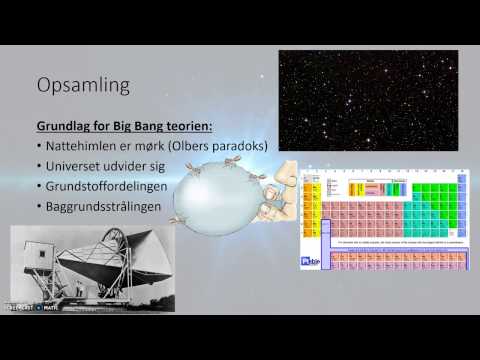
- Key evidence for the Big Bang includes:
- The dark night sky (Olbers' paradox).
- Continuous expansion of the universe since its inception.
- The elemental composition aligning with predictions made by Big Bang theory.
- Additionally, cosmic background radiation was initially misidentified but later recognized as a remnant from shortly after the Big Bang.
Turn any video into a summary like this
YouTube links, meetings, lectures. With transcripts, search, and chat.