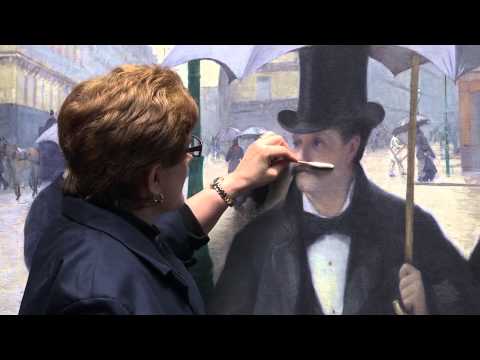
A Thousand and One Swabs: The Transformation of "Paris Street; Rainy Day"
Cleaning a Painting: The Restoration Process
Initial Cleaning Techniques
- The restoration process begins with a gentle swabbing technique, where the swab is rolled over the surface of the painting to remove yellow varnish.
Historical Context and Preparation
- The Art Institute acquired the painting in 1964, and it likely underwent treatment just before its sale. The restorer has spent several weeks familiarizing themselves with the artwork prior to focusing on its central faces.
- A notable observation during restoration is that while flesh tones will appear brighter post-cleaning, elements like hair, hats, and coats are expected to darken.
Cleaning Methodology
- For effective cleaning, the painting will be turned upside down. This allows better access to the top part of the artwork while also enhancing visibility of changes in color due to varnish removal.
- Before cleaning, the sky was uniformly yellow; however, after flipping the painting, this yellow varnish becomes more pronounced at the bottom.