A beginner's guide to quantum computing | Shohini Ghose
Introduction
The speaker introduces a simple coin game and explains how it can be played on a quantum computer.
Playing the Coin Game
- The game is played on a casino's computer.
- The computer makes moves in the game like a human player.
- The game starts with a coin showing heads, and the computer plays first. It can choose to flip the coin or not, but you don't get to see the outcome.
- Next, it's your turn. You can also choose to flip the coin or not, and your move will not be revealed to your opponent, the computer.
- Finally, the computer plays again, and can flip the coin or not. After these three rounds, the coin is revealed, and if it is heads, the computer wins; if it's tails, you win.
Quantum Computers
- A quantum computer operates by controlling atoms' behavior in a way that is completely different from our regular computers.
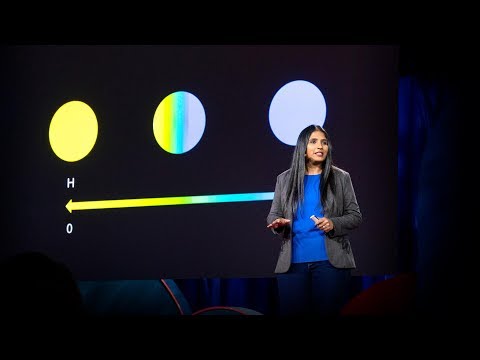
- A quantum bit has a more fluid identity than regular bits. It can exist in a superposition of zero and one with some probability of being either value.
- Quantum computers have potential applications in security needs, healthcare and even internet technology.
Playing Coin Game on Quantum Computer
The speaker explains how they played 372 games against IBM's quantum computer using audience choices.
Audience Choices
- Ahead of time TED asked viewers whether they would choose to flip a circle or square if they played this game remotely.
- Circle meant "flip," while square meant "don't flip."
- 372 responses were received.
Results
- The quantum computer won almost every game.
- It lost a few only because of operational errors in the computer.
How Quantum Computers Work
The speaker explains how quantum computers work and why they are different from regular computers.
Quantum Bits
- A regular computer simulates heads or tails of a coin as a bit, a zero or a one, or a current flipping on and off inside your computer chip.
- A quantum bit has a more fluid, nonbinary identity. It can exist in a superposition of zero and one with some probability of being either value.
- Its identity is on a spectrum; for example, it could have 70% chance of being zero and 30% chance of being one.
Uncertainty
- We have to give up precise values of zero and one and allow for some uncertainty.
Introduction to Quantum Computing
In this section, the speaker introduces quantum computing and explains how it differs from classical computing.
Quantum Computing vs Classical Computing
- Regular coins do not exist in combinations of heads and tails.
- Quantum properties are powerful and can be used to build future quantum technologies.
- The quantum computer won because it harnessed superposition and uncertainty.
- Three potential applications of quantum computing include unbreakable encryption, large-scale simulations for drug development, and teleportation of information.
Teleportation of Information
In this section, the speaker explains how teleportation of information is possible using quantum particles.
How Teleportation Works
- Teleportation of information is possible because the fluid identities of the quantum particles can get entangled across space and time.
- When you change something about one particle, it can impact the other, creating a channel for teleportation.
- Teleportation has already been demonstrated in research labs and could be part of a future quantum internet.
Conclusion
In this section, the speaker concludes by discussing her personal view on quantum physics and its potential for exploring the mysteries of nature.
Personal View on Quantum Physics
- Quantum computers are a way for us to probe the mysteries of nature and reveal more about this hidden world outside our experiences.
- The universe rewards us by showing us how incredibly interesting and surprising it is.
- The future is fundamentally uncertain, which is certainly exciting.
Turn any video into a summary like this
YouTube links, meetings, lectures. With transcripts, search, and chat.