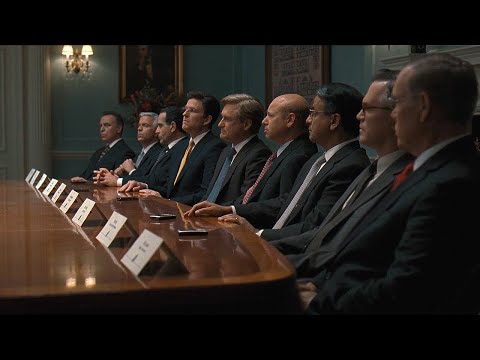
Hank Paulson presents TARP to the big banks – Too Big to Fail (2011)
New Section
In this section, the speaker discusses the need for strong action in the United States to address financial stress. The Treasury will purchase preferred stock in banks represented in the room to stabilize the financial system and restore confidence.
Taking Strong Action to Address Financial Stress
- The United States needs to take strong decisive action to arrest the stress in our financial system.
- The Treasury will purchase preferred stock in each of the banks represented in this room.
- The purchased stock will yield 5% for the first five years and 9% thereafter.
- This injection of capital will help unfreeze credit, stabilize banks, and restore confidence.
- All nine participants in the room are expected to participate in this program.
New Section
In this section, there is a discussion about some banks not needing capital while others do. The stronger banks are expected to serve as cover for weaker ones.
Capital Needs and Covering Weaker Banks
- Some participants claim they don't need any capital, but it is emphasized that all of them need it.
- Uncertainty about future market conditions makes it necessary for even stronger banks to participate.
- The money injected into weaker banks serves as a signal that they are too weak to survive without assistance.
New Section
This section focuses on discussing specific amounts of capital needed by different banks and why buying toxic assets is not feasible.
Specific Capital Amounts and Buying Toxic Assets
- Different banks require varying amounts of capital: Bank of America ($125 billion), Bank of New York Mellon ($15 billion), Citigroup ($3 billion), Goldman Sachs ($25 billion), JPMorgan ($10 billion), Merrill Lynch ($10 billion), Morgan Stanley ($10 billion), State Street ($2 billion), and Wells Fargo ($25 million).
- Buying toxic assets is considered too slow, and the banks might not survive long enough to benefit from it.
- Handing over cheap capital to the banks is seen as a better alternative.
New Section
This section addresses concerns about compensation policies and government involvement in dictating compensation.
Compensation Policies and Government Involvement
- Participants express concerns about the government dictating compensation if they become part owners of the banks.
- The potential impact on talent retention is highlighted, suggesting that competitive pay is necessary.
- The government assures limitations on deductions and golden parachutes until the money is repaid to the Treasury.
New Section
This section emphasizes the importance of preventing a financial system collapse and highlights the consequences for all participants.
Preventing Financial System Collapse
- The country is facing its worst economy since the Great Depression, making it crucial to prevent a financial system collapse.
- The speaker urges cooperation by stating that if the financial system collapses, it will take down every participant in the room.
New Section
In this final section, there is a discussion about signing papers without board approval.
Signing Papers Without Board Approval
- There is a request to sign papers immediately, but one participant mentions needing board approval within 24 hours.
- The speaker believes the board will go along with it, and if not, they will be fired.