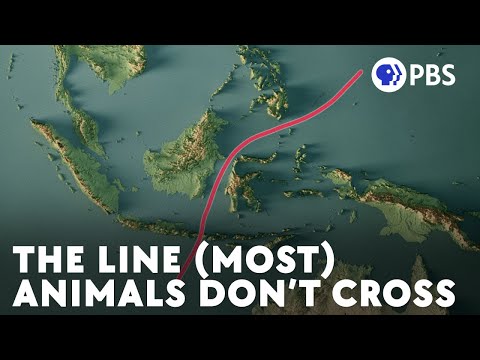
The Invisible Barrier Keeping Two Worlds Apart
The Wallace Line: A Biogeographic Boundary
This video explores the Wallace Line, an invisible biogeographic boundary that separates two regions of biodiversity in the Malay Archipelago. It discusses how this line was discovered and what it tells us about the geological history of the region.
Discovering the Wallace Line
- The Wallace Line is an invisible barrier that separates two regions of biodiversity in the Malay Archipelago.
- The line was first sketched out by British naturalist Alfred Russel Wallace in 1859 during his eight-year trip around the archipelago.
- While observing and collecting species on his voyage, Wallace noticed a sudden and distinct change in animal life as he moved east from Bali to Lombok.
- Certain species that were plentiful on Java and Bali didn't exist at all on Lombok, indicating a sharp divide between two different worlds.
Understanding the Geological History
- The biogeographic line drawn by Wallace reflected more than just proximity of islands; it also took into account ancient geological events that shaped present-day distribution of living species.
- By taking this perspective, Wallace concluded that western islands must have once been connected to each other and to Asian mainland while eastern islands were remnants of former Australian continent.
- Today's separation by expanses of water is due to geologically recent rise in sea levels, which explains why big animals like tigers and rhinos ended up on western islands but not eastern ones.
Significance for Biogeography
- The Wallace Line is a biogeographic boundary where two highly distinct regions of biodiversity meet.
- Wallace's discovery of the line helped establish him as the father of biogeography, the study of distribution of living things.
- The abrupt shift in animal life across the line indicates that other mysterious forces beyond proximity must be in play, such as geology and ancient geological events.
Wallace's Line and Plate Tectonics
This section discusses how plate tectonics helped complete the puzzle of Wallace's line, which separates distinct animal communities in Southeast Asia.
Plate Tectonics Shapes Our Planet
- The surface of the planet is dynamic and made up of individual plates that move and collide over vast stretches of geologic time.
- Plate tectonics only became widely accepted in the late 1960s, more than half a century after Wallace’s death.
- The Malay Archipelago is one of the most complex tectonic regions in the world, a meeting point of multiple plates all jostling for space.
- The two former continuous land masses on either side of Wallace's line were Sunda in the west and Sahul in the east. They existed during the ice ages when more water was locked up in ice and sea levels were lower.
Evolutionary Separation Due to Plate Tectonics
- The Sahul continent encompassed Australia, Tasmania, New Guinea, and Aru islands. It only approached the Asian Sunda continental shelf around 20 to 25 million years ago.
- Species from each side evolved separately for eons before their worlds collided fairly recently in evolutionary terms.
- Oceanic islands created by plate tectonics differ from continental islands that flank them because they were never connected to either greater land mass.
Barrier to Asian Species Moving East
- Komodo dragons first appeared on mainland Australia more than 3 million years ago but only reached their current Indonesian island homes around 1 million years ago.
- The deep waters with strong currents that weave between the two regions still limit the dispersal of many species across the line, keeping the differences in their evolutionary history visible.
- Wallace's invisible line shows how ancient geological events can echo through time and shape the diversity and distribution of life in strange and contrasting ways.
Conclusion
This section concludes by recognizing Wallace as a pioneer in figuring out how species came to be where they are.
- While Darwin gets virtually all the credit for figuring out how species came to be, Wallace is still recognized as a pioneer in figuring out how species came to be where they are.
English Setting up a Meeting
In this section, the speaker talks about setting up a meeting with Kallie and Joann from HR to discuss an issue. The speaker also mentions some names.
- The speaker needs to set up a meeting with Kallie and Joann from HR to address an issue.
- It is not okay that someone is making the speaker say puns.
- The speaker mentions several names: Raphael Haase, Jake Hart, Juan M, Annie & Eric Higgins, John Davison Ng, and Melanie Lam Carnevale.
English Joke Time
In this section, the speaker tells a joke submitted by Sonja.
- Become an Eonite at patreon.com/eons and submit a joke for the speaker to read.
- The joke submitted by Sonja is "You can’t blame barnacles for being clingy… They’re just a tiny shellfish."
- The speaker repeats the joke after taking a breath.
English Conclusion
In this section, the video concludes with some final remarks.
- If something makes the speaker laugh, then it must be considered as a joke.
- Thanks for joining in the Adam Lowe studio.
- Subscribe at youtube.com/eons for more epic epochs.