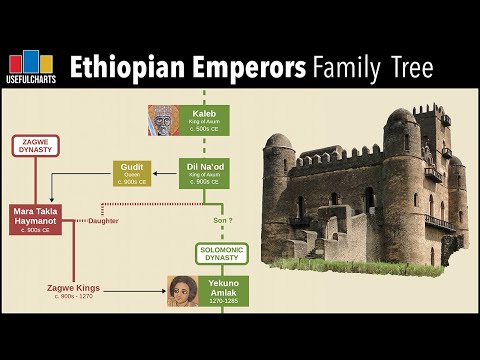
Ethiopian Emperors Family Tree (Solomonic Dynasty) | feat. From Nothing
Introduction to the Solomonic Dynasty of Ethiopia
Overview of the Dynasty
- Jabari introduces himself and the topic, focusing on the family tree of the Solomonic dynasty, claiming to be the oldest in the world with roots tracing back to King Solomon.
- The video will cover ancient kings of Axum through modern emperors, using a family tree chart designed by Matt available for download.
Legendary Beginnings
- Many royal dynasties trace origins to legendary figures for legitimacy; Ethiopia's Yekuno Amlak claimed descent from Solomon after defeating Zagwe kings.
- King Solomon is described as a biblical figure, son of David, known for building the First Temple; historians view him as a legendary character with embellished stories.
The Queen of Sheba and Ethiopian Tradition
The Kebra Nagast
- Biblical account mentions Queen of Sheba visiting Solomon; Ethiopian tradition (Kebra Nagast) states she had relations with him and bore Menelik, first king of Ethiopia.
- Menelik returned to meet Solomon as an adult and was given the Ark of the Covenant, which holds significant religious importance.
Historical Context: Kingdom of Axum
Emergence and Influence
- By 1 CE, a powerful kingdom named Axum emerged in Ethiopia, replacing Kush as a dominant state south of Egypt; archaeological evidence supports this.
- Za Haqala is noted as the first historically verifiable king; during King Ezana's reign, Christianity spread through Saint Frumentius' efforts.
Expansion and Trade
- In the sixth century, King Kaleb expanded territory into Arabia by conquering Himyar; regular trade existed between Ethiopia and India at this time.
Decline and Transition: From Axum to Zagwe Dynasty
Fall of Axum
- Oral tradition claims that Queen Gudit destroyed Axum in the ninth century by killing male royals and reigning for about 40 years.
Rise of Zagwe Dynasty
- The Zagwe dynasty followed for over 300 years; its first king married into Axum royalty to ensure continuity. Christianity was restored under their rule.
Establishment of Solomonic Dynasty
Claiming Heritage
- Yekuno Amlak overthrew Zagwe claiming descent from an escaped royal child during Gudit’s massacre; thus establishing Solomonic dynasty in 1270.
Longevity and Title Changes
- Although direct lineage to Solomon is uncertain, it is confirmed that Solomonic rule lasted until modern times—one of history's longest-reigning dynasties.
Ethiopian History: The Solomonic Dynasty and Key Figures
The Role of Women in Ethiopian History
- Eleni, a former Muslim princess, became a significant political figure after marrying Jacob (Constantine I) and demonstrated women's influence in Ethiopian politics.
- After her husband's death, she served as regent for Dawit II, showcasing the continuity of female power through generations.
The Conflict with the Adal Sultanate
- During Dawit II's reign, Ethiopia engaged in a war against the Adal Sultanate supported by the Ottoman Empire; neither side emerged victorious.
- This conflict led to a fragmentation of the Solomonic dynasty into branches, notably Gondar and Shewa.
Key Emperors and Their Contributions
- Susenyos I was the first emperor from the Gondar branch; he ruled during a time when the Oromo people began migrating into Ethiopia.
- Iyasu I initiated administrative reforms but was assassinated by his son, leading to the Zemene Mesafint or "Era of Princes," where regional princes held more power than the emperor.
Mentewab's Influence During Turbulent Times
- Mentewab wielded significant power during the Era of Princes as co-emperor alongside her son Bakaffa and grandson.
Tewodros II: Reunification Efforts and British Conflict
- Tewodros II is recognized for reuniting Ethiopia in 1855 but faced challenges maintaining authority, leading to conflicts with Britain over hostages.
- A massive British military response included 280 ships and 13,000 soldiers; Tewodros ultimately committed suicide after being unable to fend off this intervention.
Power Struggles Post-Tewodros II
- Following Tewodros' death, Yohannes IV emerged victorious over rivals like Ras Mengesha Yohannes and Menelik II in a struggle for succession.
- Menelik II became emperor after defeating his rivals; he successfully repelled an Italian invasion early in his reign.
Transition to Empress Zewditu and Haile Selassie's Rise
- Due to concerns about Iyasu V's potential support for Islam, Zewditu ascended as empress while Iyasu remained un-crowned.
- Ras Tafari Makonnen (later Haile Selassie I), initially serving as regent under Zewditu due to lineage complexities, eventually became emperor himself.
Haile Selassie's Legacy
- Haile Selassie I rose to prominence as one of Africa’s most influential leaders; Rastafarianism emerged later attributing messianic significance to him despite his personal beliefs.
History of Haile Selassie and the Solomonic Dynasty
The Reign of Haile Selassie
- During World War II, British support enabled Haile Selassie to reclaim Ethiopia, leading to his reign lasting until 1974.
- In 1974, a communist group known as the Derg overthrew the monarchy; Haile Selassie's son was briefly declared emperor before the monarchy was abolished in 1975.
The Fate of Haile Selassie
- Details surrounding Haile Selassie's death remained unclear until the fall of various communist regimes in the 1990s, revealing he had been assassinated in 1975.
- In 2000, an elaborate state funeral was held for him since he did not receive one at his time of death.
Legacy of the Solomonic Dynasty
- Today, Ethiopia operates as a democratic republic; however, descendants of the Solomonic dynasty continue to exist.
- Zira Jakob is recognized as the most senior heir to the former throne, while his cousin Prince Ermias serves as president of the crown council and represents the former monarchy when necessary.
Further Learning Resources