Neuronal Pools and Neural Processing
Introduction to Neurons
In this section, Professor Dave introduces the topic of neurons and discusses their organization and hierarchy.
Neuronal Organization
- Neurons are organized in groups, which contribute to larger structures known as neural integration.
- A small collection of neurons is called a neuronal pool, which integrates incoming information.
- Neurons can be classified into discharge zone and facilitated zone based on their points of contact with presynaptic fibers.
- The discharge zone neurons receive more synaptic contacts and are more likely to depolarize beyond the threshold for generating an action potential.
- The facilitated zone neurons depolarize to some extent but are less likely to reach the threshold unless additional stimuli are received from elsewhere.
Encoding Complex Information
This section explores how the organization and number of neurons allow for encoding complex information through electrochemical signals.
Neural Circuits
- Neurons are arranged in circuits similar to computer circuitry.
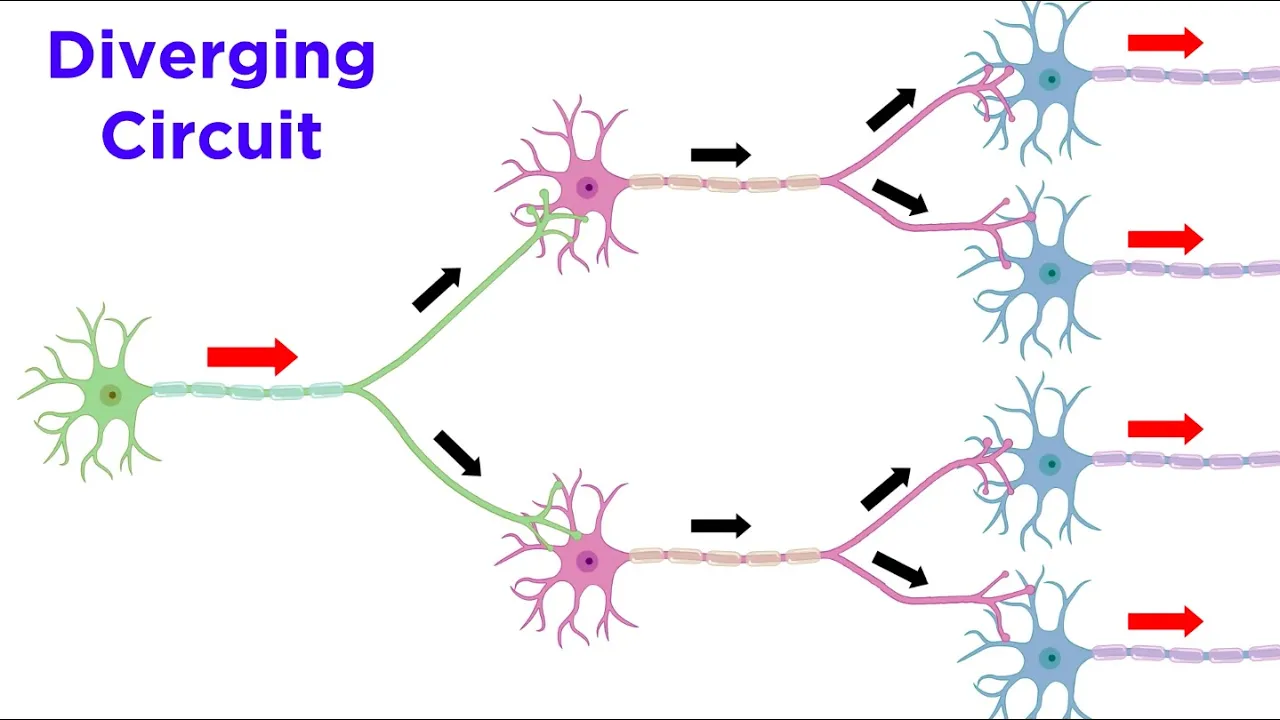
- Different types of circuits include diverging, converging, reverberating, and parallel after-discharge circuits.
- Diverging circuit amplifies the signal with each transmission, allowing a single neuron to activate multiple motor neurons.
- Converging circuit concentrates the signal by having multiple inputs converge onto one output. It is commonly seen in sensory information traveling to the brain.
- Reverberating circuit forms an oscillating loop where neurons feed back to previous ones. It controls rhythmic activities like breathing and repetitive actions like walking.
- Parallel after-discharge circuit involves parallel arrays that converge on a single output. It produces bursts of multiple impulses and is involved in complex brain activity like coincidence detection.
Neural Processing
- Serial processing involves all-or-nothing type processing where a signal travels from one neuron to another until it reaches its destination, triggering a response. Reflexes are examples of serial processing.
- Parallel processing occurs when an input diverges into many pathways, and each pathway interprets the information in its own way. It is responsible for higher-level brain activity in humans, allowing us to synthesize various information and recognize obscure objects.
Conclusion
In this final section, Professor Dave concludes the discussion on neural circuits and processing.
Recap
- Neurons are organized in groups called neuronal pools, contributing to neural integration.
- Different types of circuits include diverging, converging, reverberating, and parallel after-discharge circuits.
- Neural processing can be either serial or parallel, with parallel processing being responsible for higher-level brain activity.
The transcript does not provide any further content beyond this point.