Ecologia - Aula 12 - Ecossistemas aquáticos
Introduction to Ecological Systems
In this section, the instructor introduces the topic of aquatic ecosystems and explains that they can be freshwater or marine. Freshwater ecosystems include rivers, lakes, and reservoirs, while marine ecosystems are more diverse and include tidal zones, rocky shores, sandy beaches, coral reefs, and hydrothermal vents.
Types of Organisms in Aquatic Ecosystems
- The instructor discusses the different categories of organisms in aquatic ecosystems.
- Plankton: Organisms that cannot actively swim against currents. Includes phytoplankton (photosynthetic) and zooplankton (heterotrophic).
- Nekton: Organisms that actively swim against currents. Includes cephalopods, fish, reptiles (e.g., turtles), birds (e.g., penguins), and mammals (e.g., cetaceans).
- Benthos: Organisms associated with the bottom of water bodies. Can be plants (benthic algae) or animals (benthic invertebrates).
- Pleuston: Organisms that float on the water surface but have structures above the water. Examples include water lilies and siphonophores.
- Neuston: Organisms associated with the surface film of water or walking on it. Examples include insects like water striders and mosquito larvae.
- Periphyton/Biofilm: Thin layer formed by bacteria, unicellular algae (cyanobacteria), protozoa, etc., on submerged surfaces.
Freshwater Ecosystems
- The instructor focuses on freshwater ecosystems.
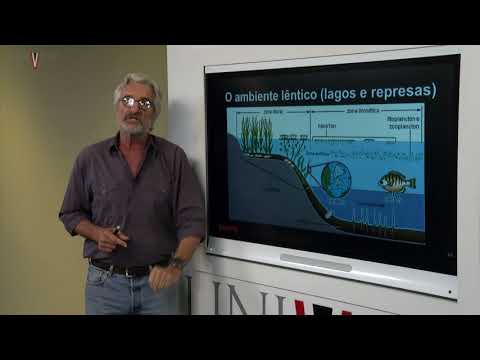
- Lentic Environment (Lakes): Water is not flowing continuously like in rivers.
- Epilimnion: The upper layer of the lake where light penetrates.
- Hypolimnion: The deeper layer of the lake where light does not reach.
- Littoral Zone: The shallow area near the shore where macrophytes (large rooted plants) grow.
- Limnetic Zone: The central, deeper part of the lake with no light penetration.
Density and Temperature in Lakes
- The instructor explains how water density affects temperature distribution in lakes.
- Thermocline: A zone of rapid temperature change between warm surface waters and cold deep waters.
- Stratification: Layering of water based on temperature and density differences.
- Epilimnion, Metalimnion (Thermocline), and Hypolimnion are distinct layers formed due to stratification.
Nutrient Cycling in Freshwater Ecosystems
- Nutrient cycling is crucial for freshwater ecosystems.
- Phytoplankton utilize nutrients like nitrogen and phosphorus for growth through photosynthesis.
- Zooplankton consume phytoplankton, transferring energy up the food chain.
- Decomposers break down organic matter, releasing nutrients back into the ecosystem.
Marine Ecosystems
- Marine ecosystems are more diverse than freshwater ecosystems due to the complexity of the environment.
- Intertidal Zone (Tidal Zone): Area between high tide and low tide with rocky shores and sandy beaches. Supports various organisms adapted to changing conditions.
- Coral Reefs: Diverse ecosystems formed by coral polyps that secrete calcium carbonate skeletons. Provide habitat for numerous species.
- Hydrothermal Vents: Found at great depths near tectonic plate boundaries. Support unique communities adapted to extreme conditions.
Conclusion
The instructor concludes the lecture by mentioning other aquatic ecosystems that are worth exploring through additional sources.
Water Stratification in Lakes
This section discusses the stratification of water in lakes, focusing on the different layers and their characteristics.
Water Stratification in Lakes
- The water in lakes can be stratified into different layers based on temperature and oxygen levels.
- The uppermost layer is called the epilimnion, which is warmer and has more oxygen.
- Below the epilimnion is the metalimnion, a transitional layer with varying temperatures.
- The deepest layer is called the hypolimnion, which is colder and has less oxygen.
- In temperate lakes, this stratification follows a predictable seasonal pattern known as seasonal stratification.
Seasonal Stratification in Temperate Lakes
- During summer, the surface water is warmer while the deeper water remains cold. Vertical mixing between these layers is limited.
- As autumn approaches, surface temperatures decrease and eventually become colder than the bottom water. This leads to vertical mixing and nutrient recycling.
- In winter, the surface may freeze but remain less dense than the bottom water due to a thermal anomaly at freezing point (0°C). This prevents vertical circulation.
Productivity and Nutrient Cycling
- The vertical mixing during autumn and spring enhances nutrient availability for primary productivity.
- In temperate lakes, increased light availability during spring leads to higher primary productivity.
Water Stratification in Rivers
This section discusses how rivers are stratified longitudinally based on their flow patterns.
Longitudinal Zonation of Rivers
- Rivers have longitudinal zones starting from their source (headwaters), passing through transitional zones, reaching lowland areas, and finally flowing into the ocean.
- The headwaters correspond to the "crenal" zone, which has a small community and limited diversity.
- As the river progresses, it receives allochthonous material from the surrounding land, increasing nutrient availability.
Transition Zone and Floodplain
- The transition zone between headwaters and floodplains is characterized by increased nutrient input and higher production due to allochthonous material.
- In the floodplain, there is a significant increase in suspended particles, affecting light penetration and restricting primary producers to the peripheral areas.
Estuary
- At the mouth of a river, where it meets the ocean, an estuary forms. Estuaries are highly productive due to nutrient-rich inputs from both freshwater and marine sources.
New Section
This section discusses the different zones of the ocean floor, including the tidal zone, continental shelf, continental slope, and abyssal plains. It also mentions the diverse types of marine sediments found in these zones.
Zones of the Ocean Floor
- The ocean floor is divided into different zones:
- Tidal zone extends from the shoreline to the continental shelf and reaches a depth of about 200 meters.
- Continental shelf is a deeper area that extends from the tidal zone to about 2000 meters deep.
- Continental slope is a steep drop-off that goes from about 200 meters to as deep as 4000 meters.
- Abyssal plains are flat areas on the ocean floor that can have trenches like the Mariana Trench, which reaches depths of up to 11,000 meters.
Marine Sediments
- Marine sediments can be classified into different types:
- Continental origin sediments come from weathering and erosion of rocks on land and are more common on the continental shelf.
- Biogenic sediments consist of accumulated microscopic organisms' skeletons over millions of years. These skeletons can be made of calcium carbonate or silica.
- Volcanic sediments originate from volcanic eruptions and are carried by water currents.
- Autogenous sediments form within the ocean through chemical precipitation.
Distribution of Sediment Types
- The distribution of sediment types varies geographically:
- Blue and green represent biogenic sediments covering large areas in ocean basins.
- Calcareous shells contribute to sediment accumulation in certain regions.
- Radiolarian and diatom skeletons are examples of siliceous biogenic sediments.
New Section
This section focuses on waves, tides, and currents as important factors in coastal areas. It explains the behavior of waves near the coast, including refraction and how coastal features affect wave patterns.
Waves
- Waves are formed by winds in distant areas of the ocean and gradually approach the coast.
- When waves reach a critical depth, called the critical depth, they start to be affected by the seafloor. This causes refraction, where waves become more parallel to the coastline.
- Coastal features such as headlands and bays can further influence wave behavior, causing convergence or dispersion of wave energy.
Tides
- Tides are another important factor in coastal areas.
- Tides can be classified as spring tides or neap tides depending on the alignment of the sun and moon relative to Earth.
- Spring tides occur during full moon and new moon phases when gravitational forces from both the sun and moon align, resulting in higher high tides and lower low tides.
- Neap tides occur during quarter moon phases when gravitational forces from the sun and moon counteract each other, resulting in lower high tides and higher low tides.
Currents
- Currents play a crucial role in distributing thermal energy around the planet.
- Surface currents follow a specific pattern due to Earth's rotation: counterclockwise in the Southern Hemisphere and clockwise in the Northern Hemisphere.
- Cold currents originate from polar regions while warm currents come from equatorial regions. These currents can impact regional climates.
New Section
This section discusses how tidal patterns are influenced by gravitational forces exerted by celestial bodies like the sun and moon. It also explains how ocean currents distribute thermal energy globally.
Tidal Patterns
- Tidal patterns depend on how the sun and moon align with Earth.
- During a new or full moon phase, when these celestial bodies are aligned, their gravitational forces combine to create spring tides with higher high tides and lower low tides.
- During a quarter moon phase, when the sun and moon are at right angles to each other, their gravitational forces counteract, resulting in neap tides with lower high tides and higher low tides.
Ocean Currents
- Ocean currents play a crucial role in redistributing thermal energy across the planet.
- Surface currents follow specific patterns due to Earth's rotation: counterclockwise in the Southern Hemisphere and clockwise in the Northern Hemisphere.
- Cold currents originate from polar regions while warm currents come from equatorial regions. These currents can impact regional climates.
New Section
This section explains how surface ocean currents are influenced by Earth's rotation and how they contribute to global climate patterns. It also mentions vertical currents that bring nutrients from the deep ocean.
Surface Ocean Currents
- Surface ocean currents are influenced by Earth's rotation, resulting in counterclockwise circulation in the Southern Hemisphere and clockwise circulation in the Northern Hemisphere.
- Cold ocean currents originate from polar regions, while warm ocean currents come from equatorial regions. These current systems can affect regional climates.
Vertical Currents
- Vertical ocean currents play an important role in nutrient distribution.
- Ressurgência is an example of a vertical current found near Cabo Frio that brings nutrient-rich waters up from the deep ocean.
- These nutrient-rich waters support marine ecosystems and contribute to biological productivity.
New Section
This section emphasizes the importance of understanding ressurgência as a vertical current that brings nutrients to coastal areas. It encourages further study on this topic.
Ressurgência
- Ressurgência is a vertical current found near Cabo Frio that brings nutrient-rich waters up from the deep ocean.
- The presence of ressurgência contributes to the productivity of marine ecosystems in coastal areas.
- Further study on ressurgência is recommended to gain a deeper understanding of its ecological significance.
The transcript was provided in Portuguese, so the notes are also written in Portuguese.
Salinity and Temperature in Oceans
This section discusses the salinity and temperature variations in oceans.
Salinity Variation
- The salinity of ocean water varies based on factors such as precipitation and evaporation.
- In regions near the equator with high freshwater precipitation, salinity is lower.
- In tropical regions where evaporation exceeds precipitation, salinity is higher.
- The salinity remains relatively constant below the surface at around 35 grams of salt per liter.
Density and Particle Sinking
- As water cools along its depth, density increases.
- Particles with slightly higher density than water will sink slowly until they reach a depth where their density matches that of the surrounding water.
- Around 500 to 1,000 meters deep, organic debris particles accumulate due to this sinking process.
Oxygen Concentration
- Bacteria act on these organic particles, releasing nutrients and consuming oxygen.
- Oxygen concentration in the water is highest at the surface due to photosynthesis and atmospheric input.
- At around 500 meters deep, oxygen levels decrease significantly or even reach zero under certain circumstances.
- Below this depth, cold waters from polar regions bring oxygen supply to deeper layers.
Light Availability for Photosynthesis
- Light is crucial for primary productivity through photosynthesis.
- The euphotic zone is where photosynthesis exceeds respiration due to sufficient light intensity.
- Below the euphotic zone lies the dysphotic zone with insufficient light for photosynthesis but still supports some organisms temporarily.
- Further down is the aphotic zone without any light. However, recent discoveries have found ecosystems based on chemosynthesis in hydrothermal vents.
Nutrient Distribution in Oceans
This section explores nutrient distribution patterns in oceans.
Nutrient Limitation
- Nutrients are often limiting factors for productivity in surface waters.
- Nutrients are assimilated and trapped within biomass through photosynthesis, reducing their availability in solution.
- Surface waters have low nutrient concentrations due to assimilation and limited light availability.
Upwelling and Nutrient Enrichment
- Upwelling currents bring nutrients from deeper layers to the surface.
- These nutrient-rich areas experience a significant increase in primary productivity, supporting abundant marine life.
- Regions with upwelling currents are among the most productive on Earth.
Rocky Shores as Ecological Observatories
This section highlights the ecological significance of rocky shores.
Diversity and Abundance
- Rocky shores provide excellent opportunities for ecological observations due to exposure during low tide.
- They exhibit high population density and species richness, thanks to diverse microhabitats created by varied topography.
Intertidal Zone
- The intertidal zone is determined by organisms' tolerance to desiccation and biological interactions within the community.
- Organisms commonly found in the upper intertidal zone include periwinkles (litorinas).
Amazonian Action on Rocky Shores
This section discusses the influence of tidal action on rocky shores.
Supralittoral Zone
- The supralittoral zone is located at the upper part of rocky shores, close to the splash zone.
- Organisms such as litorinas inhabit this area that experiences periodic wetting from waves or splashes.
Coastal Ecosystems
This section discusses the diverse organisms found in coastal ecosystems, including bivalves, gastropods, algae, sponges, and echinoderms. It also highlights the challenges faced by organisms in sandy beaches due to sediment dynamics.
Organisms in Sandy Beaches
- Bivalves such as oysters and mussels are abundant in sandy beaches.
- Gastropods called "pater informes" are grazers that scrape biofilm from the lower parts of the beach where desiccation is less problematic.
- Sandy beaches pose challenges for organisms due to sediment instability caused by waves and currents.
- Many organisms in sandy beaches bury themselves or live within galleries or tubes they construct in the sand.
- Characteristic organisms found in southern coastal areas include beach fleas (amphipods), ghost crabs (cipullo diz), polychaetes, and burrowing snails.
Coral Reefs
- Coral reefs are limestone structures created by calcareous algae, corals, and other organisms that deposit calcium carbonate.
- The growth of coral reefs depends on high light levels and warm temperatures.
- Mutualistic relationship between unicellular algae and coral polyps is crucial for reef formation.
- Sedimentation on corals can disrupt this mutualism and lead to coral bleaching.
- Different types of coral reefs include fringing reefs, barrier reefs, and atolls.
Threats to Coral Reefs
- Global warming causes high water temperatures that result in coral bleaching and death.
- Sedimentation can block sunlight from reaching the algae living within corals, destabilizing the mutualistic relationship.
- Massive sediment deposition from events like the Mariana disaster can have severe impacts on coral reefs.
Deep-sea Hydrothermal Vents
- Hydrothermal vents are hot springs on the ocean floor that release mineral-rich water.
- These vents support unique ecosystems with bacteria as the primary producers.
- The bacteria synthesize organic matter using the chemical nutrients in the vent water.
- Deep-sea hydrothermal vents are still relatively unexplored, but they sustain diverse animal communities.
Conclusion
This section concludes by highlighting the importance of further exploration and research into deep-sea ecosystems, such as hydrothermal vents. It encourages individuals to seek more information about these fascinating environments.
Importance of Deep-sea Exploration
- Deep-sea hydrothermal vents provide a rich source of chemical nutrients for bacteria, which support diverse animal communities.
- Further research is needed to understand and protect these unique ecosystems.
- There are many other unknown discoveries waiting to be made in the oceans.
The transcript provided does not include timestamps for all sections.
[Música] o [Música]
This section features music.
Music
- The video plays music.
[Música]
This section features more music.
More Music
- The video continues to play music.
[Música]
This section features additional music.
Additional Music
- The video plays more music.