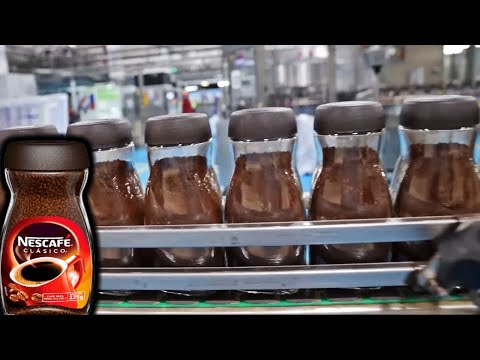
COMO se HACE el CAFÉ soluble NESCAFÉ☕| Como se PRODUCE el CAFÉ INSTANTÁNEO
How is Nescafé Made?
Global Coffee Consumption and History
- Every day, approximately 2.4 billion cups of coffee are consumed worldwide, leading to a significant demand for coffee beans.
- Coffee is the second most consumed beverage globally after water, with its cultivation dating back over 1,000 years across more than 60 countries.
- The history of Nescafé began in the early 20th century when Swiss chemist Max Morgenthaler developed a method for producing instant coffee; Nestlé acquired the patent in 1930.
Nescafé's Rise to Popularity
- During World War II, Nescafé became a staple for U.S. troops due to its portability and ease of preparation, which contributed to its post-war popularity.
- The flavor profile of coffee varies based on the region it is grown in and the roasting techniques used by producers.
Coffee Harvesting Process
- Brazil produces about 35% of the world's coffee; from flowering to harvest takes around six to nine months.
- Workers selectively pick ripe red berries while leaving green ones on the plant; each sack contains about two kilograms of beans sufficient for roughly 200 cups.
Mechanization in Coffee Harvesting
- Some plantations use mechanical harvesters that can replace up to a hundred workers by shaking berries off trees as they pass through rows.
Processing Freshly Picked Coffee Beans
- Freshly picked berries are processed at wet mills where they are washed and depulped using machinery that separates the outer skin from the beans.
- After washing, beans are dried traditionally on cement patios for four days before being hulled and sorted into three weight categories.
Production at Nestlé's Factory
- Annually, around 35 million tons of freshly harvested fruit arrive at large soluble coffee plants like Nestlé’s factory where 175,000 jars of instant coffee are produced daily.
Quality Control and Types of Coffee Used
- Each day, up to 170 tons of South American coffee beans arrive at Nestlé’s factory; quality control involves sampling each shipment before processing begins.
- Two main types of coffee used: Arabica (fine and aromatic) and Robusta (strong-bodied); both undergo thorough cleaning processes before roasting.
Roasting Process Importance
How is Instant Coffee Made?
The Roasting and Grinding Process
- Caffeine is lost during the roasting process, where coffee beans are constantly stirred to ensure even roasting without burning.
- After roasting, the beans fall into an industrial grinder that grinds them into a coarse powder.
Extraction of Coffee Flavors
- The ground coffee is mixed with hot water in large tanks, initiating a process known as extraction to obtain flavors and aromas.
- The coffee mixture is heated until it condenses into an extract, which then moves along a conveyor belt to the freezing chamber.
Freezing and Sublimation Process
- In the freezing chamber, liquid coffee is exposed to extremely low temperatures (around -50 degrees Celsius), forming a thin surface that can be broken into pieces.
- The frozen coffee granules are crushed into sizes between 2 and 3 millimeters before being placed in shallow trays for further processing.
Vacuum Drying Method
- The granules enter a vacuum chamber where air is removed; heat melts the ice but causes it to turn directly into gas through sublimation without becoming liquid.
- Once dried, the powdered coffee reaches filling machines that fill glass jars at high speed—280 jars per minute.
Packaging and Distribution
- The packaging process involves vacuum sealing to maintain quality for up to 24 months; jars are labeled and bundled for distribution.