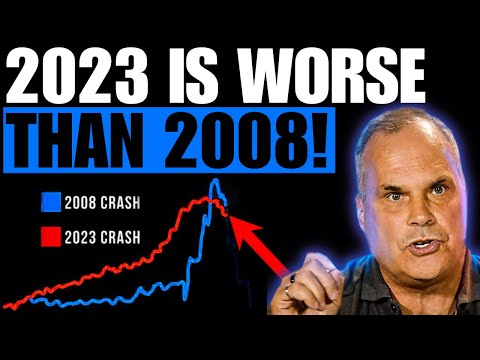
Greg Foss Explains Why the 2023 Banking Crisis Is Just Getting Started And How We Can Prepare!
Concerns over Banks and Bitcoin Hash Rate
In this section, the speakers discuss concerns over the banking system and the parabolic increase in Bitcoin hash rate. They also explore the possibility of nation-states mining Bitcoin.
Banking System Meltdown
- The speakers note that there is a lot of incoming concern over banks.
- They believe that credit is the next shoe to fall, and that we are not even into the second inning yet.
Parabolic Increase in Bitcoin Hash Rate
- The speakers discuss the parabolic increase in Bitcoin hash rate.
- They explore possible scenarios for why hash rate is increasing, including nation-states mining Bitcoin.
- The probability of China or Russia mining Bitcoin is discussed, with a likelihood estimated to be greater than 20% but less than 40%.
Nation-States Mining Bitcoin
- The speakers discuss why it would be strategically smart for nation-states to mine Bitcoin if they have an abundance of energy with almost free energy costs.
- Other ways to make it appear like it's a zero cost are explored, such as flare gas and infrastructure in oil and gas.
- There is a greater than zero percent chance that nation-states are mining Bitcoin, according to one speaker.
Risk Happens Fast
In this section, the speakers talk about how quickly risk can happen and how fast the world is changing.
Risk Happens Fast
- The speakers discuss how quickly risk can happen.
- They note that the world is changing quicker than it ever has.
CNBC and Credit Default Swaps
In this section, the speaker talks about how he never took his news or credit default swap feeds from CNBC. He explains what credit default swaps are and how they were developed by Blythe Mathers at JP Morgan in the early 2000s. The speaker also discusses how CDs Market is played by big boys and how Equity guys are misinformed about it.
Credit Default Swaps
- The speaker never took his news or credit default swap feeds from CNBC.
- Credit default swaps were developed by Blythe Mathers at JP Morgan in the early 2000s.
- CDS provides a more frictionless ability to take a wager and hedge credit default exposure.
- CDs Market is played by big boys, and Equity guys are misinformed about it.
Bitcoin as a Credit Default Swap on Fiat Currencies
- The speaker believes that Bitcoins is actually a credit default swap on a basket of fiat currencies.
- Bitcoin doesn't have any counterparty risk; it's like an infinite or perpetual insurance contract with no counterparty risk.
Jim Cramer and Stock Price Correlation
- Jim Cramer doesn't have the first clue about how to analyze the true risk in the balance sheet of a bank.
- When the spread widens, stock price goes down, which leads to stock price correlation.
- There could be conspiracy theories behind why CNBC potentially stopped providing information on credit default swaps.
Credit Suisse and Deutsche Bank Discussion
In this section, the speaker discusses Credit Suisse's rescue using alternative tier one bonds (AT1) and how it affected bondholders. The speaker also talks about Deutsche Bank's use of AT1 bonds and Jim Cramer's misunderstanding of bank profitability.
Credit Suisse Rescue with AT1 Bonds
- Credit Suisse was rescued using AT1 bonds, which are contingent convertible bonds that qualify as alternative tier one capital.
- Equity is the only thing that truly absorbs risk on a bank, not subordinate debt like tier two capital.
- 17 billion face value of these bonds got written off at zero while they still rescued three billion dollars worth of common stock.
- The bond should have been treated equally or paripasu with equity but were instead written down to zero.
- Pimco lost 800 million dollars of face value on these bonds, affecting pensioners who invested in Pimco.
Deutsche Bank's Use of AT1 Bonds
- Deutsche Bank is the biggest issuer of AT1 bonds in the world.
- Jim Cramer misunderstands bank profitability and doesn't know how to properly mark to market derivatives on Deutsche Bank's balance sheet.
- Equity ranks subordinate to bonds in a capital structure, so it's important for equity investors to understand what debt investors are saying about a company's credit quality and sustainability.
Credit Default Swaps and Hedging
In this section, the speaker discusses how credit default swaps are used to hedge against exposure in the equity markets. They also talk about how buying back debt can cause unintended consequences.
Hedging with Credit Default Swaps
- Credit default swaps are used to hedge against exposure in the equity markets.
- When credit default spreads widen, one of the hedges is to short a stock as a hedge against default risk.
- This is a complex capital structure arbitrage thing that most people don't understand.
Unintended Consequences of Buying Back Debt
- Deutsche Bank went out and repurchased some debt which caused an open leg on credit default swap sellers.
- By buying back the debt, the bank had exposed these credit default swap sellers to an open leg and they had to reach for default protection because of it.
- Sometimes there are unintended consequences when banks think they're doing a good thing by buying back debt.
Summary of Recent Banking Crises
In this section, the speaker provides a high-level synopsis of what's been going on in banking over the past few months.
Banking Crises Over Time
- Every successive bank crisis over the last 40 years has been kicked up a notch where it's nations that bail out the system but they don't solve it.
- The leverage in the banking system continues at irresponsibly high levels and socialization of losses happens at sovereign debt level.
- There have been four or five crises including Latin American debt, Long-Term Capital Management, Great Financial Crisis, COVID, and now bank runs in 2023.
Silicon Valley Bank and High-Level Problems
In this section, the speaker discusses the recent banking crisis and how it affects everyday people.
Recent Banking Crisis
- The recent banking crisis has seen Silicon Valley Bank go down, which is the biggest bank run in 80 years.
- This is a slow-motion car crash that's been happening for a while now.
- People are calling it a high-level problem or what's happening.
English Credit Suisse and Risk Management
In this section, the speaker discusses how Credit Suisse's risk management led to a loss of $20 billion due to poor decision-making and over-leveraging.
Credit Suisse's Risk Management
- Credit Suisse lost $10 billion due to poor risk management with Archigos.
- The bank was over-leveraged and under-capitalized, leaving them vulnerable to market fluctuations.
- Banks like Credit Suisse are leveraged 20-25 times their equity capital base, leaving little margin for error.
- The bank made bad decisions by buying long-term treasury bonds that were not well-matched with their loan book.
- Interest rate risk became a major factor as interest rates went down, causing bond prices to go up. When interest rates turned around, these gains turned into losses.
Deutsche Bank and Jim Cramer
- Deutsche Bank is just as poorly capitalized on a relative basis as Credit Suisse was.
- Jim Cramer is a mouthpiece for the Fiat Ponzi who gives out horrible advice without doing proper research or analysis.
- People lose real money because of his advice.
English Commercial Real Estate Mortgage-backed Securities
In this section, the speaker discusses how commercial real estate mortgage-backed securities could be in more stress than the mortgage-backed security market of 2008.
Stress in Commercial Real Estate Mortgage-backed Securities
- The speaker believes that commercial real estate mortgage-backed securities could be in more stress than the mortgage-backed security market of 2008.
- A chart from the Wall Street Journal shows the amount of losses in commercial real estate mortgage-backed securities.
The Impact of COVID-19 on Commercial Real Estate
In this section, the speakers discuss how COVID-19 has impacted commercial real estate and caused a decrease in demand for office spaces.
Decrease in Demand for Office Spaces
- COVID-19 has caused many people to work from home, leading to a decrease in demand for office spaces.
- There is currently a 20% vacancy rate in office spaces due to decreased demand.
- The valuation metrics of commercial real estate have gone down due to increased interest rates, causing the value of projects to decrease.
Impact on Banks
- As the loan-to-value ratio increases, banks may become undercapitalized due to owning properties at 100% loan-to-value.
- Commercial real estate exposure lives on regional and super-regional balance banks' balance sheets.
Bitcoin as a Risk-off Asset
In this section, the speakers discuss Bitcoin's potential as a risk-off asset and its role as an alternative to traditional banking systems.
Bitcoin as a Risk-off Asset
- Bitcoin could potentially be traded as a risk-off asset by the end of 2022.
- Bitcoin's value has increased significantly compared to equities, making it an attractive option for investors looking for risk-off assets.
Bitcoin as an Alternative Banking System
- Bitcoin was designed during the financial crisis of 2008-2009 as an alternative to traditional banking systems.
- Lack of confidence in traditional banking systems has led to increased interest in Bitcoin as an alternative.
- Education is paramount in the process of Bitcoin becoming a risk-off asset.
Bitcoin as an Asset Class
In this section, the speakers discuss Bitcoin as an asset class and its potential growth.
Bitcoin's Potential Growth
- Bitcoin is growing into an asset where people can take a view and it's getting big, with over 500 billion dollars in market cap.
- The size of Bitcoin as an asset class is finally large enough for big players to start investing in it. The speakers predict that Bitcoin will be a 10 trillion dollar asset before long, which would mean around $500,000 per bitcoin.
- Even if Bitcoin reaches a 10 trillion dollar market cap, it would still only represent just over one percent of all financial assets in the world. There are still many gains to be made even at that level.
Wall Street Journal Article and Bank Stocks
In this section, the speakers discuss the impact of a Wall Street Journal article on bank stocks.
Impact of Wall Street Journal Article
- The speakers are surprised that the Wall Street Journal article did not cause more consternation on the open in bank stocks. They speculate that either people are not subscribing to the Wall Street Journal as much as they used to or they think that the worst has passed.
- The next shoe to fall is credit, which will hit banks already reeling from losses on interest rate mismanagement. The speakers advise caution and suggest staying close to home on position sizes and true risk profile while managing risk appropriately.
Dollar Cost Averaging
In this section, the speakers discuss dollar cost averaging and its benefits.
Benefits of Dollar Cost Averaging
- The speakers agree that dollar cost averaging is the best way to get exposure to Bitcoin. They cite a tweet by Dylan Leclair, which shows that even if someone had been dollar cost averaging from the very top of Bitcoin all the way down, they would still be in profit today despite the price of Bitcoins being around break-even.
- The power of dollar cost averaging is evident in this example, and it can help investors manage risk appropriately while still gaining exposure to Bitcoin.
Skiing vs Living on the Beach
In this section, the speakers discuss their preferences between skiing and living on the beach.
Skiing vs Living on the Beach
- The speakers both love skiing and surfing but prefer stand-up paddleboarding now because it's easier for them.
- They also briefly discuss exercise routines for sciatica pain before transitioning into a conversation about weather.
Surfing and Travel
In this section, the speaker talks about his experience with surfing and traveling to different countries.
Surfing on Paddle Boards
- The speaker prefers stand-up paddle surfing over regular surfing.
- Stand-up paddle surfing allows for a standing start and is easier to do.
- The speaker enjoys peeling down the wave while stand-up paddle surfing.
Favorite Countries to Travel To
- The United States is the speaker's favorite country outside of Canada due to its importance in the world.
- El Salvador has the most vibrant Bitcoin scene according to the speaker.
- Madeira, an island off the coast of Portugal, is a beautiful place with great surfing, people, food, and weather.
- Bulgaria has a rich history and beautiful scenery that impressed the speaker during his travels there.
Meeting Bitcoiners Across the World
- The Bitcoin community is full of some of the best people in the world according to the speaker.
- The people are what make traveling to different countries enjoyable for him as he gets to meet new Bitcoiners everywhere he goes.
Bitcoin Opportunities Fund
In this section, Greg Foss talks about his involvement in the Bitcoin space and his new venture, the Bitcoin Opportunities Fund. He explains how the fund aims to support the Bitcoin ecosystem with new investments or trade existing investments.
The Bitcoin Opportunities Fund
- The fund is launched to support the Bitcoin ecosystem with new investment or trade existing Investments.
- The fund can take short positions and trade volatility. It can also do volatility management or option strategies on bitcoin itself and extract Vol from the market that otherwise people would have difficulty doing or managing.
- James Lavish and David Foley are portfolio managers of the fund, while Larry Lepard, Mark Moss, and Corey Clipston are advisors.
- The group consists of six experienced guys from a Financial Risk Management perspective that want to attract New Capital and bring a new Dynamic. They aim to provide similar returns as bitcoin but with lower risk.
- The fund aims not to outperform bitcoin but manage risks and take advantage of opportunities that markets provide them with.
Greg Foss' Twitter Account
In this section, Greg Foss talks about his social media presence on Twitter where he shares his thoughts on various topics related to Bitcoin.
Social Media Presence
- Greg Foss is active on Twitter under the handle @fossgregfoss where he shares his thoughts on various topics related to Bitcoin.
- He likes getting out and meeting younger kids in this community at conferences such as Bitcoin Miami, Thank God for Bitcoin, Unconfiscatable, Canadian Bitcoin Conference among others.
Understanding Bitcoin and the 2023 Banking Crisis
In this section, Greg Foss discusses the importance of understanding new technologies and doing your own research. He also emphasizes that owning zero bitcoin is the only wrong allocation to it and encourages people to dollar cost average themselves to get exposure for future generations.
Importance of Understanding New Technologies
- Just because you have a lot of experience doesn't mean you're an expert in a new technology.
- Charlie Munger doesn't understand technology, so don't listen to him when it comes to bitcoin.
- Do your own research and understand that the only wrong allocation to bitcoin is owning zero.
Owning Bitcoin for Future Generations
- Figure out how much exposure you need and dollar cost average yourself to get that exposure.
- Owning zero bitcoin is not a good decision for future generations.
- Investing in bitcoin now can benefit your kids and their kids.
The Coming Wave of Central Bank Bankruptcies
In this section, Greg Foss discusses whether we are in the first innings of a coming wave of central bank bankruptcies that will emerge all around the world.
Central Bank Bankruptcies
- Could the 2023 banking crisis be worse than the 2008 GFC?
- Are we in the first innings of a coming wave of central bank bankruptcies?
- Share your thoughts on these questions in the comments below.
Conclusion
In this section, Greg Foss thanks Peter McCormack for having him on his show. He encourages viewers to like and subscribe if they enjoyed his discussion with Peter. He also reminds viewers that sponsors help improve content quality on YouTube.
Thanking the Host and Encouraging Viewers
- Greg Foss thanks Peter McCormack for having him on his show.
- He encourages viewers to like and subscribe if they enjoyed his discussion with Peter.
- Sponsors help improve content quality on YouTube.