ICT Mentorship Core Content - Month 10 - Stock Trading - Valuation Stock Selection
Market Timing and Options Strategies
Overview of Market Timing
- The speaker discusses major market turning points, emphasizing the timing for buying and selling stocks.
- Key periods identified: February to May for buying stocks or stock options, and from May to mid-September for shorting stocks or long put options.
- A bullish outlook is anticipated from late September through the end of the year, focusing on reasons to buy stocks or long call options.
Simplifying Options Trading
- The speaker reflects on their early experiences with complex options strategies involving Greeks, which led to confusion and information overload.
- Emphasizes simplicity in trading by sticking to basic strategies: long call options and long put options.
Understanding Long Call Options
- A long call option gives the buyer the right (but not obligation) to purchase 100 shares at a specified strike price before expiration.
- The maximum profit potential of a long call option is unlimited until expiration; ideal usage is during bullish market periods (February-May and October-end of year).
Risk Management in Options Trading
- To profit from a long call option, one must be bullish; if the market price rises above the strike price, profitability can occur.
- Risks are limited to the premium paid plus commission costs; example given where a $2.50 premium results in a total cost of $255.
Profit Potential and Strategy Execution
- The speaker highlights that understanding seasonal tendencies can help identify strong stocks during favorable trading times.
- When purchasing call options, aim for cheaper premiums with goals of doubling or tripling investment returns consistently over time.
Hypothetical Example of Call Option Purchase
Understanding Call and Put Options
Call Option Mechanics
- A call option allows the holder to buy 100 shares of a stock at a predetermined price (strike price). If the stock price rises above this strike price, the option is considered "in the money."
- Exercising a call option means purchasing shares at the strike price. For example, if you bought an ICT call option at $50 and the stock rises to $60, you can buy shares for $50 each.
- The profit from exercising a call option is calculated as: (Market Price - Strike Price) x Number of Shares. In this case, selling 100 shares at $60 after buying them at $50 yields a total profit of $1,000.
- If expectations are incorrect and the stock drops below the strike price (e.g., to $40), the call option expires worthless, resulting in a total loss equal to the premium paid plus any commission costs.
Long Put Option Strategy
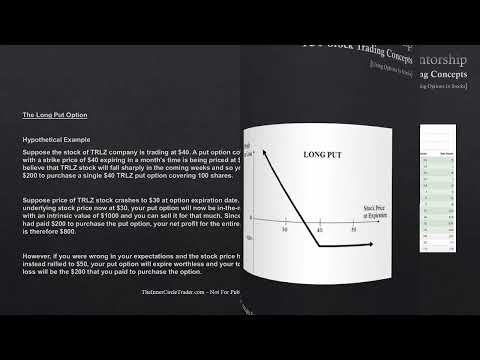
- A long put option is used when bearish on market trends. This strategy anticipates that stock prices will decline over time, particularly between May and September.
- The maximum profit potential with long puts occurs if the underlying stock's value drops to zero. Profit is realized when share prices fall below your purchased put's strike price.
- The maximum loss with long puts is limited to the premium paid for the options plus commissions. Regardless of how high stocks rise post-purchase, losses cannot exceed this amount.
- Long puts provide traders with defined risk while allowing for significant profit potential during market downturns. This makes them appealing compared to other investment vehicles where risks may be less predictable.
Hypothetical Example: TRLZ Stock
- Suppose TRLZ stock trades at $40 per share with a put option priced at $2. If you expect it to drop sharply and purchase one contract covering 100 shares for $200...
- If TRLZ falls to $30 by expiration, your put becomes valuable with an intrinsic value of $1,000. After accounting for initial costs ($200), your net profit would be approximately $795 after commissions.
Understanding Options Trading Strategies
Key Concepts in Options Trading
- The intrinsic value of an option is determined by the relationship between the underlying asset's price and the strike price. A longer time until expiration is generally preferred to maximize potential profits.
- If a trader buys a long put option at a $40 strike price while the stock drops to $25, they may not profit if there isn't enough time before expiration due to time decay affecting the option's value.
- Successful options trading requires beating three factors: market timing, intrinsic value growth, and time decay. Understanding seasonal tendencies and identifying leading or lagging stocks are crucial for making informed decisions.
Choosing Strike Prices and Expiration Dates
- When selecting options, it's important to consider both the strike price and expiration date. Traders should avoid paying more than $3.50 per option premium for better cost efficiency.
- Many traders pay higher premiums but finding low-cost trades that yield high returns is preferable. The speaker emphasizes seeking "Blue Light special deals" on options priced around $1-$2 per contract.
Importance of Time Until Expiration
- Ideally, traders should look for options with over 90 days until expiration to mitigate the effects of time decay on premium values as expiration approaches.
- Close-to-the-money options (within one to three strike prices from market price) are considered advantageous purchases when aiming for significant returns with minimal investment.
Managing Time Decay Risks
- As options approach 60 days until expiration, time decay significantly impacts their premium value. Most options expire worthless due to this effect unless properly managed through strategic trading practices.
- Having at least two weeks left on an option allows traders to assess whether its premium will increase or decrease before deciding whether to sell it prior to expiration.
Practical Application in Trading
- The speaker plans to conduct a fall top-down analysis live, demonstrating which call options are favorable based on current market conditions and anticipated bullish trends despite potential market crashes.
Turn any video into a summary like this
YouTube links, meetings, lectures. With transcripts, search, and chat.