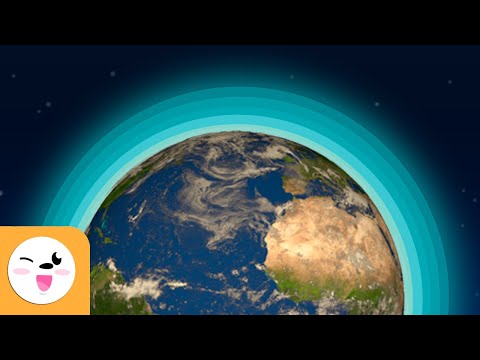
La Atmósfera - Las capas de la tierra - Ciencias para niños
Understanding the Earth's Atmosphere
Overview of the Atmosphere
- The atmosphere is the outermost layer of Earth, composed of gases that protect the planet from space hazards like solar radiation and small objects.
- It plays a crucial role in sustaining life by providing oxygen and regulating temperature, making life on Earth possible.
Layers of the Atmosphere
- The atmosphere is divided into five distinct layers based on altitude: troposphere, stratosphere, mesosphere, thermosphere, and exosphere.
Troposphere
- The troposphere is closest to Earth's surface, extending about 10 km high. It contains clouds and is where most weather phenomena occur (e.g., wind, rain).
- This layer holds the air we breathe; thus, preventing pollution is essential for maintaining life.
Stratosphere
- Ranging from 10 to 50 km above Earth’s surface, it houses the ozone layer which protects against harmful UV rays from the sun.
- Ozone depletion due to pollution has become a significant concern; airplanes often fly in this layer to avoid turbulence.
Mesosphere
- Located between 50 and 85 km above ground level, this is the coldest atmospheric layer with temperatures dropping to -90 degrees Celsius.
- Meteorites entering this layer burn up upon contact, creating visible streaks known as shooting stars.
Thermosphere
- Extending from 85 km to about 500 km high, it experiences extremely high temperatures exceeding 2000 degrees Celsius.
- This layer supports phenomena such as auroras and hosts satellites like the International Space Station.
Exosphere
- The exosphere lies between approximately 500 km and 10,000 km above Earth. It consists mainly of hydrogen and helium with very thin air.